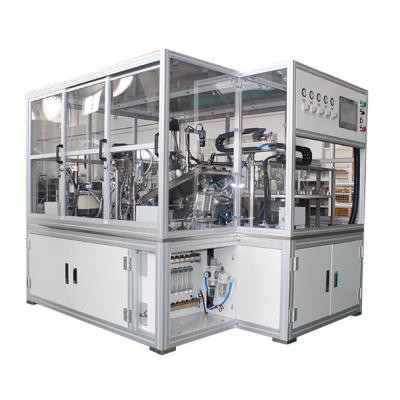


The HFDB-660 Automatic Copper Braid Crimping and Cutting Machine is designed for the automated processing of copper braided flexible connectors, copper braid shunts, and flexible electrical conductors. It integrates automatic feeding, resistance heating, end compaction, square forming, and cutting into one system.
In conventional production, copper braids are often fed manually, compacted on a separate machine, and then cut by hand. As a result, the finished length, end density, and compacted dimensions can vary depending on the operator's experience. Repeated material handling and repositioning between processes can also introduce additional errors.
These problems become more noticeable in the batch production of 16–90 mm² copper braids. Because braided copper is soft and prone to fraying, unstable feeding or clamping can affect subsequent punching, terminal joining, welding, or final assembly.
The HFDB-660 uses medium-frequency resistance heating and programmable pressure control to compact and cut copper braids under controlled conditions. Up to 64 process programs can be stored, making the machine suitable for factories that repeatedly produce copper braid products in different specifications while reducing the influence of manual operation on product consistency.

If your copper braid cross-section, braiding structure, or finished product shape falls outside this range, please provide samples and drawings. HAIFEI can evaluate whether the machine power, tooling, feeding mechanism, or cutting structure requires customization.
Send Your Copper Braid Drawing
What Production Problems Does This Machine Solve?
Reduces Repeated Positioning Between Separate Processes
The automatic copper braid crimping and cutting machine combines feeding, heated compacting, square forming, and cutting within one production cycle. This reduces material transfer between machines and makes the process better suited to continuous batch production.
Improves the Consistency of Compacted Copper Braid Ends
Copper braid is naturally soft and flexible. When only cold pressing or manual forming is used, the end width, thickness, and density can vary from part to part.
The HFDB-660 combines medium-frequency resistance heating with controlled pressure, allowing the braided end to be gradually compacted inside the tooling instead of receiving a single uncontrolled mechanical impact.
Reduces Dependence on Skilled Operators
Different copper braid specifications require different heating times, current levels, and pressure settings. The machine can store up to 64 process programs. When changing products, operators can recall previously validated parameters instead of adjusting the process from the beginning each time.
Provides Interfaces for Future Production-Line Integration
The machine is equipped with three programmable I/O outputs for signal communication with PLCs, robots, conveying systems, and other production units.
For manufacturers planning to gradually build an automatic copper braid flexible connector production line, these interfaces can simplify future equipment integration.
How Does the HFDB-660 Process Copper Braids?
Depending on the product specification and selected process settings, the machine performs the following main steps.
Copper Braid Feeding
Coiled or continuous copper braid material enters the feeding mechanism. The machine feeds the material to the compacting and cutting position according to the programmed production cycle.
The feeding mechanism must be matched to the braid width, thickness, flexibility, and coil-feeding method.
01
Material Positioning and Clamping
Once the copper braid reaches the processing position, it is secured by the clamping and tooling system.
Stable positioning prevents the braid from slipping during pressure application and helps reduce skewed ends, uneven width, and loose strands.
02
Medium-Frequency Resistance Heating
The machine uses a 1,000 Hz medium-frequency output and supports three heating stages: preheating, main heating, and tempering. During the main heating stage, the current can be programmed to rise or fall according to the product requirements, allowing the heat input to coordinate more effectively with the applied pressure.
This process is not intended simply to melt the material. Controlled resistance heating and pressure are applied to compact and form the braided structure within a defined area.
03
Programmable Pressure Forming
The machine provides a maximum working force of 24,000 N and supports up to ten programmable pressure stages.
Different pressure profiles can be created according to the braid cross-section, braiding density, and required finished thickness. This helps prevent loose ends caused by insufficient pressure while reducing dimensional deformation caused by excessive pressure.
04
Positioned Cutting
After the compacted section has been formed, the machine cuts the copper braid according to the specified process. The result is a semi-finished copper braid suitable for subsequent punching, terminal joining, welding, or assembly.
The actual processing sequence, finished length, and discharge method must be confirmed according to the customer's product structure. Fixed length tolerances or production cycle times should not be guaranteed before sample testing has been completed.
05


Technical Specifications
|
Item |
Automatic copper braids crimping and cutting machine |
|
Equipment Model |
HFDB-660 |
|
Rated Duty Cycle |
50% |
|
Operating Environment |
Temperature: 1~45°C, Humidity: 35~90% |
|
Input Power Supply |
Three-phase five-wire 380±10%V, 50Hz |
|
Transformer Capacity |
660KVA |
|
Compressed Air Requirement |
≥0.6MPa, 40μm filtration, flow rate 14.43L/cycle |
|
Cooling Water Requirement |
0.2~0.3MPa, 40μm filtration, resistivity ≥5 kΩ·cm, flow rate 50L/min |
|
Cylinder Bore / Electrode Stroke |
200mm / 150mm |
|
Max. Working Pressure |
24,000N |
|
Max. Primary Current |
200A |
|
Current Adjustment Range |
0%~99% |
|
Transformer Insulation Class |
Class F |
|
Throat Depth |
280mm |
|
Max. Secondary Short-circuit Current |
120KA |
|
Lower Electrode Arm Deflection |
Under max. cylinder pressure, electrode arm deflection < 0.1mm |
|
Max. Copper Platform Spacing |
400mm |
|
Min and Max Size |
16-90 mm² |
|
Energy Consumption Per Hour |
528 KVA |
Configuration
|
No. |
Name |
Brand |
Origin |
|
1 |
Solenoid Valve, Air Treatment Unit (FRL) |
SMC |
Japan |
|
2 |
Water Flow Switch |
CATO |
China |
|
3 |
Special Welding Main Cylinder |
HAIFEI |
HAIFEI |
|
4 |
Medium Frequency Welding Transformer |
HAIFEI, Nano Amorphous Material |
HAIFEI |
|
5 |
Welding Controller |
HAIFEI |
HAIFEI |
|
6 |
Inverter |
HAIFEI |
HAIFEI |
|
7 |
Low-voltage Electrical Appliances |
OMRON/SCHNEIDER/Garnor |
Japan/France/Switzerland |
|
8 |
Pneumatic Components |
SMC |
Japan |
|
9 |
PLC |
Mitsubishi |
Japan |
Suitable Products and Applications
The HFDB-660 can be used for the compacting and cutting of the following copper braided flexible conductors:
1
Copper braided flexible connectors for switchgear, distribution cabinets, and low-voltage electrical equipment
2
Copper braid shunts for air circuit breakers, disconnectors, and contactors
3
Flexible connections for transformers, rectifiers, and high-current electrical assemblies
4
Copper braided flexible conductors for electric vehicles and energy-storage equipment
5
Vibration-resistant flexible connections for power-electronics equipment
6
Semi-finished copper braids requiring subsequent punching, welding, or terminal joining
Different products have different requirements for conductive cross-section, flexible length, compacted end thickness, and tensile strength.
For accurate machine selection, customers should provide actual copper braid materials rather than only specifying a nominal cross-section such as "30 mm²" or "50 mm²."
Sample Testing and Customization Process
Workpiece Evaluation
HAIFEI evaluates the product drawings, copper braid structure, specification range, and production requirements to determine whether the standard HFDB-660 configuration can meet the application.
01
Sample Processing Test
Customers are advised to send actual copper braid material for testing.
HAIFEI engineers conduct trial processing to confirm the heating parameters, pressure profile, tooling structure, and cutting results. The compacted ends are also checked for loose strands, deformation, and dimensional instability.
02
Solution and Tooling Confirmation
Based on the sample-testing results, HAIFEI confirms the machine configuration, number of tooling sets, changeover method, automation interfaces, and utility requirements.
03
Manufacturing and Factory Acceptance Testing
After the machine has been manufactured, the customer's material is used for continuous operation and sample processing. The test results are recorded according to the acceptance criteria agreed upon by both parties.
04
Installation and Operator Training
HAIFEI provides guidance covering machine installation, program selection, tooling replacement, routine inspection, and abnormal-condition handling.
05
Certifications
ISO9001 quality management system certified,CE certified, compliant with international standards.


Our Partners
We have served over 5,000 customers worldwide, and our long-term partners include Tesla, BYD, and Siemens.Over 50+ Fortune 500 companies.


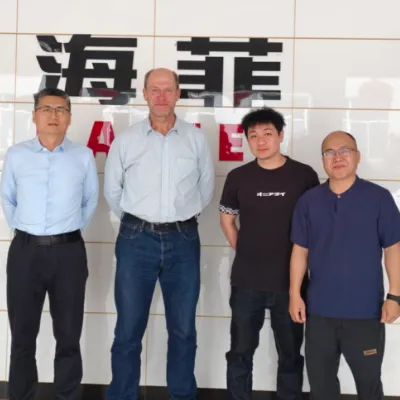
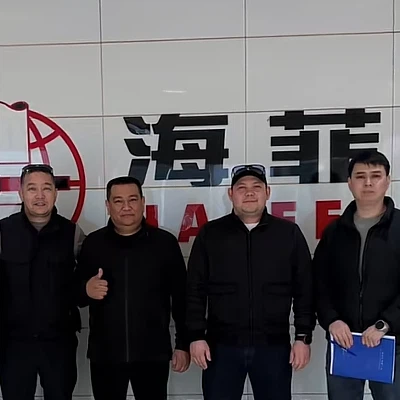
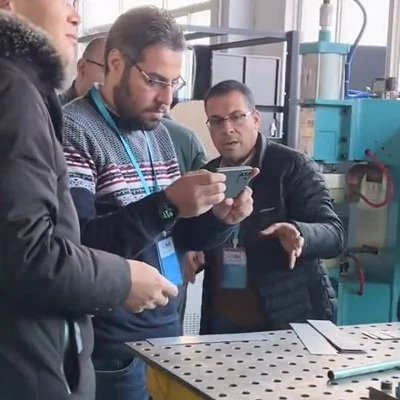
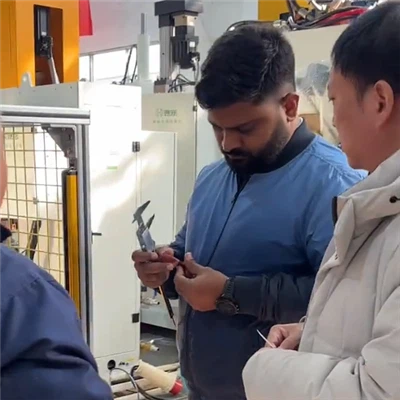
Haifei Customers Visit Factory






FAQ
Q: What copper braid sizes can the HFDB-660 process?
A: The standard processing range is 16–90 mm². Actual processability also depends on the braid width, individual wire diameter, braiding density, and required compacted dimensions.
Q: Can the machine process tin-plated copper braids?
A: Sample testing is required. The tin coating can affect contact resistance and the heating process, so the parameters used for bare-copper braids should not be applied directly.
Q: Is switching the program enough when changing the braid cross-section?
A: The machine can store up to 64 process programs. However, changing the product specification may also require compacting-tool replacement, feeding-system adjustment, and cutting-position recalibration.
Q: Can the finished length be set according to customer requirements?
A: The cutting solution can be designed according to the required product length. Specific length ranges and tolerances should only be published or guaranteed after the feeding structure and accuracy requirements have been confirmed.
Q: Are additional processes required after compacting and cutting?
A: This depends on the finished product. Copper braided flexible connectors designed for bolted assembly usually require additional punching, terminal joining or welding, and finished-product inspection.
Q: Must samples be sent before requesting a quotation?
A: An initial solution can be evaluated from drawings, but actual material samples are recommended before the machine and tooling are finalized. Copper braid flexibility and braiding structure directly affect feeding and compacting performance.
Q: Can the machine be integrated into an automated production line?
A: Yes. The machine is equipped with programmable I/O and can be connected to PLCs, robots, conveying systems, and other processing units according to the project requirements.
Get a Copper Braid Processing Solution
If manual compacting and cutting can no longer meet your production requirements, or if the finished length, compacted thickness, and end density vary between batches, send HAIFEI your copper braid samples, finished-product drawings, and production requirements.
Our engineers will evaluate the material cross-section, braiding structure, compacted dimensions, and downstream processing requirements to determine whether the HFDB-660 is suitable for your product. We can then recommend the appropriate tooling, sample-testing procedure, and automation configuration.
Hot Tags: automatic copper braids crimping and cutting machine, China automatic copper braids crimping and cutting machine manufacturers, suppliers, factory, automated welding services, automatic hot air welder, automatic tube welder, robotic welding positioners, Welding Automation for Braided Flexible, welding positioner manufacturers