


Custom Welding Automation Systems
HAIFEI designs custom welding automation systems around the customer’s workpiece, production sequence and quality requirements. Rather than applying one standard machine to every project, we evaluate how the components are loaded, positioned, welded, checked and unloaded before developing the equipment concept.
The project may be a dedicated welding machine for one operation or an automatic welding production line connecting several processes. Fixtures, component feeding, servo positioning, robotic handling, welding controls, inspection and production data recording can be included according to the confirmed project scope.
Send us your workpiece drawings, material information, required output and current production method. Our engineering team will review the application and determine whether a custom welding machine or a connected production line is more suitable.
Discuss Your Welding Automation Project
-
![Robotic Welding Integration]() Robotic Welding IntegrationHaifei provides robotic welding integration for spot, projection, seam and diffusion welding. We combine robots, welding machines, fixtures, material handling, controls and safety devices around...view more
-
![Automatic Copper Braids Crimping And Cutting Machine]() Automatic Copper Braids Crimping And Cutting MachineThe HFDB-660 Automatic Copper Braided Crimping and Cutting Machine is a high-precision, fully automated solution designed for the new energy industry. This integrated system handles the entire...view more
-
![Frame Circuit Breaker Busbar Welding Machine]() Frame Circuit Breaker Busbar Welding MachineThe Haifei 2500KVA Frame Circuit Breaker Busbar Welding Machine is engineered for the low-voltage electrical equipment industry. Utilizing advanced MFDC welding technology, it achieves flux-free,...view more
-
![Automatic Silver Contact Welding Machine]() Automatic Silver Contact Welding MachineThe Automatic silver contact welding machine adopts a dynamic resistance monitoring system, which can capture the resistance changes in real time during the welding process and adjust the current...view more
-
![Welding Automation for Automotive Parts]() Welding Automation for Automotive PartsOur Automotive Parts Welding Automation System delivers high-speed, precision joining for modern vehicle manufacturing. This advanced robotic welding solution combines AI-driven process control...view more
-
![Copper Braid Wire Automatic Squaring Welding Machine]() Copper Braid Wire Automatic Squaring Welding MachineThe HFDB-440 Copper Braid Wire Automatic Squaring Welding Machine is designed for the batch production of braided copper flexible connectors, copper shunts, and flexible electrical conductors. It...view more
-
![Automatic Copper Braided Welding and Cutting Machine]() Automatic Copper Braided Welding and Cutting MachineOur HFDB-100 Automatic Copper Braided Wire Shunt Cutting and Squaring Machine is a high-precision, fully automated solution designed for the new energy industry. This integrated system handles the...view more
-
![Silver Contact Spot Welding Machine]() Silver Contact Spot Welding MachineThe DB200H Silver Contact Spot Welding Machine uses 1000 Hz medium-frequency inverter DC power to weld silver or copper contacts onto copper electrical parts. It provides programmable current,...view more
-
![Automatic Seam Welding Machine]() Automatic Seam Welding MachineThe HAIFEI Automatic Seam Welding Machine is a fully automated robotic welding workstation designed for continuous, high-precision seam welding of tanks, battery enclosures, automotive components,...view more
-
![Air Conditioner Compressor Welding Machine]() Air Conditioner Compressor Welding MachineProduct Overview HAIFEI Air Conditioner Compressor Welding Machine is a customized resistance welding solution for air conditioner compressor manufacturing. It can be designed for compressor...view more
-
![Robotic Diffusion Welding System Integrator]() Robotic Diffusion Welding System IntegratorFully automated copper flexible connector production line integrating foil cutting, robotic handling, diffusion welding, and conveyor unloading. Ideal for busbar and EV battery manufacturing.view more
-
![Automotive Wire Welding Machine]() Automotive Wire Welding MachineOur Automotive Wire Welding Machine is a high-performance, automated solution specifically designed for the precision welding of car seat frames, backrests, and headrest rods. Engineered to meet...view more


What Is a Welding Automation System?
A welding automation system combines the welding equipment with the mechanisms required to control the complete production sequence. Depending on the project, this may include workpiece loading, part detection, positioning, clamping, welding, process monitoring, inspection and unloading.
The equipment configuration is determined by the component rather than by a fixed machine model. Two factories producing similar parts may need different automated welding systems because their output targets, product variants, loading methods, inspection standards and available floor space are different.
For this reason, HAIFEI begins with the workpiece drawing and production requirements. The welding method, fixture, electrode structure, handling system and control sequence are then developed as one project.
Choose the Right Type of Welding Automation
HAIFEI supplies two main types of welding automation. The difference is based on how many production operations must be connected, not simply on whether the equipment uses a robot.
Flexible Projection Welding Lines
An automatic welding production line connects several manufacturing operations in a defined sequence. It may include material preparation, component feeding, positioning, multiple welding stations, cooling, inspection, marking and automatic unloading.
Production lines are generally considered when the product design is stable, the required output is clearly defined and manual transfer between operations has become a production bottleneck. Robots, conveyors, rotary tables or linear transfer mechanisms may be used to move the components between stations.
The line layout, number of stations and transfer method are developed according to the workpiece, process sequence, cycle-time target and factory space.

Custom Welding Machines

A custom welding machine is an independent machine or workstation developed for a specific component and welding task. It may use manual loading, automatic component feeding, servo positioning, a rotary table or robotic loading, but the main production work remains within one equipment unit.
This option is suitable when the customer needs to improve one welding process without connecting the complete factory workflow. It can also provide a practical balance for projects with several product variants, moderate production volume or frequent changeover.
Customizable elements can include the welding power source, machine frame, electrodes, fixtures, feeding mechanism, motion system, inspection functions and safety protection.
Selected Welding Automation Projects
The following projects show how HAIFEI develops equipment around different workpieces and production sequences. They are examples of engineering approaches rather than fixed machine configurations. Final specifications depend on the customer’s actual components and technical agreement.
Automatic Copper Braid Crimping and Cutting Machine
This automated machine is designed for processing copper braided flexible conductors. It combines material feeding, resistance heating, end compaction, square forming and cutting within one production cycle, reducing repeated transfer between separate machines.
The tooling, feeding structure and process settings are selected according to the copper braid cross-section, braiding structure and required compacted dimensions. Process programs can be stored for approved product specifications, while tooling adjustments may still be required when the braid structure changes.

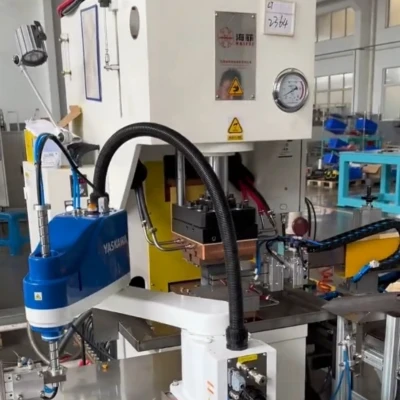
Robotic Diffusion Welding System
This project connects robotic material handling with the diffusion welding process for flexible copper conductors. Depending on the approved production scope, the system can integrate material preparation, robotic loading, diffusion welding, cooling and conveyor unloading.
The line configuration is developed according to the conductor dimensions, product weight, welding cycle, handling sequence and available factory space. Representative samples are required to evaluate the welding process and fixture before the final automation design is confirmed.
Frame Circuit Breaker Busbar Welding Machine
This custom welding machine is developed for conductive assemblies used in frame circuit breakers. Dedicated tooling positions and clamps the busbar and contact components so that the approved relationship between the parts can be maintained during welding.
The welding power source, electrode arrangement and fixture structure are selected according to the conductor material, joint area, component dimensions and required inspection method. The machine configuration is confirmed from the customer’s actual current-path assembly rather than from one standard model.


Flexible Nut Projection Welding Workstation
This workstation combines fastener feeding, workpiece positioning and projection welding for components that require nuts to be welded onto stamped metal parts. It can be evaluated for related product models where quick-change fixtures and stored welding programs are practical.
The number of fastener feeders, changeover method, detection functions and inspection requirements are confirmed according to the nut specifications and workpiece range.
What Can HAIFEI Integrate into the System?
The equipment scope is selected according to the production requirement. A project does not need to include every available function.
| Production stage | Available project scope |
| Material preparation | Cutting, stacking, forming, compacting or component separation |
| Component feeding | Bowl feeders, linear feeders, trays, conveyors or manual loading |
| Positioning | Dedicated fixtures, locating pins, clamps and component detection |
| Welding | Welding equipment selected according to the material and joint |
| Movement | Servo axes, rotary tables, slides, conveyors or industrial robots |
| Process control | Welding programs, recipe selection, sensors, alarms and parameter records |
| Inspection | Part detection, position checking and agreed weld inspection functions |
| Unloading | Manual removal, robotic unloading, conveyors or accepted/rejected part separation |
The final scope is confirmed after the workpiece, upstream process, production target and acceptance requirements have been reviewed.
How HAIFEI Develops a Custom Welding Automation Project
Application Review
The customer provides workpiece drawings, materials, weld locations, product variants, required output and information about the current production method. HAIFEI reviews the joint structure and identifies which operations should remain manual and which may be automated.
Sample Welding and Process Evaluation
Representative samples can be used to evaluate the welding process before the complete machine is designed. The test helps confirm the power source, electrode structure, fixture method and an initial welding parameter range.
Automation Concept
The engineering team develops a concept covering loading, positioning, welding, inspection and unloading. The proposal also considers operator access, maintenance space, safety protection, product changeover and connection with upstream or downstream equipment.
Technical Confirmation
Before manufacturing begins, both parties confirm the workpiece range, production sequence, system boundary, cycle-time conditions, utility requirements and acceptance criteria. Functions that are outside the confirmed scope should be identified at this stage.
Manufacturing and Factory Acceptance Test
After assembly and programming, the equipment is tested using the agreed workpieces where possible. The factory acceptance test is carried out against the technical agreement rather than a set of general performance figures that may not apply to the project.
Installation and Support
The agreed service scope may include installation guidance, commissioning, operator training, maintenance instructions and remote technical support. On-site service is arranged according to the system and project location.
FAQ
Q: How is weld quality checked before delivery?
A: The inspection method is agreed according to the workpiece and customer standard. It may include visual checks, dimensional measurement, peel or tensile testing, section analysis, electrical resistance testing or leak testing. The selected method and acceptance criteria should be recorded in the technical agreement.
Request a Custom Welding Solution
Wuxi Haifei Intelligent Equipment Co., Limited is well-known as one of the leading welding automation manufacturers and suppliers in China. Please rest assured to buy high quality welding automation made in China here from our factory. For price consultation, contact us.
automatic orbital welding machine, semi automatic welding, robotic welding intelligence and automation

