


Spot Welding Machines for Metal Parts
Haifei manufactures industrial spot welding machines for joining sheet metal, brackets, terminals, fasteners and formed metal parts. The range includes AC, MFDC, precision, press-type, double-head and automated spot welding equipment for different materials, part sizes and production requirements.
A suitable machine is selected according to the workpiece material, thickness, weld position, required joint strength and production cycle. Custom electrodes, fixtures, control programs and loading systems can be developed around the customer’s parts. Send us your drawing, sample and expected output so that our engineers can review the application before recommending a machine.
-
![MFDC Spot Welder]() MFDC Spot WelderThe MFDC (Mid-Frequency Direct Current) Spot Welding Machine represents the next generation of resistance welding technology, offering superior performance compared to traditional AC spot welders....view more
MFDC Spot WelderThe MFDC (Mid-Frequency Direct Current) Spot Welding Machine represents the next generation of resistance welding technology, offering superior performance compared to traditional AC spot welders....view more -
![Car Door Resistance Heat Riveting Machine]() Car Door Resistance Heat Riveting MachineHAIFEI Car Door Resistance Heat Riveting Machine is used for welding nuts, studs, and cover plates in car door lock assemblies. It is suitable for lock catch plates, latch brackets, threaded...view more
Car Door Resistance Heat Riveting MachineHAIFEI Car Door Resistance Heat Riveting Machine is used for welding nuts, studs, and cover plates in car door lock assemblies. It is suitable for lock catch plates, latch brackets, threaded...view more -
![Dual Head Spot Welder]() Dual Head Spot WelderIn today's pursuit of maximum production capacity, traditional single-head spot welding has become a bottleneck in production lines. Haifei's intelligent dual-head spot welding machine is...view more
Dual Head Spot WelderIn today's pursuit of maximum production capacity, traditional single-head spot welding has become a bottleneck in production lines. Haifei's intelligent dual-head spot welding machine is...view more -
![Double Head Spot Welder]() Double Head Spot WelderOptimized for automotive seat slide rail welding, this Double Head Spot Welder employs projection welding technology and simultaneous dual-head operation, dramatically enhancing speed and...view more
Double Head Spot WelderOptimized for automotive seat slide rail welding, this Double Head Spot Welder employs projection welding technology and simultaneous dual-head operation, dramatically enhancing speed and...view more -
![Dual Head Spot Welding Machines]() Dual Head Spot Welding MachinesThis Dual Head Spot Welding Machines is designed for high-strength components like automotive slide rails, ABC pillars, and sunroofs. It performs precise, rapid, and simultaneous welding on both...view more
Dual Head Spot Welding MachinesThis Dual Head Spot Welding Machines is designed for high-strength components like automotive slide rails, ABC pillars, and sunroofs. It performs precise, rapid, and simultaneous welding on both...view more -
![AC Spot Welding Machine]() AC Spot Welding MachineThe HF-25 AC Spot Welding Machine (100KVA) is an industrial-grade resistance welding solution designed for heavy-duty metal fabrication. Utilizing a high-output power frequency AC transformer,...view more
AC Spot Welding MachineThe HF-25 AC Spot Welding Machine (100KVA) is an industrial-grade resistance welding solution designed for heavy-duty metal fabrication. Utilizing a high-output power frequency AC transformer,...view more -
![Precision Spot Welding Machine]() Precision Spot Welding MachineThe HFIS-400C is a high-performance Precision spot welding machine engineered for industrial applications demanding extreme accuracy. Beyond standard steel and stainless steel, this resistance...view more
Precision Spot Welding MachineThe HFIS-400C is a high-performance Precision spot welding machine engineered for industrial applications demanding extreme accuracy. Beyond standard steel and stainless steel, this resistance...view more -
![DC Spot Welder]() DC Spot WelderThe HFDB-440 is a revolutionary DC Spot Welder designed for precision welding of compressor terminals and relays. Its advanced MFDC inverter technology ensures unmatched stability and weld...view more
DC Spot WelderThe HFDB-440 is a revolutionary DC Spot Welder designed for precision welding of compressor terminals and relays. Its advanced MFDC inverter technology ensures unmatched stability and weld...view more -
![Spot Welding Machine For Wire Harness Terminal]() Spot Welding Machine For Wire Harness TerminalThe HFDB-320 Spot Welding Machine For Wire Harness Terminal is a high-performance professional system designed for welding large-gauge harnesses (e.g., 95mm², 35mm²) to terminals in the new energy...view more
Spot Welding Machine For Wire Harness TerminalThe HFDB-320 Spot Welding Machine For Wire Harness Terminal is a high-performance professional system designed for welding large-gauge harnesses (e.g., 95mm², 35mm²) to terminals in the new energy...view more -
![Intermediate Frequency Spot Welder]() Intermediate Frequency Spot WelderIntermediate Frequency Spot Welder delivers exceptional performance and reliability for precision metal joining applications. Designed for stable operation and user-friendly functionality, it...view more
Intermediate Frequency Spot WelderIntermediate Frequency Spot Welder delivers exceptional performance and reliability for precision metal joining applications. Designed for stable operation and user-friendly functionality, it...view more -
![Automative Spot Welding Machine]() Automative Spot Welding MachineThe HFDB-320 automotive spot welding machine is designed for resistance spot welding and projection welding of automotive metal parts, including brackets, seat rails, door hinges, seatbelt...view more
Automative Spot Welding MachineThe HFDB-320 automotive spot welding machine is designed for resistance spot welding and projection welding of automotive metal parts, including brackets, seat rails, door hinges, seatbelt...view more -
![Spot Welder Welding Machine]() Spot Welder Welding MachineIn the field of copper spot welding machines, Haifei has developed a segmented heating process tailored to the high thermal conductivity of copper: the first stage uses low current preheating to...view more
Spot Welder Welding MachineIn the field of copper spot welding machines, Haifei has developed a segmented heating process tailored to the high thermal conductivity of copper: the first stage uses low current preheating to...view more


Compare Spot Welding Machine Types
| Machine type | Typical production requirement | Main consideration |
| AC spot welding machine | General steel parts and standard sheet metal production | Simple process, material and thickness suitability |
| MFDC spot welding machine | Controlled heat input and repeatable production | Current response, force control and cooling |
| Precision spot welding machine | Small terminals, contacts and thin parts | Low heat input and accurate electrode movement |
| Press-type spot welding machine | Fixture-supported parts requiring vertical force | Throat depth, stroke and fixture access |
| Double-head spot welding machine | Two fixed weld points on one part | Head spacing and simultaneous positioning |
| Automated spot welding system | Higher output and repeatable production flow | Loading, detection, cycle time and process monitoring |
This table is intended for initial comparison. A final machine recommendation requires the workpiece drawing, material, thickness, weld location and expected joint strength.
Specifications of Spot Welding Machine
|
Items \ Model |
Unit |
HFDB-50 |
HFDB-100 |
HFDB-200 |
HFDB-320 |
HFDB-440 |
HFDB-660 |
|
Rated capacity |
KVA |
80 |
160 |
240 |
320 |
440 |
660 |
|
Power supply |
V/Ø/Hz |
380V±10% / 3 phases / 50Hz |
|||||
|
Rated duty cycle |
% |
20% |
20% |
20% |
20% |
50% |
50% |
|
Primary current Max. |
A |
45 |
100 |
150 |
200 |
300 |
400 |
|
Primary cable |
mm2 |
3*16+2*6 |
3*25+2*16 |
3*50+2*16 |
3*70+2*16 |
3*90+2*16 |
3*135+2*16 |
|
Short-circuit current Max. |
KA |
18 |
38 |
58 |
76 |
100 |
120 |
|
Secondary voltage |
V |
9 |
9 |
9.6 |
12.5 |
12.5 |
12.5 |
|
Air pressure cylinder |
Ø*L |
Ø125*80 |
Ø160*120/ |
Ø160*120/ |
Ø200*120/ |
Ø200*120/ |
Ø200*120/ |
|
Ø125*80 |
Ø200*120 |
Ø250*120 |
Ø250*120 |
Ø250*120 |
|||
|
Working pressure Max. (0.5/10.5MPa) |
KN |
6 |
10/6 |
10/15 |
15/24 |
15/24 |
25 |
|
Cooling water demand |
/ |
0.2~0.3MPa,40 micron filtration, Resistivity of 5 kΩ. cm |
|||||
|
Cooling water consumption |
L/Min |
20 |
25 |
35 |
50 |
50 |
50 |
|
Throat depth |
mm |
460 |
425 |
425 |
380 |
380 |
425 |
|
Distance between copper plates |
mm |
208 |
248 |
248 |
320 |
/ |
/ |
|
Working environment |
Temperature: 1~45℃ humidity: 35~90% |
||||||
How Does a Resistance Spot Welding Machine Work?
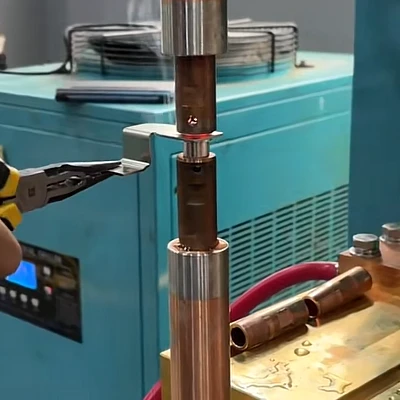
A resistance spot welding machine joins overlapping metal parts by passing electrical current through the contact area while the electrodes apply force. Electrical resistance generates heat at the interface between the parts, forming a weld nugget. The electrodes continue to hold the workpiece for a short time after the current stops so that the joint can begin to solidify under pressure.
Weld quality is affected by current, weld time, electrode force, electrode shape, surface condition, cooling and part fit-up. Increasing only the welding current does not automatically produce a stronger joint. Excessive heat can cause spatter, deep electrode marks, coating damage or rapid electrode wear.
For repeat production, the fixture must hold the parts in the same position and the electrode tips must be maintained at a consistent shape. These conditions are as important as the selected machine capacity.
Materials and Parts Suitable for Spot Welding
The suitability of a spot welding process depends on electrical conductivity, thermal conductivity, surface coating, thickness ratio and joint design. Mild steel and stainless steel are commonly welded by resistance spot welding, while coated steel requires closer control of current and electrode condition.
Copper, aluminium and some dissimilar-metal combinations are more demanding because they conduct heat and electricity differently from steel. These applications should not be confirmed from a general material list alone. HAIFEI recommends a sample welding evaluation before selecting the power source, electrodes and process settings.
| Material or workpiece | Application consideration |
| Mild steel sheet | Commonly suitable when the surfaces fit closely and the electrodes can reach both sides |
| Stainless steel | Usually requires controlled heat input to limit marking and distortion |
| Galvanized steel | Coating affects contact resistance and can increase electrode wear |
| Metal brackets and formed parts | Fixture design is needed to control position and part fit-up |
| Terminals and electrical contacts | Electrode shape and heat input must match the small joint area |
| Nuts and fasteners | Projection welding may be more suitable than standard spot welding |
| Copper or aluminium parts | Sample testing is required because of high electrical and thermal conductivity |
| Dissimilar metals | Joint design, plating and interlayer conditions must be evaluated individually |
Spot Welding Machine Applications
HAIFEI spot welding machines are used for metal parts with overlapping joints and clearly defined weld positions. Typical workpieces include automotive brackets, sheet metal components, stainless steel parts, electrical terminals and small hardware assemblies. The machine structure and welding power source are selected according to the material, thickness, weld location and required production cycle.
Automotive Metal Parts
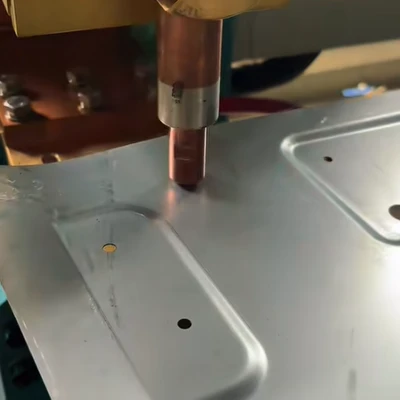
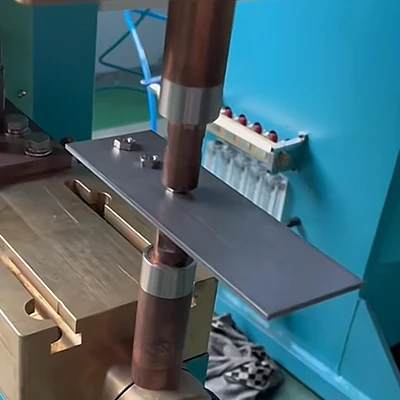
MFDC, press-type and double-head spot welding machines can be used for automotive brackets, mounting plates and formed metal assemblies. Custom fixtures keep the parts aligned during welding, while double welding heads or automated loading can be added when one part has several fixed weld points.
Sheet Metal and Stainless Steel Parts
AC and MFDC spot welding machines are suitable for brackets, supports, covers and other sheet metal assemblies used in appliance and general metalworking production. For stainless or coated steel, the electrode shape, welding current and pressure should be tested to control indentation, spatter and electrode wear.
Electrical Terminals and Small Components
Precision spot welding machines are used for terminals, contacts and small metal components that require controlled heat input and accurate electrode positioning. Material grade, plating, thickness and joint size should be checked before the welding process is confirmed, especially for copper alloys, aluminium or dissimilar metals.
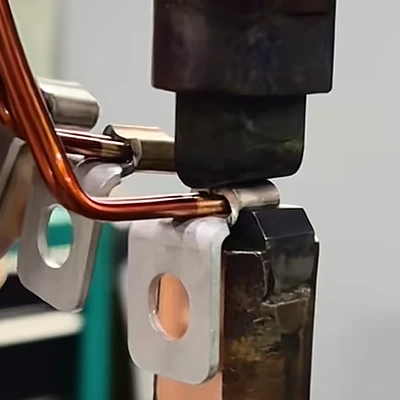
HAIFEI can provide custom electrodes, fixtures, PLC control and automated handling according to the workpiece and production requirements. Send us your drawing, material information and required output for machine selection and sample welding review.
How to Select a Spot Welding Machine?
The correct spot welding machine should be selected from the joint and production process, not from transformer capacity alone. Before requesting a quotation, prepare the following information.
Workpiece Material and Thickness
Provide the material grade, surface coating and thickness of each layer. If two different metals are being joined, identify both materials and any plating or intermediate layer.
01
Part Drawing and Weld Position
A drawing or clear sample photo allows the engineer to check electrode access, throat depth, fixture space and loading direction. Mark the required weld positions and indicate any visible surfaces that must be protected from electrode marks.
02
Required Weld Strength
Specify how the joint will be inspected. Depending on the part, this may include a peel test, pull test, torque test, visual inspection or section examination. The acceptance method should be agreed before production settings are finalised.
03
Production Output
Provide the required pieces per hour or expected cycle time. This information affects the number of welding heads, cooling system, loading method and level of automation.
04
Factory Requirements
Confirm the available power supply, compressed-air pressure, cooling-water conditions, installation space and operator loading method. These details help avoid changes after the machine design has started.
05
Why Work with HAIFEI?
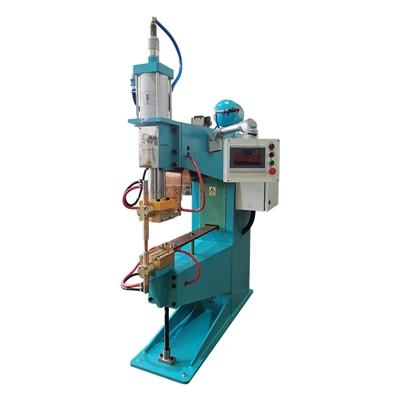
HAIFEI designs and manufactures resistance welding machines and custom welding systems in China. The company’s equipment range includes spot welding, seam welding, capacitor discharge welding, diffusion welding and application-specific automation.
For spot welding projects, the engineering team reviews the part drawing, joint position, material, expected output and factory conditions before recommending the machine structure. The scope may include the welding power source, machine frame, electrodes, fixture, control program and loading arrangement.
Customers can also discuss sample welding, operator training, installation guidance and remote technical support according to the project requirements. Final equipment specifications, delivery scope and acceptance conditions are confirmed in the technical agreement.
FAQ About Spot Welding Machine
Talk to our welding engineer for MFDC machine type selection.
Wuxi Haifei Intelligent Equipment Co., Limited is well-known as one of the leading spot welding machine manufacturers and suppliers in China. Please rest assured to buy high quality spot welding machine made in China here from our factory. For price consultation, contact us.
laser spot welding machine, projection welding machine price, MFAC Inverter Spot Welder


