


Haifei develops industrial welding solutions for manufacturers of busbars, electrical components, automotive parts, battery and energy storage components, and metal assemblies.
Our equipment range covers diffusion welding, resistance spot and projection welding, seam welding, capacitor discharge welding, and ultrasonic metal welding. Solutions can include a standalone welder, dedicated tooling, a custom welding machine, or an automated production system.
Explore the applications below to find components and production requirements similar to yours.
Explore Welding Solutions by Industry
Each industry includes different joint structures and acceptance requirements. Select an application to view the relevant components, welding considerations, equipment, and available project examples.

Automotive Parts Welding Solutions
For weld nuts, bolts, brackets, stamped parts, shock absorber components, and other metal assemblies. Automotive resistance welding projects may require dedicated locating fixtures, automatic fastener feeding, part detection, or multiple weld positions within one loading cycle.

Battery & Energy Storage Welding Solutions
For conductive connections and structural components used in battery modules, packs, and stationary energy storage systems. Applications include copper and aluminum foil connectors, rigid busbars, panels, and enclosures. The joining process is evaluated separately for each component and material combination.

Low-Voltage Electrical & Busbar
For rigid busbars, laminated flexible connectors, copper braided connections, contacts, and terminals used in switchgear and power distribution equipment. Busbar welding solutions must account for conductor material, joint structure, electrical performance, and the positioning required for subsequent assembly.

Electric Vehicle Component Welding
For EV wire harness connections and related conductive or sheet-metal components. Evaluation focuses on conductor structure, terminal geometry, accessible weld positions, and permitted heat input. Different joints within the same vehicle assembly may require separate welding processes and tooling.

Metal Hardware Welding Solutions
For elevator door panels, fan mesh, welded nuts, and other metal hardware assemblies. Equipment options include spot welders, projection welding stations, seam welders, and multi-head systems, selected according to weld access, part size, and the required production sequence.

Household Appliance Welding Solutions
For range hood panels, dishwasher inner tubs, heat exchanger plates, brackets, and thin-sheet housings. Appliance welding equipment is configured around panel support, weld location, visible surface requirements, and any sealing tests required for the finished assembly.

Motor & Coil Welding Solutions
For motor coil and wire connection applications requiring controlled weld positioning. The wire structure, insulation at the joining area, terminal design, and available electrode space should be reviewed before selecting the welding machine and fixture.

PV, Solar Power & Wind Power Generation
Explore welding applications for renewable-energy electrical components, including the junction box applications shown in this category. For other solar or wind power components, send the actual joint drawing so that process suitability can be evaluated.

Robotic Welding Intergration
For production tasks involving repeated weld positions, component handling, and transfer between stations. Haifei evaluates robotic welding integration around the workpiece, welding process, fixture access, cycle-time target, and workshop layout to determine a suitable automated welding configuration.
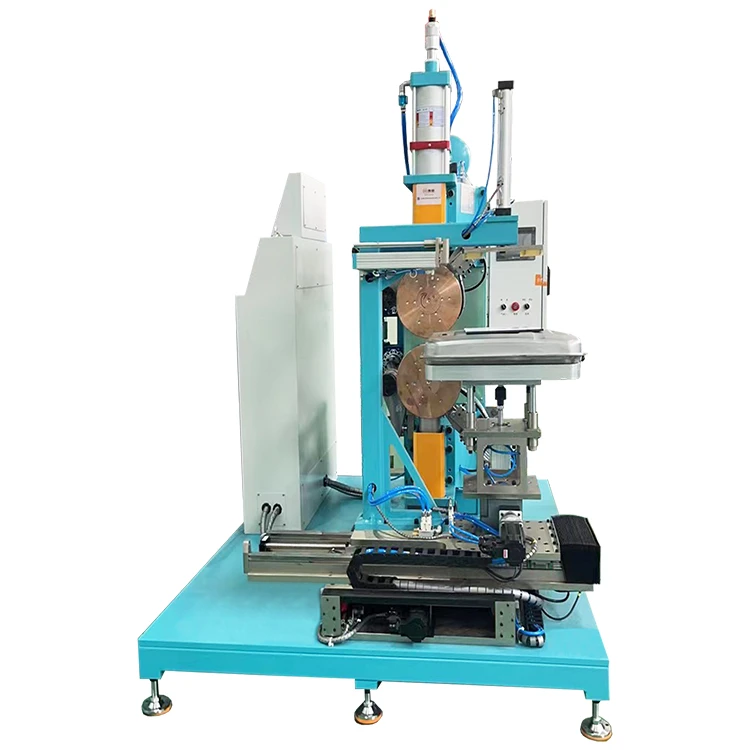
Motorcycle Component Welding Solutions
For motorcycle fuel tanks, shock absorber components, and associated metal assemblies. Fuel tank shell joints require attention to seam continuity and leak testing, while mounting and suspension components have different positioning and mechanical requirements.

5G Communications Welding Solutions
For VC vapor chambers and related thin metal thermal-management components. Welding development focuses on the specified joining path, fixture support, deformation, and sealing requirements. Suitability depends on the component structure, including internal features that may be affected during welding.
What Determines the Right Welding Solution?
Material and Surface Condition
Material grade, coating, plating, and surface preparation can change the joining requirements. Copper, aluminum, steel, and mixed-metal joints should be assessed using representative materials.
Joint Structure and Tool Access
Overlap, weld area, component tolerances, and access from one or both sides influence the electrode and fixture design. A machine must reach and support the joint throughout the welding cycle.
Acceptance Criteria
Define how the finished joint will be accepted. Depending on its function, checks may include electrical resistance, mechanical strength, dimensional accuracy, appearance, or leakage. A weld photograph alone cannot demonstrate all of these properties.
Production and Changeover
Required output must include loading, clamping, welding, unloading, inspection, and routine electrode maintenance. Model variety and changeover frequency also affect the choice between a manually loaded station and an automated system.
From Standalone Welders to Automated Welding Systems
Haifei's custom welding solutions can combine welding equipment with application-specific handling and control functions.
| Equipment configuration | Production situation | Configuration focus |
|---|---|---|
| Standalone welding machine | Manual loading is practical and the welding operation is accessible | Welding process, electrodes, and part fixture |
| Dedicated welding workstation | A component needs special positioning, several weld locations, or a defined sequence | Custom tooling, controlled movement, and optional detection |
| Automated welding system | The project requires linked feeding, transfer, welding, inspection, or unloading operations | Station coordination, handling, monitoring, and changeover |
Robotic welding integration can be evaluated where robot movement suits the workpiece and production layout. Feeding, part detection, parameter recording, and production-system communication are project options to define during equipment specification.
FAQ
Q: How do I choose a welding solution for my component?
A: Start with the material, joint drawing, and acceptance criteria. These establish which processes are worth evaluating. Production volume and handling requirements then help determine the equipment configuration.
Q: Can one welding machine produce different parts?
A: It may be possible when the parts have compatible materials, joint structures, machine capacity requirements, and tool access. Different fixtures, electrodes, and welding programs may be needed. A stored recipe alone does not make an incompatible part suitable for the machine.
Q: Can Haifei arrange sample welding before equipment selection?
A: Haifei supports sample welding for project evaluation. Discuss the required materials, sample quantity, joint checks, and acceptance criteria before sending parts. The test scope should reflect the questions that need to be resolved before the equipment specification is confirmed.
Q: How should copper-to-aluminum welding projects be evaluated?
A: Provide the exact material grades, surface condition, joint geometry, and service requirements. Copper-to-aluminum connections require application-specific process evaluation and testing; a method suitable for a copper-to-copper joint should not be assumed suitable for the mixed-metal joint.
Q: When should I consider automated welding equipment?
A: Consider automation when repeated loading, positioning, transfer, or inspection limits production. Assess the complete cycle and model mix before specifying robots or automatic feeders. A dedicated workstation may be sufficient when only one operation needs improvement.
Q: What if my industry is not listed?
A: Send a drawing or clear component photos with the weld positions marked. A component from another industry may have a similar joining requirement. Haifei can review the application and identify whether it fits the available welding processes.