


Welding Controllers for Industrial Welding Systems
Haifei provides resistance welding controllers and customized weld control systems for spot welding, projection welding, seam welding and robotic welding applications. The controller can be configured as part of a new welding machine, an automated production line or an upgrade project for an existing welder.
A resistance welding controller does not work independently. It must be matched with the welding power supply, transformer, pressure system, electrodes, secondary circuit and machine operating sequence. For automated equipment, it also needs to exchange signals with the PLC, robot, servo system, safety circuit and other production-line devices.
HaifeiI evaluates the complete welding system before recommending a controller. This helps determine whether the project requires a standard MFDC welding controller, a seam welding control system, a robotic spot welding controller or a control cabinet developed around a customized machine.
-
![Seam Welding Machine Controller]() Seam Welding Machine ControllerHaifei seam welding machine controller is designed for MFDC resistance seam welding systems that require stable current control, welding speed synchronization, multiple welding modes, program...view more
Seam Welding Machine ControllerHaifei seam welding machine controller is designed for MFDC resistance seam welding systems that require stable current control, welding speed synchronization, multiple welding modes, program...view more -
![Busbar Welding Machine Controller]() Busbar Welding Machine ControllerThe model 350 four-column diffusion bonder is engineered to meet the demanding connection requirements of the power transmission and new energy sectors. By integrating a patented quad-post...view more
Busbar Welding Machine ControllerThe model 350 four-column diffusion bonder is engineered to meet the demanding connection requirements of the power transmission and new energy sectors. By integrating a patented quad-post...view more -
![Robot Spot Welding Controller]() Robot Spot Welding ControllerGuided by the precise command of the Haifei Robot Spot Welding Controller , modern industrial welding has entered a new intelligent era. Designed to tackle the challenges of new materials and...view more
Robot Spot Welding ControllerGuided by the precise command of the Haifei Robot Spot Welding Controller , modern industrial welding has entered a new intelligent era. Designed to tackle the challenges of new materials and...view more


What Is a Welding Controller
Definition and Core Functions
A welding controller is the core control unit of a welding system. It governs critical welding parameters such as welding current, conduction time, welding sequence, cycle timing, and safety protection.
In spot welding, projection welding, seam welding, and automated welding systems, the controller coordinates with the power source, actuators, and upper-level systems to keep the welding process operating within a defined and stable process window.
Technical Foundation of Welding Controllers
The technical foundation of a welding controller lies in real-time control and feedback. The system must execute parameters, evaluate status, and respond to abnormalities within extremely short timeframes to prevent weld defects.
High-performance controllers typically support multi-stage parameter control, multi-pulse welding, logic decision functions, and comprehensive fault protection, enabling reliable execution of complex welding processes.
Why the Controller Matters for Weld Quality
Unstable weld quality, inconsistent nugget strength, spatter, or cold welds are often caused not by the welding machine itself, but by insufficient control accuracy or mismatched control logic.
A mature and reliable controller significantly improves weld consistency, reduces rework rates, and provides a stable foundation for high-volume production.
Typical Applications
Automotive Spot and Projection Welding
Resistance welding controllers are used in spot welders, nut projection welders, bolt welders and robotic welding cells for automotive parts. The controller must be matched with the material stack, projection design, electrode force and production cycle.
01
Fuel Tank and Metal Container Seam Welding
A seam welding control system coordinates current pulses with electrode-wheel motion to form overlapping weld nuggets. Typical components include motorcycle fuel tanks, automotive tanks, drums, cans and selected sealed metal products.
02
Switchgear and Busbar Components
Busbars, flexible conductors and low-voltage electrical components may require resistance welding, brazing or diffusion welding depending on their material and joint structure. The control system is therefore configured around the selected welding process rather than the industry name alone.
03
Robotic Welding Workstations
Robotic resistance welding systems combine robot movement, welding-gun control, program selection and process feedback. The controller must communicate reliably with the robot and cell PLC while maintaining the required welding sequence.
04
Customized Automated Welding Lines
For multi-station production, the welding controller may be integrated with part detection, automatic loading, indexing, welding, inspection and unloading. The interface and data requirements are defined according to the complete line layout.
05
HAIFEI In-House Developed Welding Controllers
In-House Development and Engineering Experience
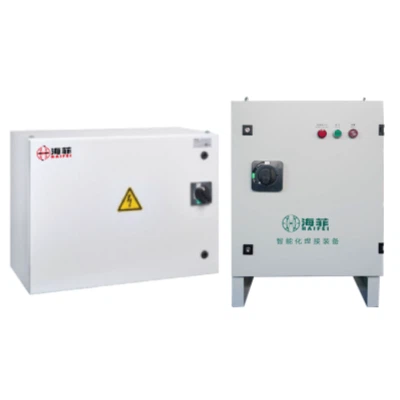
HAIFEI welding controllers are not generic off-the-shelf modules. They are industrial-grade control systems independently developed based on years of welding equipment manufacturing and on-site application experience.
During development, real production conditions, material characteristics, and automation integration requirements are fully considered, ensuring the controller performs reliably in actual factory environments.
Core Advantages of HAIFEI Controllers
- High parameter control accuracy and excellent weld consistency
- Support for multi-stage and multi-pulse welding control
- Industrial-grade stability for continuous operation
- Comprehensive fault detection and protection mechanisms
- Easy integration with robotic and automated welding systems
Modular Design and Scalability
The controller adopts a modular architecture, allowing flexible configuration of HMI units, communication modules, and I/O expansion according to different equipment and project requirements. This design supports applications ranging from standalone machines to fully automated production lines.
Value Delivered by a High-Quality Welding Controller
Improved weld quality consistency and reduced defect rates
Higher equipment reliability and lower maintenance costs
Support for automation and digital manufacturing upgrades
A stable control foundation for long-term production growth
Key Technical Parameters Explained
- Output Accuracy and Control Precision
The accuracy of current and time control directly affects weld formation. High-precision control minimizes heat input fluctuations and improves nugget strength consistency.
- Multi-Stage and Multi-Pulse Capability
Multi-stage and multi-pulse control allow fine adjustment for different material thicknesses, surface conditions, and joint structures, greatly improving process adaptability in complex welding scenarios.
- Protection Functions and System Feedback
Built-in protection functions include overcurrent, overload, short-circuit, and abnormal condition detection. Real-time system feedback further enhances operational safety and long-term reliability.
- Communication and System Integration
The controller supports multiple industrial communication protocols, enabling seamless integration with automated lines, quality traceability systems, and MES platforms, providing a solid foundation for smart manufacturing.
Why Work With HAIFEI on a Welding Control Project?
Controller Selection Based on the Welding Process
HAIFEI evaluates the workpiece, welding method, transformer, pressure system and automation requirements together. This reduces the risk of selecting a controller that cannot be integrated with the rest of the machine.
01
Experience With Complete Welding Equipment
Because the controller is applied as part of a welding machine, practical knowledge of electrodes, tooling, transformers, pressure and secondary circuits is important. HAIFEI develops resistance welding machines and customized automation systems in addition to supplying control equipment.
02
Electrical and Automation Integration
For a customized project, the control system can be developed around the machine sequence, production-line signals and required operator interface. All requested functions and communication interfaces are confirmed before production.
03
Functional Testing Before Delivery
The controller or complete control system is checked according to the agreed scope before delivery. For a complete machine, testing may also include operating sequence, alarm logic, interlocks and welding trials with customer workpieces.
04
Commissioning and Technical Support
Support can cover installation guidance, wiring review, parameter setup and troubleshooting. The exact commissioning scope depends on whether the order is for a controller, a control cabinet or a complete welding machine.
05
Ordering Process
Send Us Inquiry → Receive Our Quotation → Negotiate Details → Confirm the Sample → Sign Contract/Deposit → Mass Production →Cargo Ready → Balance/Delivery → Further Cooperation
Certificate
Payment Terms
T.T with 30% downpayment, 70%before shipment.
Paypal or West Union also accept.
Packaging & Shipping

FAQ
Q: What information is needed to select a resistance welding controller?
A: The basic information includes the welding process, workpiece material and thickness, machine type, transformer specifications, input power, target output, pressure system, duty cycle and automation interface. For an existing machine, the wiring diagram and control-cabinet photographs are also required.
Q: Can a new controller replace the controller on our existing welder?
A: Possibly, but compatibility must be reviewed first. The existing transformer, power unit, feedback signals, valves, safety circuits and PLC interface may not match the new controller directly.
Q: What is the difference between an AC and MFDC welding controller?
A: An AC controller operates with an AC resistance welding power system, while an MFDC controller works with an inverter and medium-frequency welding transformer. The appropriate system depends on the application, transformer, required output and process conditions.
Q: Does the welding controller include the transformer?
A: Not necessarily. The controller, inverter or power unit, transformer, HMI and electrical cabinet may be supplied separately or as an integrated system. The exact scope should be stated in the quotation.
Q: Can the controller store different welding programs?
A: Program storage may be available for different workpieces or welding schedules. The number of programs and method of program selection depend on the controller model and project configuration.
Q: Does it support multi-pulse or multi-stage welding?
A: Selected controllers can be configured for multi-pulse or multi-stage processes. The required heating sequence should be confirmed through the application review and welding trials.
Need a Controller for a New Machine or an Existing Welder?
Send HAIFEI your workpiece drawing, welding process, transformer specifications, input voltage, existing controller model and control-cabinet photographs.
Our engineers will review whether your project requires an MFDC welding controller, seam welding controller, robotic spot welding controller, replacement weld control or a customized control system.
Wuxi Haifei Intelligent Equipment Co., Limited is well-known as one of the leading controller manufacturers and suppliers in China. Please rest assured to buy high quality controller made in China here from our factory. For price consultation, contact us.
industrial chiller system, hvac water chillers and cooling towers, glycol chiller industrial


