


Resistance Welding Machines for Industrial Production
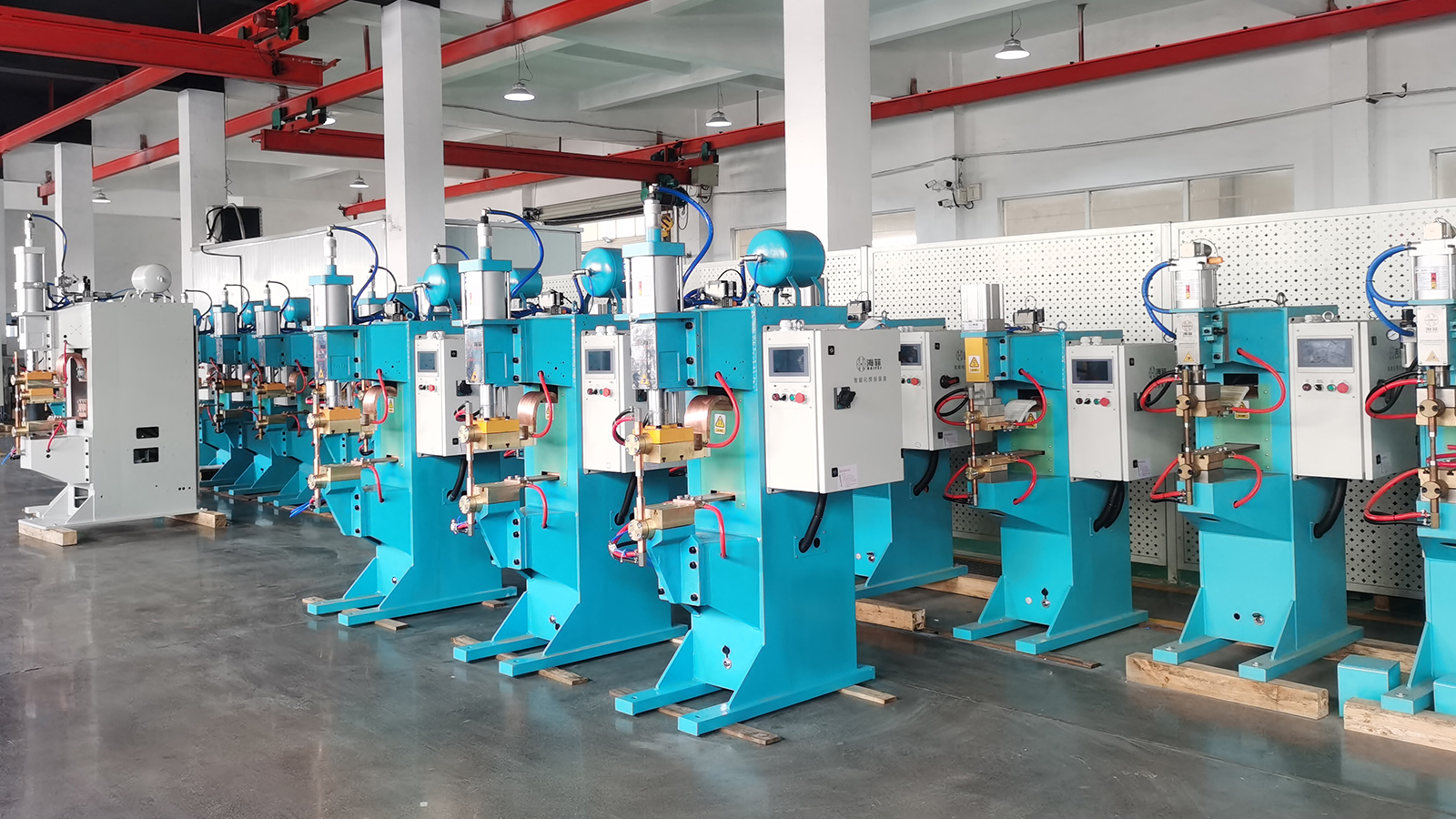
Haifei designs and manufactures industrial resistance welding machines for spot, projection, seam and capacitor discharge welding. Our equipment is used to join sheet-metal parts, nuts, studs, terminals, tanks, pipes and other conductive metal components.
The correct machine is selected according to the workpiece—not simply by transformer capacity. Material, thickness, coating, joint form, electrode access, weld quality and production output must be considered before the machine, electrodes and tooling are confirmed.
Haifei supplies stand-alone welders, dedicated tooling, multi-point equipment and automated systems with part feeding, positioning, welding, inspection and unloading.
Send us your workpiece drawing, material, thickness and production requirements. We will evaluate the welding process and recommend a suitable machine configuration.
You may be looking for
-
![Capacitor Discharge Spot Welder For Three-Way Catalytic Converters]() Capacitor Discharge Spot Welder For Three-Way Catalytic C...Product Introduction This Capacitor Discharge Spot Welder for Three-Way Catalytic Converters is designed for spot welding and projection welding applications in automotive exhaust system...view more
Capacitor Discharge Spot Welder For Three-Way Catalytic C...Product Introduction This Capacitor Discharge Spot Welder for Three-Way Catalytic Converters is designed for spot welding and projection welding applications in automotive exhaust system...view more -
![Dual-head Energy Storage Spot Welding Machine]() Dual-head Energy Storage Spot Welding MachineThe Dual-head Energy Storage Spot Welding Machine is an industrial-grade solution engineered for manufacturers who prioritize precision, aesthetics, and high-volume output. By leveraging advanced...view more
Dual-head Energy Storage Spot Welding MachineThe Dual-head Energy Storage Spot Welding Machine is an industrial-grade solution engineered for manufacturers who prioritize precision, aesthetics, and high-volume output. By leveraging advanced...view more -
![Nut Projection Welding Machine]() Nut Projection Welding MachineThe Nut Projection Welding Machine (HFTR-20000) is a high-performance industrial solution designed for precision and durability. Beyond welding standard materials like steel and iron, it is widely...view more
Nut Projection Welding MachineThe Nut Projection Welding Machine (HFTR-20000) is a high-performance industrial solution designed for precision and durability. Beyond welding standard materials like steel and iron, it is widely...view more -
![Capacitor Discharge Welding Machine]() Capacitor Discharge Welding MachineThe Capacitor Discharge Welding Machine is a high-stability capacitor energy storage welding system designed for high-strength steel, hot-formed steel, galvanized sheets, and non-ferrous metals....view more
Capacitor Discharge Welding MachineThe Capacitor Discharge Welding Machine is a high-stability capacitor energy storage welding system designed for high-strength steel, hot-formed steel, galvanized sheets, and non-ferrous metals....view more -
![Automotive Heat Shield Seam Welding Machine]() Automotive Heat Shield Seam Welding MachineThe Automotive Heat Shield Seam Welding Machine is a mid-frequency resistance seam welding system developed by HAIFEI Welding Equipment Co., Ltd. specifically for metal thin-sheet components used...view more
Automotive Heat Shield Seam Welding MachineThe Automotive Heat Shield Seam Welding Machine is a mid-frequency resistance seam welding system developed by HAIFEI Welding Equipment Co., Ltd. specifically for metal thin-sheet components used...view more -
![Corrugated Pipe Seam Welding Machine]() Corrugated Pipe Seam Welding MachineThe Corrugated Pipe Seam Welding Machine is a medium frequency resistance welding solution designed for producing strong, continuous seams on large-diameter corrugated pipes. In addition to...view more
Corrugated Pipe Seam Welding MachineThe Corrugated Pipe Seam Welding Machine is a medium frequency resistance welding solution designed for producing strong, continuous seams on large-diameter corrugated pipes. In addition to...view more -
![Fuel Tank Seam Welding Machine]() Fuel Tank Seam Welding MachineThe Fuel Tank Seam Welding Machine is used for continuous resistance welding of automotive metal fuel tank shells. Its electrode wheels clamp and weld the overlapping joint while controlled...view more
Fuel Tank Seam Welding MachineThe Fuel Tank Seam Welding Machine is used for continuous resistance welding of automotive metal fuel tank shells. Its electrode wheels clamp and weld the overlapping joint while controlled...view more -
![Wheel Hub Seam Welding Machine]() Wheel Hub Seam Welding MachineThe Wheel Hub Seam Welding Machine is designed for high-performance welding of automotive and motorcycle wheel hubs. It supports steel, iron, stainless steel, copper, silver, nickel, and various...view more
Wheel Hub Seam Welding MachineThe Wheel Hub Seam Welding Machine is designed for high-performance welding of automotive and motorcycle wheel hubs. It supports steel, iron, stainless steel, copper, silver, nickel, and various...view more -
![Stainless Steel Seam Welding Machine]() Stainless Steel Seam Welding MachineIf inconsistent or porous welds are causing leaks and product rejects, the HFFZ-250 Stainless Steel Seam Welding Machine is the solution you need. Engineered with advanced inverter technology and...view more
Stainless Steel Seam Welding MachineIf inconsistent or porous welds are causing leaks and product rejects, the HFFZ-250 Stainless Steel Seam Welding Machine is the solution you need. Engineered with advanced inverter technology and...view more -
![Dual-Head Capacitor Discharge Welder]()
-
![Seam Welding Machine Suppliers]() Seam Welding Machine SuppliersThe HFFN-200H(B) Seam Welding Machine Suppliers delivers continuous, hermetic seams for mission-critical applications. By leveraging precise Medium Frequency Direct Current (MFDC) technology, this...view more
Seam Welding Machine SuppliersThe HFFN-200H(B) Seam Welding Machine Suppliers delivers continuous, hermetic seams for mission-critical applications. By leveraging precise Medium Frequency Direct Current (MFDC) technology, this...view more -
![HFTR-45000 Capacitor Welding Machine]() HFTR-45000 Capacitor Welding MachineThe HFTR-45000 Capacitor Welding Machine is an industrial powerhouse engineered to conquer the toughest materials. When standard welders fail on automotive "hot-stamped steel" and...view more
HFTR-45000 Capacitor Welding MachineThe HFTR-45000 Capacitor Welding Machine is an industrial powerhouse engineered to conquer the toughest materials. When standard welders fail on automotive "hot-stamped steel" and...view more


Choose a Resistance Welding Machine by Joint Type
Spot Welding Machine
Spot welding is used to create individual weld nuggets between overlapping metal parts. It is commonly considered for sheet-metal assemblies, brackets, terminals, contacts and stamped components.
Press-type and bench-type configurations can also be fitted with platens and dedicated electrodes for selected nut, bolt and projection welding applications.
Before selecting a machine, Haifei reviews:
- Material and coating
- Thickness of each layer
- Number and position of weld points
- Electrode access
- Required joint strength
- Permitted surface marking
- Production volume
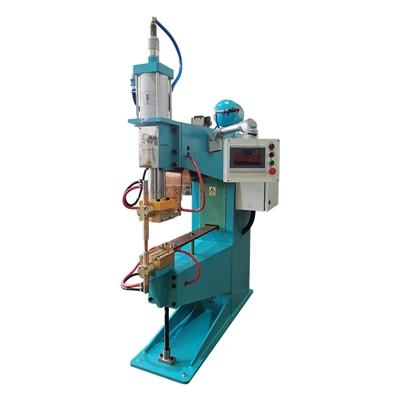

Seam Welding Machine
Seam welding uses rotating electrode wheels to produce a series of overlapping weld nuggets along a straight, circular or shaped path.
The process is used for selected tanks, containers, cylindrical shells, pipes and sheet-metal parts that require a continuous or leak-resistant joint.
Important selection information includes:
- Workpiece diameter and shape
- Straight or circumferential weld path
- Sheet thickness
- Joint overlap
- Welding length
- Required welding speed
- Surface requirement
- Leakage test standard
Capacitor Discharge Welding Machine
Capacitor discharge welding stores electrical energy and releases it over a short welding period. It is commonly evaluated for selected projection joints, fasteners, high-strength steel parts and components where a concentrated energy input is required.
The correct configuration is determined by the material, projection geometry, workpiece thickness, required weld strength and acceptable surface condition.

Choose a Resistance Welding Machine Based on Your Application
The joint form is usually the first factor in machine selection. Individual weld points, projections and continuous seams require different equipment structures and tooling.
Resistance welding machine welding video
| Application Requirement | Recommended Equipment | Why It Is Selected |
|---|---|---|
| Joining overlapping sheet-metal parts | Spot Welding Machine | Produces individual weld points through controlled current, welding time and electrode force |
| Welding nuts, bolts or studs to stamped parts | Projection Welding Machine | Concentrates welding current at one or several projections |
| Producing a continuous or leak-resistant lap joint | Seam Welding Machine | Rotating electrode wheels create a series of overlapping weld nuggets |
| Welding selected high-strength steel or low-marking parts | Capacitor Discharge Welding Machine | Releases stored electrical energy over a short welding cycle |
| Completing several weld points on one component | Multi-Point Resistance Welding Machine | Reduces repeated positioning and manual workpiece handling |
| Automatic loading, welding and unloading | Custom Resistance Welding System | Combines the welding process with dedicated tooling and automation |
| Joining large stacks of copper or aluminium foil | Diffusion Welding Machine | Better suited to large bonding areas and flexible conductive connections |
This table provides an initial direction. Final equipment selection should be confirmed using the actual workpiece, production material and acceptance criteria.
Resistance Welding Applications by Industry
Automotive Parts and Metal Stampings
Resistance welding is used for brackets, hinges, seat components, nuts, bolts, heat shields and other stamped or formed metal parts.
Automotive production often requires more than a standard welding machine. The system may also need:
- Automatic nut or bolt feeding
- Accurate part positioning
- Several welds in one loading cycle
- Stable tooling under repeated pressure
- Quick model changeover
- Weld monitoring
- Integration with an existing production line
The correct solution depends on the workpiece design and the customer’s production sequence.
Battery and Energy Storage Components
Selected battery and energy storage parts use spot or projection welding for terminals, conductive contacts, brackets, enclosures and supporting structures.
Machine selection should consider:
- Electrical and thermal conductivity
- Material thickness
- Required joint strength
- Permitted heat input
- Surface marking
- Electrical performance after welding
- Weld inspection method
Large stacks of copper or aluminium foil are normally evaluated separately because they may require a diffusion welding process rather than conventional resistance spot welding.
Low-Voltage Electrical Equipment
Switchgear, circuit breakers and electrical cabinets contain different types of conductive and structural components. These may include contacts, terminals, brackets, metal enclosures, copper conductors and braided connections.
A single electrical assembly may require more than one joining process. Spot or projection welding may be used for contacts, terminals and structural parts, while flexible copper busbars may require diffusion welding.
The material combination and required electrical performance should be confirmed before choosing the equipment.
Household Appliance Components
Spot, projection and seam welding are used for selected sheet-metal housings, brackets, frames, handles and internal components in household appliance production.
Typical project requirements include:
- Dedicated fixture positioning
- Multi-point welding
- Nut and fastener feeding
- Controlled surface appearance
- Compatibility with different part sizes
- Automatic loading and unloading
Applications may include parts for range hoods, dishwashers, heat exchangers and other metal appliance assemblies.
Tanks, Pipes and Sealed Components
Resistance seam welding can be used for fuel tanks, metal containers, cylindrical shells, corrugated pipes and other overlapping sheet-metal joints.For these applications, the equipment must be selected according to:
- Straight or circumferential weld path
- Workpiece diameter
- Overlap width
- Sheet thickness
- Welding speed
- Wheel electrode direction
- Surface appearance
- Required leakage test
A sample weld should be tested using the actual production material before the final tooling is confirmed.
Refrigeration and Compressor Components
Compressor shells, terminals, tubes, mounting parts and related components may require spot, projection or seam welding.
The main considerations are joint position, sealing requirements, dimensional control and whether the part can be reached by both electrodes. Dedicated tooling is normally required to hold the component during welding.
Materials and Joint Types We Evaluate
Resistance welding can be applied to many conductive metals, but the same machine settings cannot be used for every material or joint.


| Material or Joint | Main Evaluation Points | Possible Process |
|---|---|---|
| Low-carbon steel | Thickness, joint overlap, weld strength and electrode access | Spot, projection or seam welding |
| Stainless steel | Surface condition, heat input, deformation and appearance | Spot or seam welding |
| Galvanized steel | Coating behaviour, electrode wear and surface marking | Spot, projection or CD welding |
| High-strength steel | Projection design, required force and weld acceptance | Projection or CD welding |
| Copper components | High electrical and thermal conductivity, electrode material and current demand | Application-specific resistance welding or diffusion welding |
| Aluminium components | Surface oxide, conductivity, thickness and electrode condition | Application-specific evaluation |
| Dissimilar-metal joints | Material compatibility, coating, joint design and performance requirement | Sample testing required |
| Nuts, bolts and studs | Projection geometry, thread protection and positioning accuracy | Projection welding |
Resistance Welding vs Other Welding Technologies
The correct process should be chosen according to the joint—not according to which machine has the highest capacity.
| Welding Technology | Commonly Considered For | Main Selection Factors |
|---|---|---|
| Resistance Welding | Sheet-metal parts, projections, terminals and overlapping seams | Electrode access, welding current, force, material resistance and joint form |
| Diffusion Welding | Copper or aluminium foil stacks and flexible busbars | Bonding area, foil stack, conductivity and controlled heat input |
| Ultrasonic Welding | Thin conductive foils, wires and selected non-ferrous parts | Material combination, joint size and vibration response |
- Resistance welding is generally selected when the workpiece can be clamped between electrodes and the joint can be formed through controlled current, time and force.
- Diffusion welding is usually a better direction for large-area flexible copper or aluminium connections. Ultrasonic welding may be considered for thin foils, wires and small conductive joints.
Why Work with Haifei?
Equipment Designed Around the Workpiece
Haifei supplies standard resistance welding machines and develops custom equipment for specific parts. The machine proposal is based on the material, joint form, weld position, production output and automation requirement.
01
Sample Testing Before Final Selection
When the welding result cannot be determined from drawings alone, customers can provide representative materials or workpieces for process evaluation.This reduces the risk of choosing a machine based only on transformer capacity or a general product catalogue.
02
Custom Electrodes and Tooling
Electrodes and fixtures are developed according to the actual contact area, weld position and workpiece shape. Compatible parts may use interchangeable tooling and separate welding recipes.
03
Stand-Alone and Automated Equipment
Available configurations range from manually loaded welding machines to multi-head, turntable, servo-positioned and robot-integrated systems.
The required automation level is confirmed according to production output, operator involvement and the customer’s existing line.
04
Factory Assembly and Machine Testing
Equipment should be tested with the agreed workpiece and acceptance method before shipment. Real welding samples, machine operation videos and test records can be used during project confirmation.
05
FAQ About Resistance Welding Machines
Q: What is a resistance welding machine?
A: A resistance welding machine joins conductive metal parts by passing controlled electrical current through the contact area while applying electrode force. The heat generated at the joint forms the weld, normally without conventional filler metal.
Q: What is the difference between resistance welding and spot welding?
A: Resistance welding is the overall process group. Spot welding is one type of resistance welding used to create individual weld points. Other types include projection welding and seam welding.
Q: What is the difference between spot welding and projection welding?
A: Spot welding concentrates current through the electrode contact area. Projection welding concentrates current through one or more projections on the fastener or workpiece. Projection welding is commonly used for nuts, bolts and studs.
Q: Which machine is suitable for welding nuts and studs?
A: Projection welding machines are normally considered for nuts, bolts and studs. The correct configuration depends on the fastener size, projection geometry, base material, required torque and feeding method.
Q: Should I choose AC, MFDC or capacitor discharge welding?
A: The choice depends on the material, thickness, joint resistance, required current, surface condition and factory power supply. Sample testing is recommended when the process window is uncertain.
Q: Can resistance welding machines weld copper and aluminium?
A: Selected copper and aluminium components can be evaluated for resistance welding, but their high conductivity makes the process more demanding. Large foil stacks and flexible busbars may require diffusion welding instead.
Wuxi Haifei Intelligent Equipment Co., Limited is well-known as one of the leading resistance welding machine manufacturers and suppliers in China. Please rest assured to buy high quality resistance welding machine made in China here from our factory. For price consultation, contact us.


