


Specific heat capacity is a fundamental physical property that plays a crucial role in various thermal processes, including welding. As a prominent supplier of Spot Welding Electrodes, I've witnessed firsthand the intricacies of how the electrode's specific heat capacity can significantly influence the welding process. In this blog post, I will delve into the science behind specific heat capacity and explore its impact on spot welding.
Understanding Specific Heat Capacity
Specific heat capacity, denoted as ( c ), is defined as the amount of heat energy required to raise the temperature of one unit mass of a substance by one degree Celsius (or Kelvin). It is expressed in units of joules per kilogram per degree Celsius ( (J/kg \cdot ^{\circ}C) ). Different materials have different specific heat capacities, which depend on their molecular structure and atomic properties.
For example, water has a relatively high specific heat capacity of approximately ( 4186 J/kg \cdot ^{\circ}C ), which means it can absorb a large amount of heat energy without undergoing a significant temperature change. In contrast, metals generally have lower specific heat capacities. Copper, a common material used in spot welding electrodes, has a specific heat capacity of about ( 385 J/kg \cdot ^{\circ}C ).
Role of Specific Heat Capacity in Spot Welding
Spot welding is a process in which two or more metal sheets are joined together by applying pressure and heat at specific points. The heat is generated by passing an electric current through the electrodes and the workpieces. The specific heat capacity of the electrode material affects several aspects of the welding process, including heat generation, heat transfer, and electrode wear.
Heat Generation
When an electric current passes through the electrode, Joule heating occurs. The heat generated (( Q )) in a conductor is given by the formula ( Q = I^{2}Rt ), where ( I ) is the current, ( R ) is the resistance, and ( t ) is the time. The specific heat capacity of the electrode material influences how quickly the electrode heats up during the welding process.
Electrodes with a lower specific heat capacity will heat up more rapidly for a given amount of heat input. This can be advantageous in some cases, as it allows for faster welding cycles. However, it also means that the electrode may reach higher temperatures more quickly, which can lead to increased electrode wear and reduced electrode life.
Heat Transfer
During spot welding, heat is transferred from the electrode to the workpieces. The specific heat capacity of the electrode affects the rate at which heat is transferred. Electrodes with a higher specific heat capacity can absorb more heat from the welding process and transfer it to the workpieces more effectively.
This can result in a more uniform distribution of heat across the weld area, leading to better weld quality. Additionally, electrodes with a higher specific heat capacity can help to reduce the risk of overheating the workpieces, which can cause distortion, cracking, or other defects.
Electrode Wear
The temperature reached by the electrode during the welding process is a critical factor in determining electrode wear. Electrodes that heat up too quickly or reach high temperatures are more likely to experience wear and damage. The specific heat capacity of the electrode material can influence the temperature rise and, therefore, the rate of electrode wear.
Electrodes with a lower specific heat capacity may wear out more quickly due to the higher temperatures they reach during welding. On the other hand, electrodes with a higher specific heat capacity can better withstand the heat generated during the welding process, resulting in less wear and a longer service life.
Impact of Electrode Material on Specific Heat Capacity
As mentioned earlier, different materials have different specific heat capacities. In the context of spot welding electrodes, the choice of electrode material can have a significant impact on the welding process.
Copper Electrodes
Copper is a popular choice for spot welding electrodes due to its high electrical conductivity and relatively low cost. However, copper has a lower specific heat capacity compared to some other materials. This means that copper electrodes can heat up quickly during the welding process, which can lead to increased electrode wear.
To mitigate this issue, copper electrodes are often alloyed with other elements, such as chromium, zirconium, or beryllium, to improve their mechanical and thermal properties. These alloyed copper electrodes have a slightly higher specific heat capacity and better resistance to wear, making them more suitable for high-volume welding applications.
Tungsten Electrodes
Tungsten is a refractory metal with a very high melting point and a relatively high specific heat capacity. Tungsten electrodes are commonly used in applications where high temperatures and long electrode life are required, such as in the welding of high-strength steels or aluminum alloys.
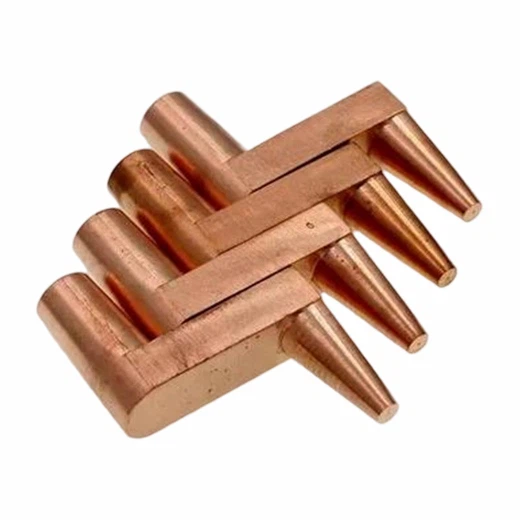

The high specific heat capacity of tungsten allows the electrode to absorb more heat during the welding process without reaching excessively high temperatures. This results in less electrode wear and a more stable welding process. However, tungsten electrodes are more expensive than copper electrodes and may require special handling and maintenance.
Practical Considerations for Selecting Electrodes Based on Specific Heat Capacity
When selecting spot welding electrodes, it is important to consider the specific heat capacity of the electrode material in relation to the welding application. Here are some practical considerations:
Welding Speed
If high welding speeds are required, electrodes with a lower specific heat capacity may be more suitable, as they can heat up quickly and allow for faster welding cycles. However, this may come at the expense of increased electrode wear.
Weld Quality
For applications where weld quality is critical, electrodes with a higher specific heat capacity are often preferred. These electrodes can help to ensure a more uniform distribution of heat across the weld area, resulting in better weld quality and fewer defects.
Electrode Life
If electrode life is a major concern, electrodes with a higher specific heat capacity are recommended. These electrodes can better withstand the heat generated during the welding process, leading to less wear and a longer service life.
Conclusion
The specific heat capacity of the electrode material is a critical factor that affects the spot welding process in several ways. By understanding the role of specific heat capacity in heat generation, heat transfer, and electrode wear, welders and manufacturers can make informed decisions when selecting spot welding electrodes.
As a [Your company description], we offer a wide range of high-quality spot welding electrodes, including Spot Welding Curved Electrode, Spot Welding Electrode Cap Tips, and Electrode Grip. Our electrodes are available in different materials and configurations to meet the specific needs of your welding applications.
Whether you are looking for electrodes with a low specific heat capacity for fast welding speeds or electrodes with a high specific heat capacity for improved weld quality and electrode life, we have the solutions you need. Contact us today to discuss your requirements and explore how our spot welding electrodes can enhance your welding process.
References
- Fundamentals of Welding Processes, Stava, Gerald
- Welding Metallurgy and Weldability of Stainless Steels, Lippold, John C. and Kotecki, David J.
- The Welding Institute - Welding Processes Handbook


