

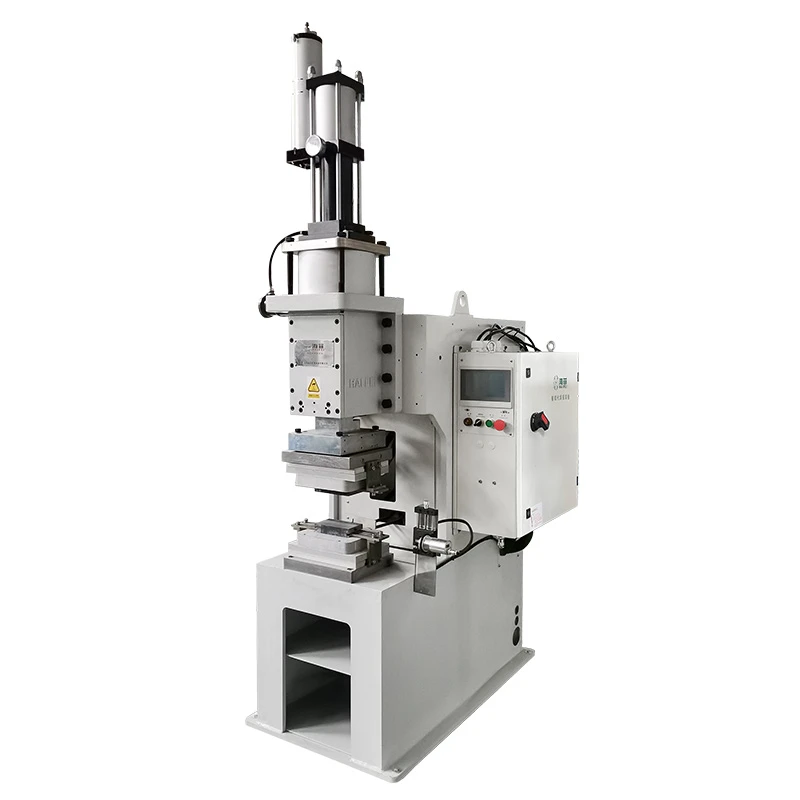
The Aluminum Flexible Busbar Welding Machine is designed to consolidate the terminal areas of smaller laminated aluminum foil stacks. The HFVD-100-Q combines controlled electrical resistance heating with pneumatic pressure to form a compact terminal while the remaining foil section retains the flexibility required for installation and operation.
Machine suitability is evaluated from the aluminum grade, individual foil thickness, number of layers, bonding dimensions, finished terminal thickness and required production cycle.
Product Specifications
|
Items / Model |
Unit |
HFTD-100-Q |
|
Rated capacity |
KVA |
100 |
|
Power supply |
V/Ø/Hz |
380V±10% / 3 phases / 50Hz |
|
Rated duty cycle |
% |
50% |
|
Primary current Max. |
A |
100 |
|
Primary cable |
mm2 |
3*35+2*16 |
|
Short-circuit current Max. |
KA |
80 |
|
Secondary voltage |
V |
21 |
|
Air pressure cylinder |
Ø*L |
Ø100*80 |
|
Hydraulic cylinder |
Ø*L |
/ |
|
Working pressure Max. (0.5/10.5MPa) |
KN |
50 |
|
Cooling water demand |
/ |
0.2~0.3MPa,40 micron filtration, Resistivity of 5 kΩ. cm |
|
Cooling water consumption |
L/Min |
100 |
|
Throat depth |
mm |
270 |
|
Distance between copper plates |
mm |
180 |
|
Working environment |
mm |
Temperature: 1~45℃ humidity: 35~90% |
Why Is Aluminum Foil Welding More Difficult Than Copper?
Aluminum presents unique engineering challenges that directly affect welding quality.
Surface Oxide
Aluminum quickly forms a stable oxide layer. If the surface condition is not controlled, the oxide can prevent consistent contact between foil layers.
The cleaning method, time between cleaning and welding, and storage condition should therefore be defined during sample approval.
Narrower Process Window
Thin aluminum foils can deform when pressure or heat input is too high. If the input is too low, the layers may not consolidate evenly.
Current, pressure, heating time and holding time must be qualified using the actual foil stack.
Multiple Bonding Interfaces
A foil stack contains an interface between every two layers. Increasing the number of layers changes the heating and pressure distribution even when the external dimensions appear similar.
Finished Terminal Thickness
The welded terminal must usually meet a controlled thickness so that it can be punched, drilled or assembled. Tooling position, pressure and holding time all influence the final dimensions.
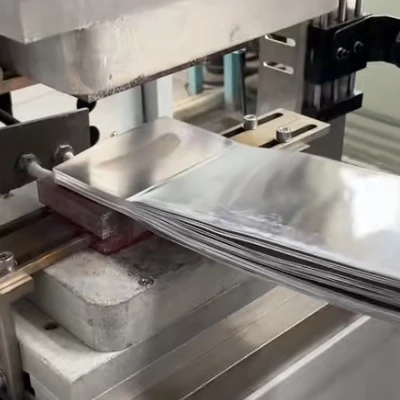
Welding demonstration of Aluminum Flexible Busbar Welding Machine
Applications of Aluminum Flexible Busbar Welding Machine
Battery Aluminum Tabs
Used in EV battery packs and energy storage systems where aluminum tabs must be reliably connected with low resistance and high consistency.
01
Aluminum Busbars
Suitable for compact power systems requiring lightweight conductive structures with stable electrical performance.
02
Aluminum Foil Laminations
Used in multi-layer aluminum structures requiring uniform bonding across thin materials.
03
Aluminum-to-Copper Connections
Applied in hybrid electrical systems where aluminum must be connected to copper conductors.
04
Electronic Conductive Components
Used in precision electronic assemblies requiring stable conductivity and low thermal distortion.
05
How Is the Welded Aluminum Terminal Inspected?
The inspection method should match how the flexible busbar will be used.
Dimensional Inspection
Check the terminal width, length, thickness, flatness and hole position against the drawing.
Surface Inspection
Inspect for excessive deformation, layer displacement, local overheating, cracks or other unacceptable surface conditions.
Peel or Layer-Separation Test
The terminal can be checked for separation between foil layers using an agreed test direction and loading method.
Bend Test
A bend test may be used to evaluate the transition between the compact terminal and the flexible foil section.
Electrical Test
Contact resistance or voltage-drop testing can be carried out when electrical performance is part of the acceptance requirement. Test points and test current must remain consistent.
Cross-Section Inspection
When required, a cross-section can be prepared to examine the condition between foil layers in the consolidated area.
Why Choose Us?
Haifei focuses on application-driven welding engineering rather than standard equipment supply.
We provide:
- Application-specific machine selection
- Aluminum welding process development
- Sample validation support
- Fixture customization
- Engineering consultation
- Automation integration solutions
- Long-term technical support
Our goal is to ensure stable, repeatable, and production-ready aluminum welding performance.
cooperative partner
We have served over 5,000 customers worldwide, and our long-term partners include Tesla, BYD, and Siemens.
Over 50+ Fortune 500 companies.


Honor and qualification
40+ Patents and 2 National Software Copyrights
10,000㎡ Factory with 100+ skilled employees


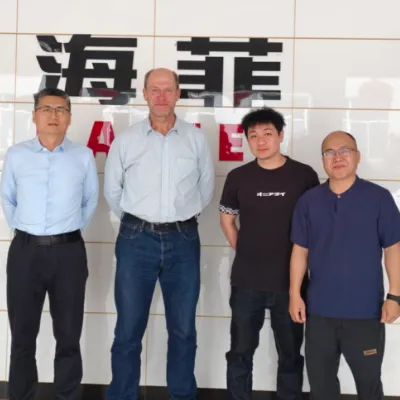
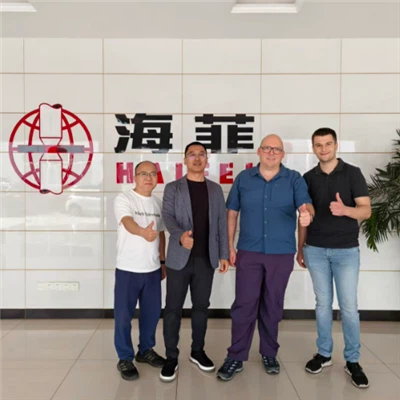
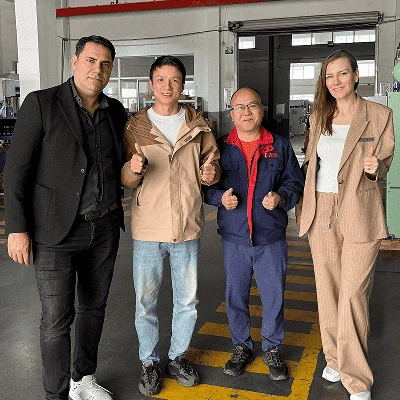
Haifei customers visit factory



FAQ
01.What is an aluminum flexible busbar welding machine used for?
02.Can the machine weld different numbers of aluminum foil layers?
03.How do I know whether 100 KVA is sufficient?
04.Why must aluminum foils be cleaned before welding?
05.Can the welded terminal be punched or drilled?
06.How is the finished terminal thickness controlled?
Wuxi Haifei Intelligent Equipment Co., Limited is one of the leading manufacturers and suppliers of Aluminum Flexible Busbar Welding Machine in China. With abundant experience, we warmly welcome you to buy advanced Aluminum Flexible Busbar Welding Machine for sale here from our factory. Quality products and reasonable price are available.
Hot Tags: Aluminum Flexible Busbar Welding Machine, China Aluminum Flexible Busbar Welding Machine manufacturers, suppliers, factory, aluminium diffusion welder


