

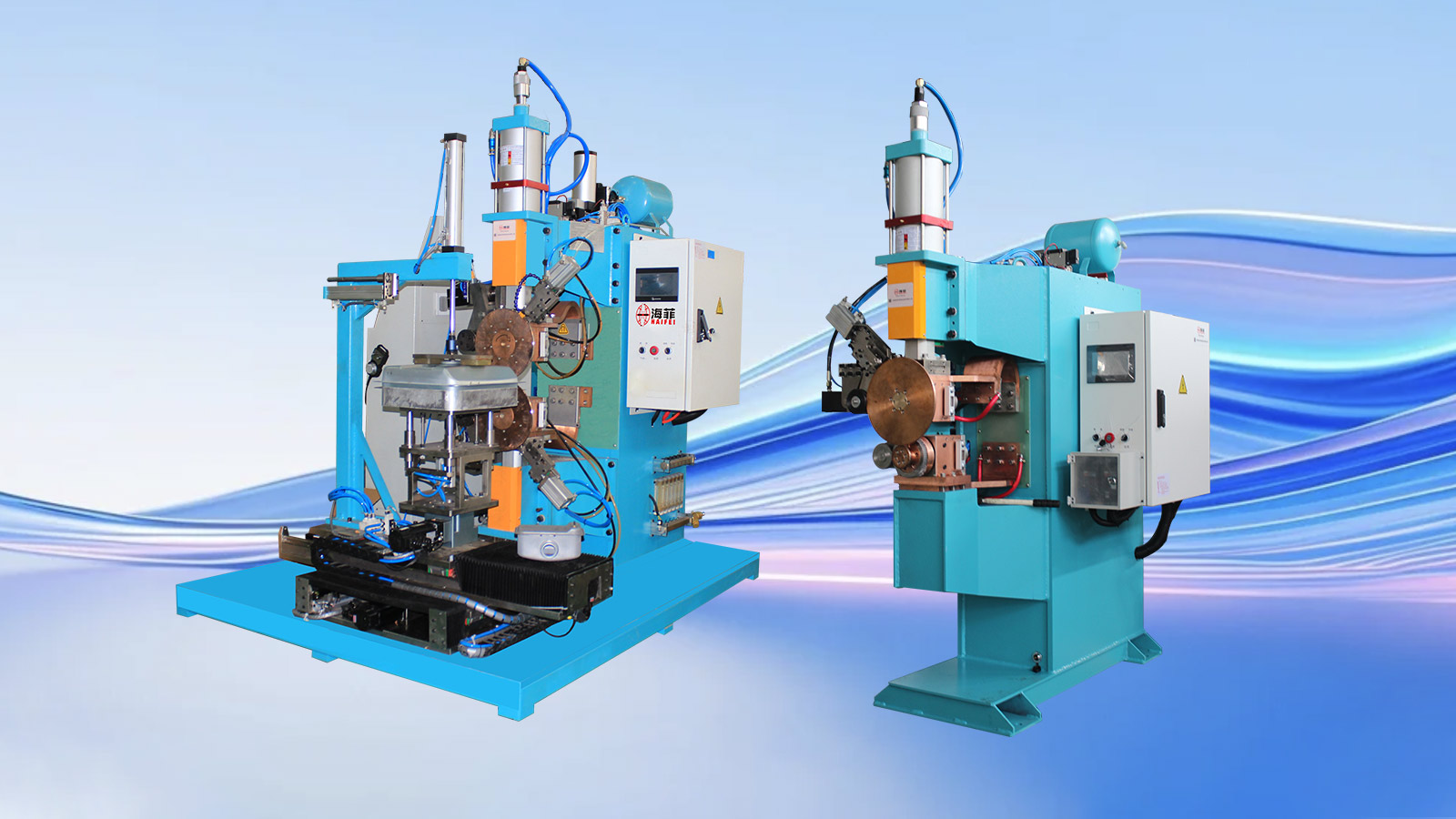
Haifei developed this motorcycle fuel tank welding solution for a manufacturer producing thin-sheet fuel tank assemblies for different motorcycle models.
The project used a customized seam welding system, profile-matching positioning fixture and programmable process control. The solution was developed to address uneven shell alignment, discontinuous seams, excessive heat deformation and variation between production batches.
Because fuel tank dimensions, sheet thicknesses and joint profiles vary, the final welding machine, tooling and process settings must be confirmed from the customer's drawings and sample-welding tests.
Project at a Glance
|
Project item |
Details |
| Industry | Motorcycle component manufacturing |
| Workpiece | Motorcycle fuel tank assembly |
| Main structure | Thin formed steel shells with curved profiles |
| Main welding process | Continuous seam welding |
| Main joint | Connection between the upper and lower tank shells |
| Equipment | Customized motorcycle fuel tank welding machine |
| Tooling | Profile-matching positioning and supporting fixture |
| Process control | Programmable welding current, pressure, welding time and holding sequence |
| Main quality concerns | Seam continuity, leakage risk, deformation and shell alignment |
| Verification | Sample welding, visual and dimensional inspection, followed by the customer-specified leak test |
What Is This Motorcycle Fuel Tank Welding Solution Used For?
The solution is used to join the formed upper and lower shells of a motorcycle fuel tank.
These shells normally have thin walls, curved surfaces and an irregular peripheral joint. The welding process must create a continuous joint while limiting distortion of the tank body.
The main shell connection is completed using seam welding. Rotating electrode wheels apply pressure and welding current while following the joint, producing a series of overlapping weld nuggets. These overlapping welds form the continuous seam required for a sealed tank structure.
Mounting brackets, reinforcement parts, filler connections and other auxiliary components may require different welding methods. Haifei evaluates each weld position instead of applying one process to the entire tank.
Customer Background
The customer manufactures motorcycle fuel tank assemblies for several motorcycle models.
Its product range includes tanks with different capacities, curved profiles and sheet configurations. This made it difficult to use one fixed fixture and one set of welding parameters for every product.
The customer needed a production solution that could control welding heat and pressure more consistently, improve workpiece positioning and retain process settings for repeat orders.
What Problems Did the Customer Have with the Previous Process?
Excessive Deformation of Thin Tank Shells
Thin formed shells are sensitive to heat accumulation. Uneven or excessive heat input can cause bulging, local collapse, edge lifting or overall warping.
Deformation not only affects appearance. It can also interfere with subsequent assembly and create uneven contact along the joint.
01
Inconsistent Shell Positioning
The previous loading and clamping method depended heavily on the operator.
When the upper and lower shells were not positioned against the same reference points, the joint gap and overlap changed. This resulted in variations in seam width, weld position and local heat input.
02
Discontinuous or Incomplete Welds
Unstable movement and inconsistent contact between the two shells could produce incomplete fusion, small pores or discontinuous sections.
A weld that appears acceptable from the outside may still contain a small leakage path. For this reason, visual inspection cannot replace the customer's specified sealing test.
03
Unstable Welding Energy and Pressure
Variations in welding current, electrode pressure or travel speed affected penetration and seam formation.
Too little energy could leave an incomplete joint. Excessive energy could cause surface burning, indentation or deformation of the thin sheet.
04
No Reusable Process Records
The previous process did not provide a suitable method for storing and recalling welding settings.
Operators had to adjust the process again when changing products or returning to a previous tank model, increasing setup time and dependence on individual experience.
05
What Did the Customer Require?
The customer requested a welding solution that could:
- Control heat input for thin formed tank shells
- Reduce bulging, warping and local surface damage
- Maintain a more consistent joint gap before welding
- Produce a continuous seam around the required path
- Coordinate welding current, electrode pressure and travel speed
- Reduce variation caused by manual positioning
- Store process settings for different fuel tank models
- Support production records and process traceability
- Adapt to tanks with different capacities, profiles and sheet thicknesses
- Allow welded tanks to be checked using the agreed leakage-test method
These were project requirements. Final acceptance criteria were to be defined according to the customer's drawings, product standard and test procedure.
Why Was Seam Welding Selected for the Main Tank Shell?
The upper and lower shells require a continuous joint. Individual spot welds cannot provide the same continuous sealing path around the tank body.
A seam welding machine uses rotating electrode wheels to apply current and pressure along the joint. Correctly overlapping the weld nuggets creates a continuous seam.
For motorcycle fuel tanks, the process must balance four factors:
| Process factor | If insufficient | If excessive or unstable |
| Welding current | Incomplete fusion or weak seam formation | Overheating, surface damage or burn-through |
| Electrode pressure | Poor electrical contact and irregular welds | Deep indentation or local deformation |
| Welding speed | Excessive heat at individual positions | Insufficient heat and discontinuous welding |
| Holding and cooling sequence | Joint movement before stabilization | Unnecessary cycle extension or excessive clamping |
These values cannot be selected from a general machine catalogue alone. They must be developed using the actual material, thickness, shell profile and required sealing standard.
Haifei's Customized Welding Solution
1. Welding Trials with Different Fuel Tank Samples
Haifei carried out welding trials on motorcycle fuel tanks with different capacities, curved profiles and sheet thicknesses.
The trials were used to evaluate:
- Welding-current range
- Electrode pressure
- Welding speed
- Energizing time
- Holding and cooling sequence
- Shell contact condition
- Visible heat influence
- Weld continuity
- Fixture support requirements
The purpose was to establish a workable process window before finalizing the equipment and tooling.
2. Controlled Seam Welding System
The selected welding equipment provides coordinated control of welding energy, electrode pressure and workpiece movement.
Stable control is particularly important for a thin fuel tank shell because changes in one parameter affect the others. For example, increasing welding speed without adjusting current may reduce heat input at the joint. Increasing current without controlling speed may increase deformation.
The final welding program is therefore established as a complete parameter set rather than as an isolated current value.
3. Profile-Matching Positioning Fixture
Haifei designed a dedicated fixture according to the fuel tank profile.
The fixture establishes repeatable locating points for the upper and lower shells and supports the curved surfaces during welding. It also helps maintain joint contact and distribute clamping force around the tank body.
The fixture design considers:
- Fuel tank shape and capacity
- Location of the peripheral seam
- Upper and lower shell references
- Joint gap and overlap
- Areas sensitive to clamping pressure
- Loading and unloading direction
- Product changeover requirements
When multiple tank models are involved, replaceable or quick-change fixture components can be evaluated.
4. Automatic Positioning and Continuous Welding
After the tank is loaded and positioned, the fixture holds the shells against the defined references.
The machine then follows the specified welding sequence. Controlled movement helps reduce variation caused by manual guidance and keeps welding speed coordinated with current and electrode pressure.
The exact level of automation can be adjusted according to the customer's required output, available operators and number of product models.
5. Programmable Process Settings
Welding programs can be stored for different fuel tank specifications.
This allows approved parameter sets to be recalled when changing models or repeating an order. Access control and production-data recording can also be evaluated when the customer requires process traceability.
Stored recipes reduce repeated manual adjustment, but the operator must still select the correct program and fixture for the loaded product.
How Did the Solution Address the Original Problems?
|
Original production problem |
Haifei configuration |
Practical function |
| Uneven positioning of upper and lower shells | Profile-matching locating fixture | Establishes repeatable loading references |
| Variable joint gap | Dedicated clamping and supporting structure | Maintains closer and more consistent shell contact |
| Excessive heat deformation | Coordinated current, pressure and speed control | Limits unnecessary heat accumulation |
| Discontinuous or uneven seam | Controlled continuous welding movement | Maintains a repeatable welding path |
| Dependence on manual guidance | Automated welding sequence | Reduces operator-related movement variation |
| Repeated setup during model changes | Stored welding programs | Allows approved settings to be recalled |
| Lack of production records | Optional data storage and traceability functions | Supports process review and production management |
The actual level of improvement must be verified against the customer's acceptance criteria. No general percentage should be applied to every fuel tank design.
Which Welding Processes Are Used on a Complete Motorcycle Fuel Tank?
Not every part of a motorcycle fuel tank should be welded with the same process.
Fuel tank area |
Typical process |
Main purpose |
| Upper and lower main shells | Seam welding | Form a continuous sealed joint |
| Mounting brackets | Resistance spot welding | Attach structural components efficiently |
| Reinforcement parts | Spot or projection welding | Provide local structural support |
| Filler connection or irregular positions | MIG welding or another evaluated process | Reach joints that are unsuitable for electrode wheels |
| Completed tank | Leakage testing | Verify sealing performance after welding |
The actual process combination depends on joint access, material, thickness and product design.
Welding Machine or Complete Production Line?
Choose the scope according to the current condition of your factory.
Choose a Fuel Tank Welding Solution If:
Stamping equipment is already available
Upper and lower shells are already formed
The current problem is mainly welding quality or output
Only the welding fixture and machine need to be upgraded
Existing polishing, coating and testing processes can remain in use
Choose a Complete Fuel Tank Production Line If:
A new fuel tank manufacturing facility is being established
Blanking and hydraulic forming equipment are also required
Multiple welding processes must be integrated
Polishing, coating and leakage testing need to be planned
The customer needs assistance with the complete factory process
Haifei can supply an individual fuel tank seam welding machine or evaluate a larger production-line project.

Why Work with Haifei on a Fuel Tank Welding Project?
Process Evaluation Before Machine Finalization
Machine selection is based on drawings, samples and welding trials rather than only on the fuel tank name.
01
Equipment and Fixture Developed Together
For curved thin-sheet tanks, fixture support is part of the welding process. The machine and fixture are therefore evaluated as one system.
02
Configuration Based on Actual Production
The automation level is selected according to output, product variety, operator involvement and available factory space.
03
Pre-Delivery Sample Testing
Agreed samples can be used for process development and pre-acceptance before shipment.
04
Support for Individual Machines and Production Lines
Customers can begin with a welding-machine project or request a broader solution covering forming, welding, finishing, inspection and assembly.
05
FAQ

01.What is the best welding method for a motorcycle fuel tank?
02.Can one machine weld different motorcycle fuel tank models?
03.How does Haifei reduce fuel tank deformation during welding?
04.Can seam welding alone guarantee that a fuel tank will not leak?
05.Can Haifei test our fuel tank samples before we order?
06.Can Haifei provide the complete fuel tank production line?