

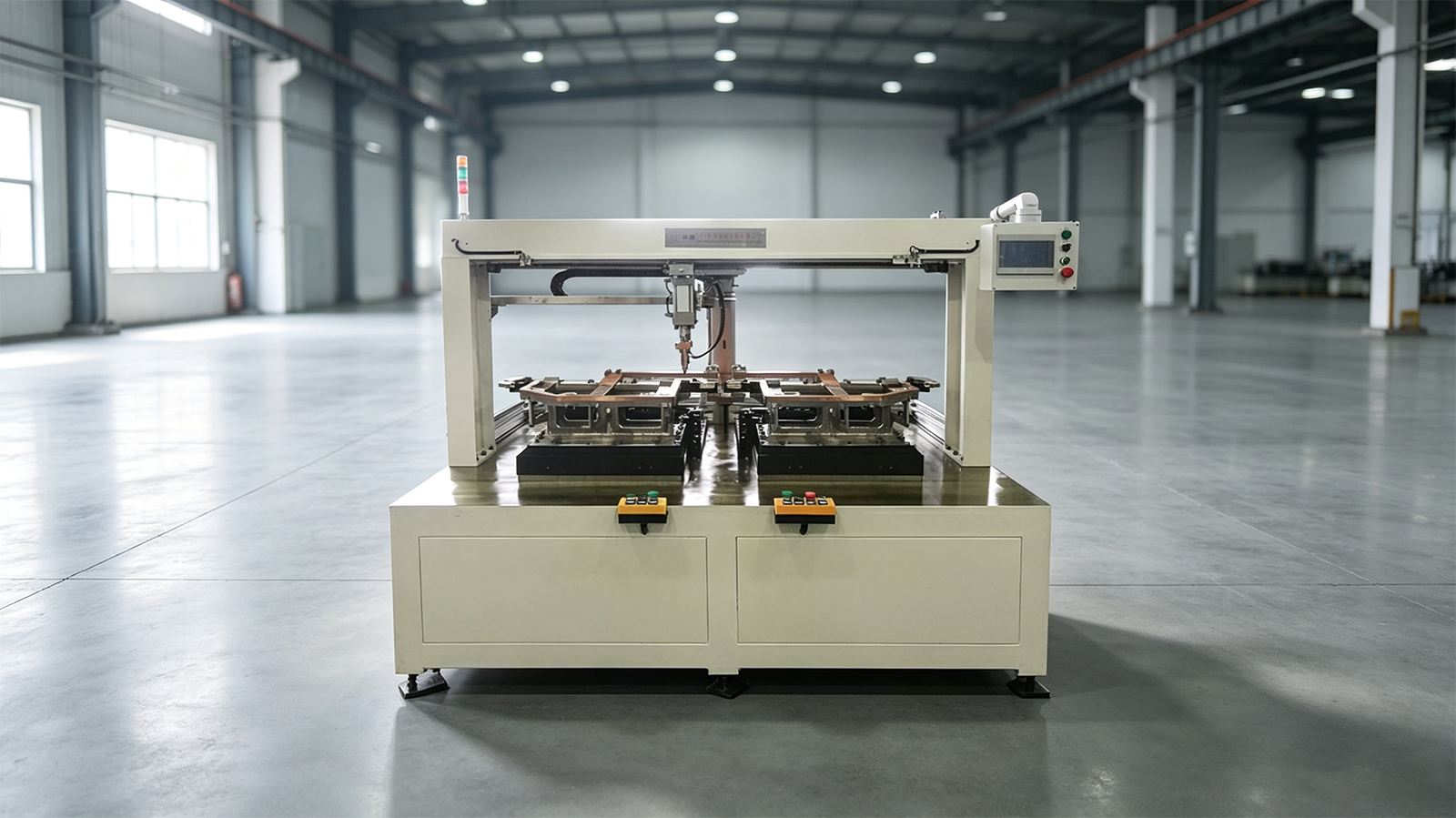
Haifei developed this automatic spot welding solution for joining sheet-metal parts used in range hoods, also known as cooker hoods or kitchen exhaust hoods.
The system is designed for body panels, smoke collection hoods, frames, fixing brackets and reinforcing ribs. Controlled welding energy, dedicated positioning fixtures and programmable operation help reduce missed welds, uneven weld positions, excessive spatter and thin-sheet deformation.
The final machine configuration is determined from the customer's component drawings, material, thickness, weld layout and required production capacity.
What Is a Range Hood Automatic Spot Welding Solution?

A range hood automatic spot welding solution is a customized resistance welding system used to join the sheet-metal panels, frames, brackets and reinforcing parts of a kitchen range hood.
Unlike a standard manually operated spot welder, the solution combines the welding power source, electrodes, component positioning fixture, welding sequence and process control around the actual range hood structure.
It is suitable when manufacturers need repeatable weld positions, controlled heat input and more consistent batch production.
Project Background
The customer in this project manufactures sheet-metal parts for kitchen and household appliances. Its products include range hood housings, smoke collection panels, internal supports and reinforcing components for several range hood models.
The original production process relied heavily on manual positioning and conventional welding equipment. Because the panels were relatively thin and had large visible surfaces, changes in positioning, welding energy or electrode contact could affect both assembly accuracy and surface quality.
The customer therefore required an automatic welding system that could improve weld consistency while reducing deformation and manual operating differences.
What Problems Did the Customer Need to Solve?
Deformation of Large Thin-Sheet Panels
Range hood panels have a large surface area but relatively low rigidity. Excessive or uneven heat input can cause bulging, indentation and warping.
These changes can affect later assembly, producing uneven gaps or misalignment between the housing and internal components.
01
Spatter and Visible Welding Marks
Unstable welding conditions can produce spatter, darkened weld locations and excessive electrode marks. These defects increase surface finishing and rework, especially on parts with visible appearance requirements.
02
Misplaced, Missed or Incomplete Welds
Manual positioning does not always provide the same welding reference for every component. The result may be offset welds, missed weld positions, incomplete joints or insufficient fusion.
03
Inconsistent Batch Quality
When welding quality depends heavily on operator experience, weld appearance and joint strength can vary between operators, shifts and production batches.
04
Low Production Efficiency
Repeated manual positioning and welding require more operator involvement. Production becomes slower when one component contains many weld locations or when different models require frequent adjustment.
05
Customer Requirements for the Welding System
Based on the component structure and existing production problems, the project needed to meet the following requirements:
| Requirement | Purpose |
| Controlled welding current and electrode force | Maintain repeatable heat generation and joint formation |
| Accurate component positioning | Keep weld locations aligned with the drawing |
| Thin-sheet welding process | Reduce panel deformation, burn marks and excessive spatter |
| Dedicated range hood fixture | Support large panels and maintain joint contact |
| Programmable welding parameters | Store suitable settings for compatible components |
| Multi-model production capability | Simplify changeover between range hood parts |
| Stable continuous operation | Reduce quality variation during batch production |
| Process traceability | Make welding settings easier to manage and review |
These requirements were used as the basis for process testing and equipment development.
Haifei's Customized Range Hood Welding Solution
Welding Process Testing
Haifei carried out welding trials using representative range hood materials and component structures.
The testing considered:
- Sheet material and thickness
- Number and position of welds
- Joint overlap
- Surface condition
- Electrode access
- Electrode shape
- Welding current
- Welding time
- Electrode force
- Panel deformation after welding
The purpose of testing was to establish a usable process window before finalizing the machine and fixture design.
Controlled Resistance Spot Welding
The solution uses resistance spot welding to concentrate heat at each required joint instead of heating a large area of the panel.
Welding current, time and electrode force are controlled according to the sheet-metal combination. Stable parameter output helps reduce incomplete joints, excessive spatter and unnecessary heat input.
The exact process settings are not fixed for every range hood. They must be confirmed using the customer's actual materials and joint structure.
Dedicated Positioning Fixture
A range hood panel can move or flex if it is not supported correctly. HAIFEI therefore designed a component-specific fixture around the workpiece shape and weld layout.
The fixture is used to:
- Establish a repeatable loading reference
- Hold overlapping parts in contact
- Support large sheet-metal surfaces
- Reduce movement during electrode pressure
- Maintain access to each welding position
- Improve consistency between production batches
For multiple product models, interchangeable locating parts or separate quick-change fixtures can be evaluated.
Automatic Welding Sequence
After the component is loaded and positioned, the system carries out the specified welding sequence according to the stored program.
A controlled welding sequence is important for large thin-sheet parts because concentrating too many welds in one area can increase accumulated distortion. The sequence can therefore be arranged according to the panel structure and weld distribution.
Parameter Storage and Process Control
Compatible welding programs can be stored in the control system. When the production model changes, the operator selects the corresponding program and installs the required fixture.
Depending on the project, recorded information can include the welding program, weld count and process alarms. Additional traceability functions should be defined during technical review.
What Range Hood Parts Can Be Evaluated?
| Range Hood Part | Welding Purpose | Main Process Concern |
| Body panels | Join overlapping sheet-metal sections | Surface marks and panel deformation |
| Smoke collection hood | Assemble formed panels and supports | Positioning of large irregular parts |
| Internal frame | Provide structural support | Weld strength and dimensional accuracy |
| Fixing brackets | Attach assembly and mounting components | Repeatable weld position |
| Reinforcing ribs | Improve panel rigidity | Uneven joint gaps and visible indentation |
| Motor mounting parts | Secure internal components | Position accuracy and vibration resistance |
| Small sheet-metal accessories | Complete subassemblies | Fast changeover and consistent weld quality |
The table identifies typical applications, not a fixed machine specification. Actual feasibility depends on the component drawing and available electrode access.
Can the System Weld Coated or Painted Range Hood Panels?
Weldability depends on the coating material, coating thickness and condition of the weld area.
Insulating coatings can interfere with electrical contact and produce unstable heat generation. Welding after final painting may also damage the visible surface.
For many components, welding before the final coating or painting process provides more stable results. If the customer must weld a coated part, the coating and proposed weld location should be tested before equipment selection.
FAQ
Q: What type of welding is used for range hood panels?
A: Resistance spot welding is commonly used for overlapping panels, frames, brackets and reinforcing ribs. It creates individual structural welds without requiring a continuous seam.
Q: Can spot welding reduce deformation on thin range hood panels?
A: It can limit the heated area compared with processes that apply heat along a larger joint. However, current, welding time, electrode force, fixture support and weld sequence must still be tested and controlled.
Q: Can the machine weld stainless steel and cold-rolled steel?
A: Both materials can be evaluated. They require different welding parameters and may require different electrode or fixture arrangements. Sample testing is recommended.
Q: Can painted range hood parts be spot welded?
A: It depends on the coating. Insulating paint can interfere with current flow and may be damaged by welding. Welding before final painting is often more practical, but the actual production sequence should be reviewed.
Q: Can one machine support different range hood models?
A: Yes, when the models fall within the equipment's capacity and have compatible welding requirements. Changeable fixtures and stored programs can be used for model changeover.