

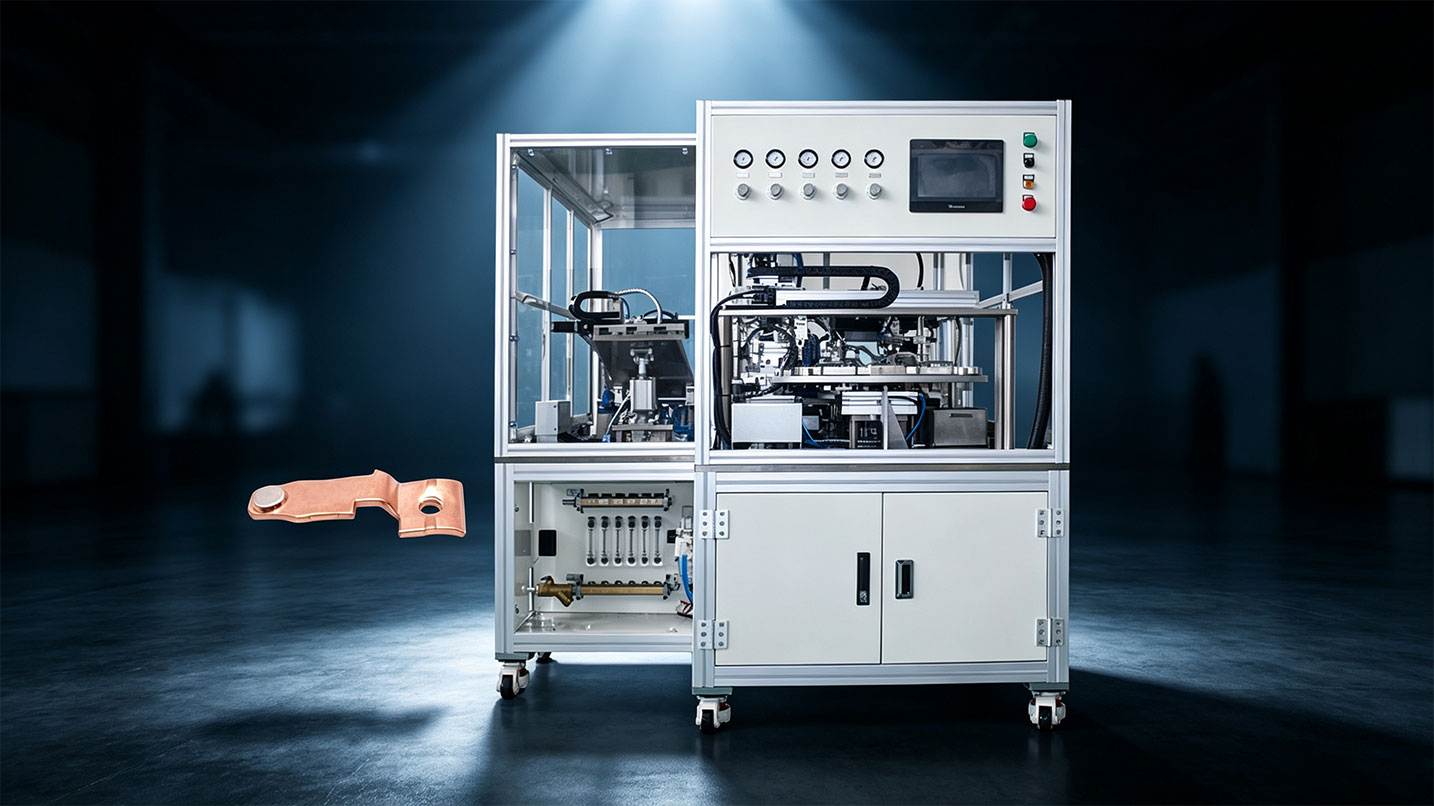
HAIFEI developed this silver contact automatic welding machine for manufacturers of relays, contactors, electrical switches and other low-voltage electrical components.
The system combines automatic feeding, positioning, resistance spot welding, forming and unloading. Dedicated tooling and controlled welding parameters help address contact displacement, incomplete bonding, surface damage and inconsistent production.
What Does This Silver Contact Welding Machine Do?
The machine automatically positions and welds silver-alloy contacts to the specified carrier or contact component. It is designed for small electrical contacts that are difficult to align consistently by hand.
The system developed for this project included:
- Automatic component feeding
- Contact orientation and positioning
- Resistance spot welding
- Post-weld forming
- Automatic unloading
- Welding recipe storage
- Process parameter recording
The actual configuration must be adjusted according to the silver alloy, contact dimensions, carrier material, joint design and required production rate.
Send Your Silver Contact Drawing
Project Overview
| Project Item | Case Information |
| Equipment | Silver Contact Automatic Welding Machine |
| Welding method | Controlled resistance spot welding |
| Customer industry | Low-voltage electrical component manufacturing |
| Typical products | Silver contacts, composite silver contacts and switch contact assemblies |
| End applications | Contactors, relays, industrial switches and related switching devices |
| Main problem | Unstable positioning and welding consistency |
| Automation scope | Feeding, positioning, welding, forming and unloading |
| Process development | Sample welding with different contact specifications |
| Changeover | Stored recipes for compatible contact models |
No fixed welding current, electrode force or production cycle is stated on this page because these values depend on the customer's actual contact and carrier structure.
Customer Background
The customer manufactures silver contacts, composite silver contacts and electrical switching assemblies for contactors, relays and industrial control switches.
Silver contacts are small current-carrying components. Their location, bonding condition and contact surface can affect how the finished electrical assembly makes and breaks the circuit. The customer's existing process relied heavily on manual positioning and basic spot welding equipment, making production consistency dependent on operator experience.
The project required more than replacing the welding power source. Feeding, orientation, positioning, welding and handling needed to be considered as one production process.
Problems with the Original Welding Process
Contact Position Varied During Manual Loading
The contacts were small, and manual loading did not provide a uniform positioning reference. This could cause contact offset, an uneven fitting gap or differences between finished components.
01
Welding Heat Was Difficult to Control
Unstable energy output could produce surface blackening, local burning, excessive indentation or damage to the contact surface. Excessive heat could also affect the condition of the silver-alloy layer.
02
Some Joints Were Not Fully Bonded
A weld could appear acceptable from the outside while the internal joint remained incomplete. In service, an inconsistent joint may contribute to unstable contact resistance or local heating.
03
Finished Parts Varied Between Operators and Batches
Manual loading, positioning and welding required several separate actions. Differences in operator experience affected the location, appearance and consistency of the completed contacts.
04
Welding Data Could Not Be Traced
The previous process did not provide effective recipe management or parameter records. When an abnormal weld was found, it was difficult to review the corresponding production conditions.
05
What the Customer Required?
The customer specified five main requirements for the new equipment.
| 1 | the welding process needed controlled heat input to reduce burning, deformation and unnecessary surface damage. |
| 2 | the welding energy and electrode pressure needed to remain stable during repeated production. The joint had to be properly consolidated according to the customer's electrical and mechanical acceptance requirements. |
| 3 | the machine needed an automatic positioning mechanism with a consistent loading reference to reduce contact offset and uneven fitting. |
| 4 | feeding, positioning, welding, forming and unloading needed to be integrated into an automatic production sequence to reduce manual handling. |
| 5 | the control system needed to store recipes for compatible contact specifications and retain relevant process data for production review. |
The HAIFEI's Solution
HAIFEI developed a dedicated automatic resistance welding system around the customer's silver contact components rather than adapting a general-purpose spot welder without process verification.
Sample Welding Before Machine Configuration
The engineering team carried out welding trials using silver contacts and silver rivet contact assemblies with different dimensions, thicknesses and alloy specifications.
These tests were used to evaluate the required heat input, welding pressure, electrode contact condition and fixture arrangement. The purpose was to establish a workable process before finalizing the machine design.
Dedicated Resistance Welding Equipment
The selected silver contact automatic welding machine applies localized resistance heat at the joint. The welding cycle is controlled to form the joint while limiting unnecessary heat exposure around the contact.
The correct welding window still depends on:
- Silver-alloy composition
- Contact thickness and diameter
- Carrier material and thickness
- Surface coating
- Joint area
- Electrode geometry
- Required electrical and mechanical performance
Parameters established for one contact specification should not be copied directly to another material or joint structure without testing.
Application-Specific Positioning Tooling
HAIFEI designed dedicated tooling around the customer's contact and carrier geometry.
The fixture establishes a repeatable loading reference, holds the parts in position and controls the fitting condition before welding. This reduces the influence of manual alignment and helps keep the contact in the specified location during the welding cycle.
Integrated Automatic Production Sequence
The machine brings several operations into one controlled sequence:
Component feeding → orientation → positioning → welding → forming → unloading
Part detection and process interlocks can be configured according to the project. Their purpose is to prevent the welding cycle from starting when a component is missing or incorrectly positioned.
Recipe and Process Management
Compatible contact models can use stored process recipes after each specification has been tested and approved.
Recipe management reduces repeated manual parameter entry during changeover. Depending on the agreed configuration, production records may include welding parameters, weld counts, alarms and product identification information.
How the Solution Addresses the Original Problems?
| Original Problem | HAIFEI Solution |
| Contact offset during manual loading | Dedicated positioning fixture and automatic alignment |
| Uneven fitting between the contact and carrier | Controlled loading reference and part holding |
| Surface burning or blackening | Localized heat input and tested welding parameters |
| Incomplete or inconsistent bonding | Controlled welding energy, pressure and process timing |
| Quality differences between operators | Automatic production sequence with reduced manual intervention |
| Difficult model changeover | Stored recipes for tested contact specifications |
| No process records | Parameter and production-data management when specified |
FAQ
Q: What is a silver contact automatic welding machine?
A: It is an application-specific resistance welding system used to position and weld silver-alloy contacts to carriers or switching components. Automatic versions may integrate feeding, alignment, welding, forming and unloading.
Q: What products use welded silver contacts?
A: Welded silver contacts are commonly used in relays, contactors, electrical switches, industrial control components and other devices that make or break an electrical circuit.
Q: Why is silver contact welding difficult?
A: Silver contacts are small and sensitive to positioning and heat input. Incorrect alignment can cause contact offset, while excessive or unstable welding energy may produce burning, deformation or an inconsistent joint.
Q: Can one machine weld different silver contact sizes?
A: It may be possible when the contact range is compatible with the machine capacity and feeding system. Different models may require changeable tooling, electrodes and approved welding recipes.
Q: Can the machine weld different silver alloys?
A: Different silver alloys can be evaluated, but the same parameters should not be assumed to work for every alloy. Material composition, thickness, carrier material and joint structure must be tested.
Q: How does the machine reduce contact misalignment?
A: The machine uses a defined feeding direction, positioning mechanism and dedicated fixture. Part detection can also be added to confirm that the contact and carrier are present before welding.