


Gas-insulated switchgear cabinets contain frames, panels, reinforcements and mounting parts that must remain accurately aligned throughout welding. Unstable heat input or insufficient clamping can cause weak welds, panel distortion and poor fit-up between adjoining components.
WUXI HAIFEI developed a dedicated switchgear cabinet spot welding machine with current-and-force closed-loop control and an application-specific clamping fixture. The system is designed to stabilize weld formation, control cabinet deformation and improve consistency across repeated production.
The machine configuration is determined from the customer's cabinet drawing, material, sheet thickness, weld layout and acceptance requirements.
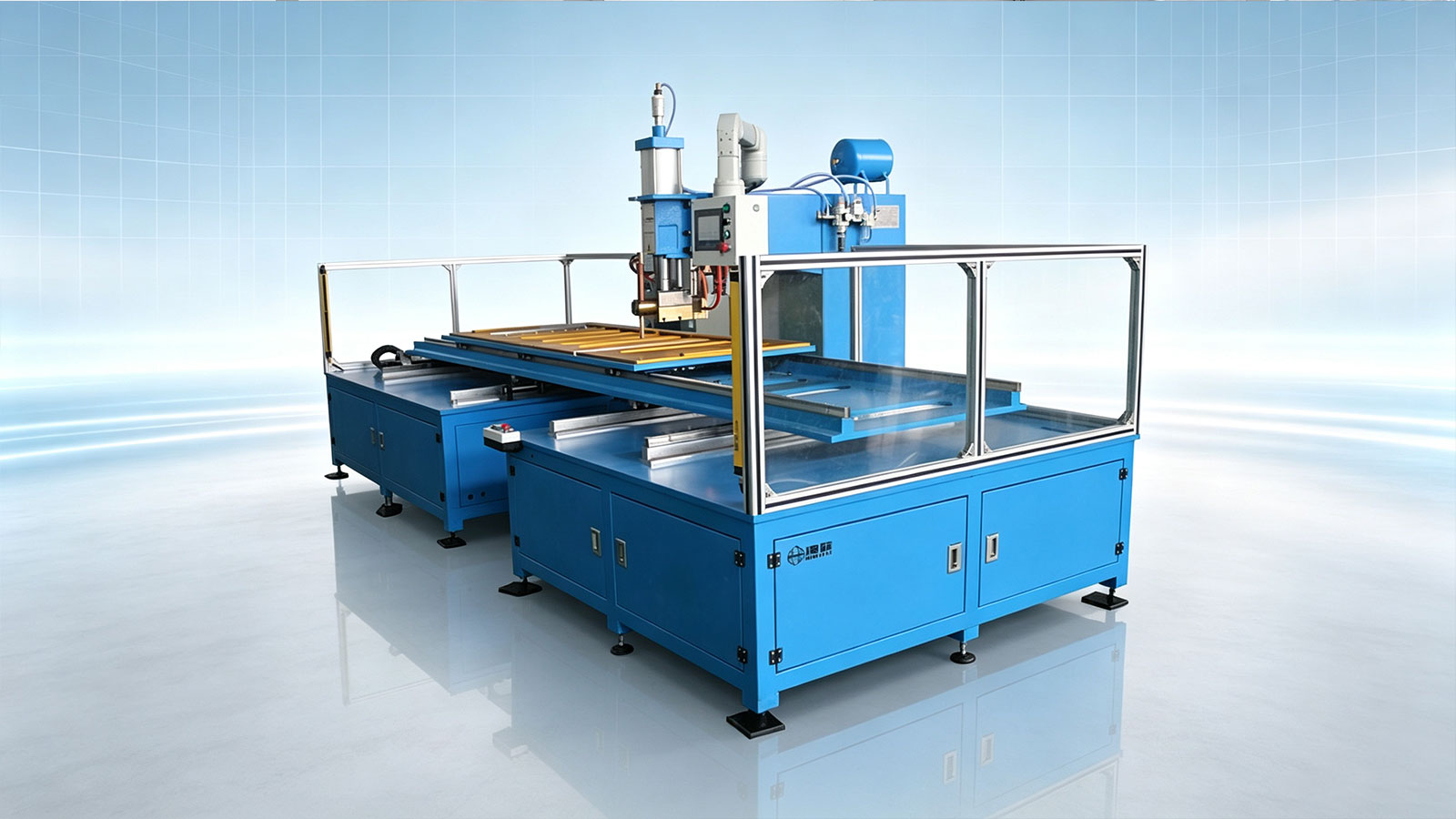
What Is This Welding Solution Designed For?
This solution is intended for resistance spot welding of compatible overlapping sheet-metal parts used in gas-insulated switchgear and high-voltage cabinet assemblies, including:
- Cabinet frames
- Reinforcement plates
- Internal supports
- Mounting brackets
- Sheet-metal partitions
- Load-bearing structures
- Panel-to-frame joints
- Overlapping structural sheet assemblies
The welding machine, electrodes and fixture are developed around the actual cabinet structure. A machine should not be selected only by the overall cabinet dimensions.
Project Overview
| Project Item | Case Information |
|---|---|
| Equipment | Dedicated closed-loop spot welding machine |
| Workpiece | High-voltage gas-insulated switchgear cabinet assemblies |
| Typical components | Frames, sheet panels, reinforcements, supports and load-bearing structures |
| Main process | Resistance spot welding |
| Main challenges | Weak welds, inconsistent fusion, cabinet distortion and variable positioning |
| Control method | Welding current and electrode-force closed-loop control |
| Tooling | Dedicated multi-point clamping fixture |
| Product changeover | Welding recipes and tooling configured for compatible cabinet models |
| Development method | Drawing review, sample testing, parameter optimization and trial production |
The Customer's Manufacturing Background
The customer manufactures sheet-metal components for high-voltage cabinets, ring main units and related electrical enclosures.
Its products include cabinet structures, reinforcement frames, sealed sheet-metal assemblies and load-bearing components. These parts contain multiple weld positions and must maintain dimensional accuracy after welding so that panels, doors, partitions and sealing interfaces can be assembled correctly.
The previous welding process could produce individual welds, but weld formation and cabinet geometry were not sufficiently consistent during repeated production.
What Problems Were Affecting Production?
Inconsistent Weld Formation
Fluctuations in welding energy and electrode pressure caused differences in weld formation. Some welds showed insufficient fusion or inadequate strength, while others received excessive heat input.
Because the cabinet contained many weld points, variation at individual joints could affect the strength and consistency of the complete assembly.
Cabinet Frames Distorted During Welding
Large sheet-metal structures are sensitive to accumulated welding heat and residual stress.
An unsuitable welding sequence or insufficient fixture support could cause:
- Frame twisting
- Panel warping
- Flatness deviation
- Misalignment between adjoining components
- Uneven gaps at assembly interfaces
These dimensional problems could continue into cabinet assembly, door installation and sealing operations.
Workpiece Fit-Up Was Not Consistent
If the sheets, reinforcements or frame members were not held against the correct locating surfaces, gaps could form at the overlap before welding.
Variable fit-up changed the electrical contact condition and made it difficult to reproduce the same weld using one parameter setting.
Quality Depended on Manual Adjustment
The previous process relied heavily on operator experience. Differences in part positioning, clamping and parameter adjustment resulted in inconsistent weld location and appearance between operators and batches.
Long Production Runs Caused Parameter Drift
Without effective process control, changes in electrode condition, part contact and operating temperature could influence the welding result during continuous production.
The customer therefore needed a more controlled process rather than simply increasing welding current.
What Did the Customer Need?
The customer required a welding system that could:
- Produce repeatable welds on thicker cabinet sheet-metal structures
- Control welding current and electrode force
- Reduce weak welds and incomplete fusion
- Hold the cabinet assembly against stable positioning references
- Reduce frame twisting and panel warping
- Maintain consistent weld location and spacing
- Store process settings for different cabinet models
- Support changeover between compatible products
- Reduce dependence on manual parameter adjustment
- Provide traceable welding recipes and production information when required
HAIFEI's Engineering Solution
Instead of treating the welding machine and fixture as separate items, WUXI HAIFEI developed the process around three connected elements:
- Closed-loop welding control
- Cabinet-specific positioning and clamping
- A verified welding sequence for the complete assembly
Current-and-Force Closed-Loop Control
The dedicated welding machine uses closed-loop control of welding current and electrode force.
Stable welding current helps control the electrical energy delivered to the joint. Controlled electrode force helps maintain contact between the overlapping sheets during heating and solidification.
The welding program can define and reproduce key parameters such as:
- Welding current
- Welding time
- Electrode force
- Squeeze time
- Hold time
- Current stages
- Weld sequence
The actual values must be developed from the customer's material, thickness and joint structure. One recipe should not be applied to every cabinet component without testing.
Dedicated Cabinet Positioning Fixture
HAIFEI designed a fixture around the cabinet's locating surfaces and weld layout.
The fixture uses multiple support and clamping positions to hold the frame, panels and reinforcement parts against the required assembly references.
Its purpose is to:
- Maintain workpiece alignment
- Reduce gaps between overlapping sheets
- Prevent movement during electrode contact
- Distribute clamping force across the cabinet structure
- Support deformation-sensitive areas
- Improve repeatability between parts
The number and position of clamps depend on cabinet size, sheet stiffness, component tolerances and electrode access.
Controlled Welding Sequence
Cabinet distortion is not controlled by welding current alone. The order in which the weld points are completed also affects accumulated heat and stress.
For this project, the welding sequence was developed together with the fixture and process parameters. Depending on the cabinet structure, the sequence may use:
- Balanced welding on opposite sides
- Welding from fixed reference areas toward free edges
- Alternating weld positions
- Dividing the cabinet into welding zones
- Allowing time between heat-sensitive sections
The final sequence must be verified using the actual cabinet assembly.
Welding Recipes for Compatible Cabinet Models
When different cabinets use compatible materials and joint structures, the control system can store separate process recipes.
Recipe management helps operators select the established welding conditions for each product instead of adjusting the machine from experience during every changeover.
Different models may still require changeable locating blocks, fixtures or electrodes. Recipe storage does not remove the need to verify the physical tooling.
How the Solution Addresses the Production Problems
| Production Problem | Engineering Response | Verification Method |
|---|---|---|
| Inconsistent weld strength | Closed-loop current and force control | Peel, chisel, pull or section testing |
| Variable gaps between sheets | Multi-point cabinet clamping fixture | Fit-up and gap inspection |
| Frame twisting | Balanced support and planned weld sequence | Diagonal and dimensional measurement |
| Panel warping | Controlled heat input and fixture support | Flatness inspection |
| Different results between operators | Stored welding recipes | Parameter record review |
| Incorrect weld location | Defined fixture references | Weld-position measurement |
| Difficult product changeover | Changeable tooling and separate recipes | Trial production using each model |
FAQ
Q: What welding machine is used for gas-insulated switchgear cabinets?
A: A closed-loop resistance spot welding machine can be used for compatible cabinet frames, reinforcement plates, brackets and overlapping sheet-metal assemblies. The power source, electrode and fixture must be selected according to the material, thickness and weld layout.
Q: Can spot welding make a GIS enclosure gas-tight?
A: Spot welding creates separate weld nuggets, not a continuous hermetic seam. A gas-retaining compartment normally requires an additional continuous sealing process and an agreed pressure or leak test.
Q: How does closed-loop control improve switchgear cabinet welding?
A: Closed-loop control helps maintain the specified welding current and electrode force during production. This reduces process variation caused by changing contact conditions, but correct material preparation, fit-up and electrode maintenance are still necessary.
Q: How is cabinet deformation reduced during spot welding?
A: Deformation is managed through controlled heat input, balanced fixture support, multi-point clamping and a planned welding sequence. The final result must be checked using cabinet flatness, diagonal and interface dimensions.
Q: Can one machine weld different switchgear cabinet models?
A: It may be possible when the models fall within the same welding capacity and electrode-access range. Separate recipes and changeable locating fixtures may be required.
Q: What tests are recommended for cabinet spot welds?
A: Common checks include visual inspection, peel or chisel testing, pull or shear testing, weld-position measurement and cabinet dimensional inspection. Cross-section examination can be added when internal weld formation must be confirmed.