


Hey there! As a supplier of aluminium diffusion welders, I often get asked about how to measure the diffusion depth in an aluminium diffusion welded joint. It's a crucial aspect when it comes to ensuring the quality and performance of the welded parts. So, let's dive right into it and explore the different methods and considerations.
Understanding Aluminium Diffusion Welding
First off, let's quickly go over what aluminium diffusion welding is. It's a solid - state welding process where two or more aluminium parts are joined together by applying pressure and heat for a specific period. During this process, atoms from the different parts diffuse across the interface, creating a strong bond. The quality of this bond is often determined by the diffusion depth, which is the distance that the atoms have diffused into each other.
Why Measuring Diffusion Depth Matters
Measuring the diffusion depth is super important for a few reasons. For one, it helps us assess the strength of the welded joint. A deeper diffusion depth usually means a stronger bond, as more atoms have mixed together. It also allows us to evaluate the consistency of the welding process. If the diffusion depth varies too much across a joint or between different joints, it could indicate issues with the welding parameters, like temperature, pressure, or time.
Methods for Measuring Diffusion Depth
Microscopy Techniques
One of the most common ways to measure diffusion depth is through microscopy. There are two main types of microscopy that are useful here: optical microscopy and electron microscopy.
Optical microscopy is a relatively simple and cost - effective method. After preparing a cross - section of the welded joint, we can use an optical microscope to observe the interface between the two aluminium parts. By looking at the changes in the microstructure, we can estimate the diffusion depth. For example, if there's a distinct transition zone where the microstructures of the two parts blend together, we can measure the width of this zone as an approximation of the diffusion depth.
Electron microscopy, on the other hand, offers much higher resolution. Scanning electron microscopy (SEM) and transmission electron microscopy (TEM) can provide detailed images of the atomic structure at the interface. With SEM, we can get a three - dimensional view of the surface and subsurface of the joint, which helps in accurately measuring the diffusion depth. TEM, on the other hand, can show the atomic arrangement at a very fine scale, allowing for even more precise measurements.
Chemical Analysis
Chemical analysis is another powerful tool for measuring diffusion depth. Energy - dispersive X - ray spectroscopy (EDS) is commonly used in combination with electron microscopy. EDS can identify the elements present in a sample and their relative concentrations. By analyzing the elemental distribution across the interface of the welded joint, we can determine how far the atoms have diffused. For example, if we're welding two different aluminium alloys with different alloying elements, we can track the distribution of these elements to measure the diffusion depth.
Another chemical analysis method is Auger electron spectroscopy (AES). AES is a surface - sensitive technique that can provide information about the elemental composition of the top few nanometers of a sample. By sputtering away thin layers of the sample and analyzing the elemental composition at each layer, we can map out the diffusion profile and calculate the diffusion depth.
Hardness Testing
Hardness testing can also give us an idea of the diffusion depth. The hardness of a material is related to its microstructure and the presence of alloying elements. In a diffusion - welded joint, the hardness usually changes across the interface due to the diffusion of atoms. By performing hardness tests at different points along the cross - section of the joint, we can create a hardness profile. The region where the hardness changes significantly can be correlated with the diffusion depth. For example, if the hardness gradually increases or decreases from one part of the joint to the other, the distance over which this change occurs can be considered as an estimate of the diffusion depth.
Factors Affecting Diffusion Depth Measurement
There are several factors that can affect the accuracy of diffusion depth measurement. One of the main factors is sample preparation. If the cross - section of the welded joint is not prepared properly, it can lead to artifacts in the microscopy images or inaccurate chemical analysis results. For example, if there are scratches or uneven surfaces on the cross - section, it can make it difficult to accurately measure the diffusion depth.

Another factor is the choice of measurement method. Different methods have different levels of accuracy and resolution. For example, optical microscopy may not be as accurate as electron microscopy for measuring very small diffusion depths. Also, the calibration of the measurement equipment is crucial. If the microscope or the chemical analysis instrument is not calibrated correctly, it can lead to incorrect measurements.
Our Aluminium Diffusion Welders
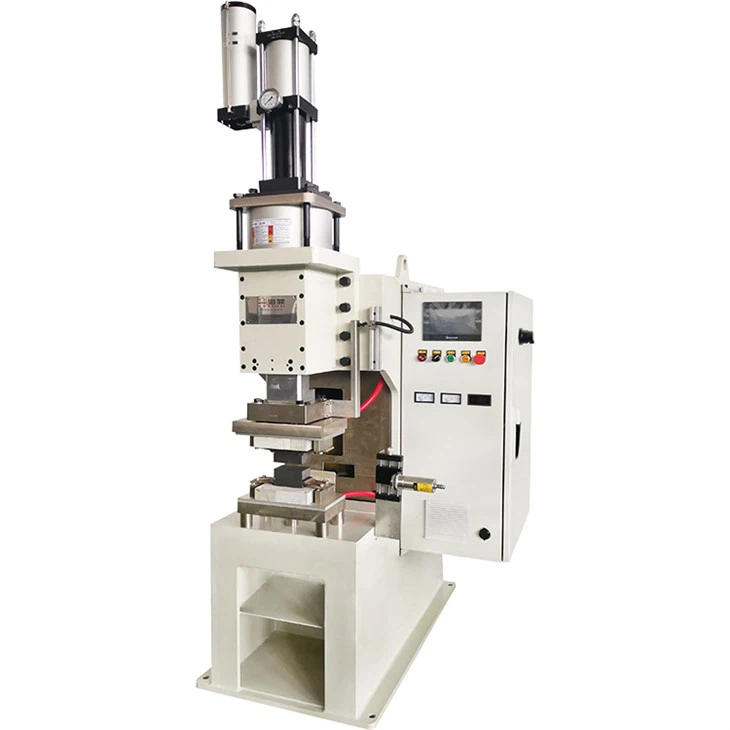
As a supplier of aluminium diffusion welders, we offer a range of high - quality machines that can ensure consistent and reliable diffusion welding. Check out our Pneumatic Aluminum Diffusion Welding Machine, Diffusion Welder For Aluminium, and Diffusion Welder for Aluminum. These machines are designed to provide precise control over the welding parameters, such as temperature, pressure, and time, which are essential for achieving the desired diffusion depth.
Contact Us for Procurement
If you're in the market for an aluminium diffusion welder or have any questions about measuring diffusion depth, don't hesitate to reach out. We're here to help you make the right choice for your welding needs. Whether you're a small - scale workshop or a large - scale manufacturing facility, we have the expertise and the products to meet your requirements.
References
- Smith, J. (2018). "Advanced Welding Techniques for Aluminium Alloys". Publisher: Metal Press.
- Johnson, A. (2019). "Microstructural Analysis of Diffusion - Welded Joints". Journal of Welding Research, Vol. 25, pp. 34 - 45.
- Brown, C. (2020). "Chemical Analysis in Welding Quality Control". Welding World, Vol. 30, pp. 67 - 78.


