


Hey there! As a spot welding machine supplier, I often get asked about the difference between single - point and multi - point spot welding machines. So, I thought I'd write this blog to break it down for you in a simple way.
Let's start with single - point spot welding machines. These are like the workhorses of the spot welding world. They're designed to create a single weld point at a time. Picture it like using a pen to make a single dot on a piece of paper. The process is straightforward: you place the two metal pieces you want to join together, bring the electrodes of the single - point spot welder into contact with the specific spot on the metals, and then apply an electric current. This current generates heat, which melts the metal at that point, and when it cools down, it forms a strong bond.
One of the biggest advantages of single - point spot welding machines is their precision. Since they focus on one spot at a time, you have a high level of control over where the weld is made. This makes them ideal for applications where accuracy is crucial, like in the production of small electronic components. For example, when you're making a circuit board, you need to weld tiny wires to specific points on the board, and a single - point spot welder can do that job with ease.
Another plus is their simplicity. They're relatively easy to operate and maintain. You don't need a lot of training to get the hang of using a single - point spot welder. If you're a small business or a hobbyist just starting out with spot welding, a single - point machine can be a great choice. You can check out our Bench Spot Welder which is a great example of a single - point spot welding machine that offers simplicity and precision.
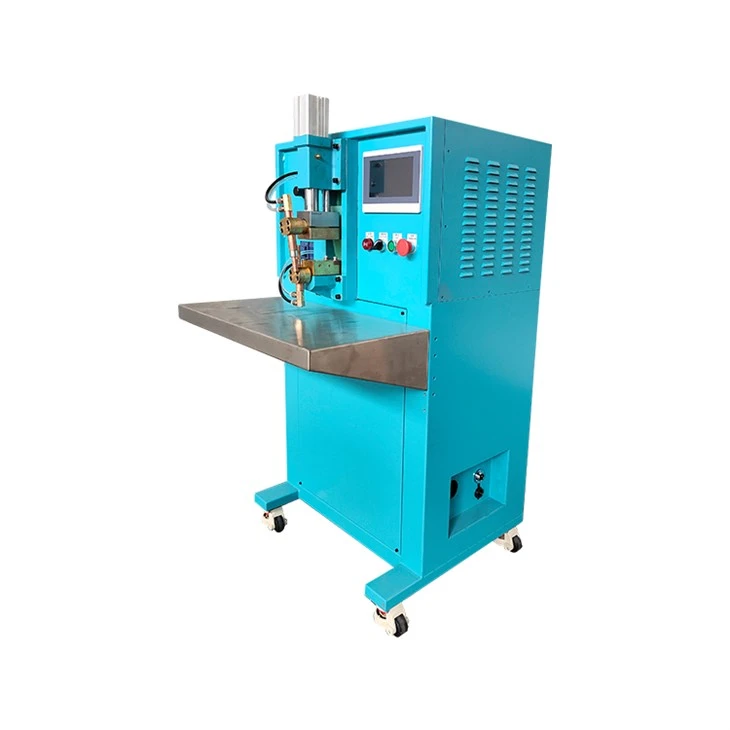

However, single - point spot welding machines do have their limitations. They're not the fastest option out there. If you have a large - scale production line where you need to make a lot of welds quickly, using a single - point welder can slow things down. Each weld takes time, and if you have to make hundreds or thousands of them, it can be a real bottleneck.
Now, let's move on to multi - point spot welding machines. These are like the superheroes of high - volume spot welding. Instead of making one weld at a time, they can create multiple weld points simultaneously. It's like using a stamp with multiple dots to make several marks on a piece of paper all at once.
The main advantage of multi - point spot welding machines is their speed. They can significantly increase the production rate. In industries like automotive manufacturing, where you need to join large sheets of metal together quickly, multi - point spot welders are a game - changer. They can make multiple welds in a fraction of the time it would take a single - point welder to do the same job.
Multi - point spot welders also offer better uniformity. Since all the welds are made at the same time, they tend to be more consistent in terms of quality and strength. This is important in applications where the structural integrity of the welded parts is critical.
But multi - point spot welding machines aren't without their drawbacks. They're more complex than single - point machines. Operating and maintaining them requires more specialized knowledge and skills. You also need to invest more in terms of cost. Not only are the machines themselves more expensive, but the setup and calibration can also be costly.
If you're in the market for a multi - point spot welding machine, we have some great options. Our Dual Head Spot Welding Machines are a popular choice. They offer the benefits of multi - point welding with a relatively more manageable level of complexity.
In addition to the basic differences between single - point and multi - point spot welding machines, there are also some technological advancements to consider. For example, our Intermediate Frequency Spot Welder combines the best of both worlds in some ways. It can be used as a single - point welder for precision work, but it also has the ability to be configured for more efficient multi - point welding in certain applications. This type of welder uses intermediate frequency technology, which provides more stable and efficient power output, resulting in better weld quality and energy savings.
So, which one should you choose? Well, it really depends on your specific needs. If you're working on small - scale projects that require high precision and you're on a budget, a single - point spot welding machine might be the way to go. On the other hand, if you're in a high - volume production environment where speed and uniformity are key, a multi - point spot welding machine could be the better option.
If you're still not sure which type of spot welding machine is right for you, don't hesitate to reach out. We're here to help you make the best decision for your business. Whether you need more information, a product demonstration, or just some advice on which machine to choose, we're just a message away.
References
- Welding Handbook, American Welding Society
- Resistance Welding: Principles and Applications, John C. Lippold


