


Power consumption is a crucial factor to consider when evaluating the efficiency and cost - effectiveness of industrial equipment, especially for a servo - motorized welder. As a supplier of servo - motorized welders, I've had numerous discussions with customers about the power consumption of these machines. In this blog, I'll delve into the key aspects that influence the power consumption of a servo - motorized welder and provide insights to help you make informed decisions.
Understanding Servo - Motorized Welders
Servo - motorized welders are advanced welding machines that utilize servo motors to control the movement and force during the welding process. These motors offer precise control, high speed, and excellent repeatability, making them ideal for a wide range of welding applications, from automotive manufacturing to electronics production.
The servo motors in these welders are designed to provide the necessary force and movement to bring the welding electrodes into contact with the workpiece and maintain the correct pressure during the welding cycle. This precise control ensures consistent weld quality and reduces the risk of defects.
Factors Affecting Power Consumption
1. Welding Current and Voltage
The welding current and voltage are the primary factors that determine the power consumption of a servo - motorized welder. According to Ohm's law (P = VI, where P is power, V is voltage, and I is current), an increase in either the current or the voltage will result in a higher power consumption.
In a servo - motorized welder, the welding current is adjusted based on the thickness and type of the workpiece. Thicker workpieces generally require higher welding currents to achieve proper fusion. For example, when welding a 5 - mm thick steel plate, a higher current may be needed compared to a 1 - mm thick plate. Similarly, the welding voltage also plays a role in determining the power. Higher voltages are typically used for longer welding arcs, which can be necessary for certain welding processes.
2. Duty Cycle
The duty cycle of a welder refers to the percentage of time that the welder can operate continuously within a 10 - minute period without overheating. A welder with a high duty cycle can operate for longer periods without interruption, but it also consumes more power.
For instance, a welder with a 60% duty cycle can operate for 6 minutes out of every 10 - minute period. If you need to perform continuous welding operations, a welder with a higher duty cycle may be required, but you should be aware that it will consume more power.
3. Servo Motor Efficiency
The efficiency of the servo motors used in the welder also affects power consumption. High - efficiency servo motors convert a larger percentage of the electrical energy they consume into mechanical energy, resulting in lower power consumption.
Modern servo motors are designed with advanced technologies such as permanent - magnet synchronous motors (PMSMs), which offer higher efficiency compared to traditional motors. When choosing a servo - motorized welder, it's important to consider the efficiency rating of the servo motors to minimize power consumption.
4. Welding Frequency
In some welding processes, such as resistance welding, the welding frequency can also impact power consumption. Higher welding frequencies generally require more power, as the welder needs to supply more energy in a shorter period of time.
For example, in Resistance Seam Welding Machine, the welding frequency can be adjusted to optimize the welding process. However, increasing the frequency may lead to an increase in power consumption.
Measuring Power Consumption
To accurately measure the power consumption of a servo - motorized welder, you can use a power meter. A power meter can measure the real - time power consumption of the welder, allowing you to monitor and analyze the energy usage.
When measuring the power consumption, it's important to consider the different operating conditions of the welder. For example, you can measure the power consumption during idle, welding, and standby modes. This will give you a comprehensive understanding of the energy usage of the welder under various scenarios.
Strategies to Reduce Power Consumption
1. Optimize Welding Parameters
By optimizing the welding current, voltage, and frequency, you can reduce the power consumption of the welder without compromising the weld quality. Work with a welding engineer or technician to determine the optimal welding parameters for your specific application.

2. Use High - Efficiency Servo Motors
As mentioned earlier, high - efficiency servo motors can significantly reduce power consumption. When purchasing a servo - motorized welder, look for models that are equipped with high - efficiency servo motors.
3. Manage Duty Cycle
Avoid overloading the welder by operating it within its specified duty cycle. If you need to perform continuous welding operations, consider using multiple welders or a welder with a higher duty cycle. This will prevent the welder from overheating and reduce unnecessary power consumption.
Comparing Power Consumption with Other Welders
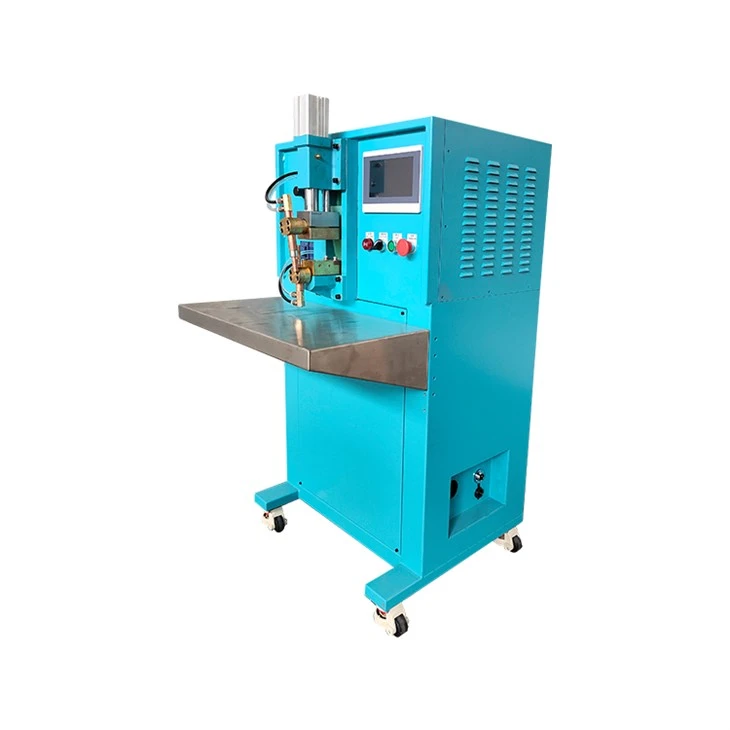
Compared to traditional welders, servo - motorized welders generally offer better power efficiency due to their precise control and high - efficiency servo motors. For example, in Nuts Studs Welder and Conveyor and Bench Spot Welder, servo - motorized versions can achieve more consistent welds with less power consumption.
Traditional welders may require more power to achieve the same level of weld quality, as they may have less precise control over the welding process. Additionally, servo - motorized welders can be programmed to adjust the power consumption based on the specific requirements of the welding task, further improving energy efficiency.
Conclusion
The power consumption of a servo - motorized welder is influenced by several factors, including welding current, voltage, duty cycle, servo motor efficiency, and welding frequency. By understanding these factors and implementing strategies to reduce power consumption, you can optimize the energy usage of your welder and save on operating costs.
As a supplier of servo - motorized welders, we are committed to providing high - quality, energy - efficient welding solutions. If you are interested in learning more about our products or have any questions regarding power consumption, please feel free to contact us for a detailed discussion and potential procurement. We look forward to helping you find the best welding solution for your needs.
References
- Ohm, Georg Simon. "Die galvanische Kette, mathematisch bearbeitet." (1827).
- Welding Handbook, American Welding Society.


