

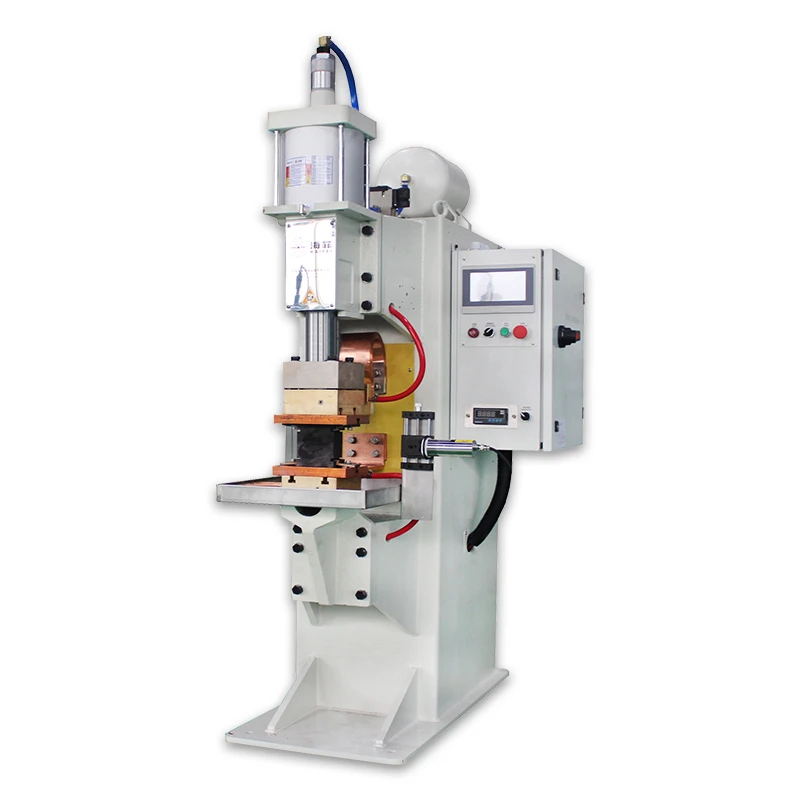

Machine Overview
| Item | Details |
|---|---|
| Model | HFTD-100-Q |
| Rated capacity | 100 KVA |
| Pressure system | Pneumatic |
| Welding method | Resistance-heated pressure bonding |
| Typical workpieces | Copper foil stacks, flexible copper busbars and copper braid ends |
| Reference welding size | Up to 40 × 40 × 10 mm, subject to workpiece evaluation |
| Control | Programmable microcomputer controller |
| Cooling | Water cooling |
| Machine selection | Drawing review and sample welding |
Products Description

A pneumatic pressure system can be considered when the copper part has a relatively small bonding area and does not require the higher force range of a hydraulic machine.
The HFTD-100-Q may be suitable when:
- The bonding area is within the machine and tooling range
- The foil stack or copper conductor does not require hydraulic-level pressure
- The required production cycle matches the 50% rated duty cycle
- The factory can provide stable compressed air
- The workpiece can be positioned within the available throat depth
- The required terminal dimensions can be controlled with dedicated tooling
For larger bonding areas, thicker copper stacks, higher pressure requirements or continuous-duty production, a hydraulic model may be more appropriate.
A drawing and sample evaluation should be completed before the final machine is selected.
What Copper Parts Can Be Processed?
Laminated Copper Foil Terminals
Multiple copper foils can be stacked and consolidated at one or both ends. The welded area forms a compact terminal, while the unwelded section remains flexible.Two foil stacks with the same total thickness may require different settings if their individual foil thicknesses and layer quantities are different.
Small Flexible Copper Busbars
The machine can be evaluated for smaller flexible busbars used in battery modules, power-distribution systems and electrical assemblies.
The workpiece width alone cannot determine whether 100 KVA is sufficient. Bonding area, material structure, interface quantity and pressure requirement must be considered together.
Copper Braid Ends
Copper braids can be consolidated into compact terminals for later drilling, punching or assembly. Because braided conductors can spread during compression, the tooling must hold the strands while protecting the flexible section.
Bare copper and plated copper braids should be tested separately because their surfaces can respond differently during heating and compression.
Small Copper Conductive Components
Small copper terminals, copper plates and other conductive components can also be evaluated when their joint area, geometry and tooling access are within the machine range.
Copper-aluminum assemblies should not be assumed suitable for this machine without a separate process evaluation.


Main Machine Features
Pneumatic Pressure System
The pneumatic system applies controlled force during heating and holding. It offers a relatively simple structure for smaller copper parts that do not require the pressure capacity of a hydraulic machine.
Stable factory air pressure is necessary for repeatable operation.
100 KVA Heating Capacity
The medium-frequency heating system supplies controlled current to the joint area. The available capacity is intended for smaller copper conductors within the confirmed process range.
The correct machine cannot be selected from KVA alone. The heating circuit, tooling and copper structure must be evaluated together.
Programmable Process Control
The controller manages heating time, holding time and the welding sequence. Approved settings can be used for repeat production of the same copper part.
When several products are processed, their tooling and parameters should be identified separately.
Dedicated Copper Tooling
The tooling is designed around the bonding area, finished terminal dimensions and loading direction. Correct tooling helps distribute pressure, position the layers and control deformation.
Tooling design is especially important for thin foils and braided conductors.
Water-Cooled System
Water cooling helps control the operating temperature of the transformer, current-carrying components and tooling during repeated production.
Cooling-water pressure, flow, filtration and temperature should meet the machine requirements.
Compact Working Structure
The 425 mm throat depth provides access for smaller copper parts and flexible conductor assemblies. The complete workpiece drawing should still be checked to confirm loading clearance.
How Is the Correct Machine Selected?
Before recommending the HFTD-100-Q, Haifei reviews the following information:
| Information required | Details to provide |
|---|---|
| Material | Copper grade, hardness and surface plating |
| Workpiece structure | Copper foil, braid, flexible busbar or solid component |
| Layer information | Single-layer thickness, number of layers and total thickness |
| Bonding dimensions | Joint length, width and required finished thickness |
| Workpiece dimensions | Overall length, width and loading direction |
| Quality requirements | Dimensions, pull force, bend performance or resistance limit |
| Production requirement | Quantity per shift and expected cycle time |
| Factory utilities | Voltage, frequency, compressed air and cooling water |
| Automation requirement | Manual loading or connection to other equipment |
Descriptions such as "small copper busbar" or "strong welding" are not sufficient for machine selection. Drawings, representative samples and measurable acceptance limits should be provided.
Why Work with Haifei?
For each project, the engineering review covers the workpiece structure, heating circuit, pressure requirement, tooling design, cooling conditions and acceptance criteria. The machine is not selected from the rated capacity alone.
Project support can include:
- Workpiece drawing review
- Sample welding
- Process evaluation
- Customized tooling
- Machine configuration
- Factory acceptance testing
- Installation guidance
- Operator training
- Remote technical support
Actual service scope is confirmed in the technical proposal and commercial quotation.
FAQ
Q: Is this machine pneumatic or hydraulic?
A: The HFTD-100-Q uses a pneumatic pressure system. It is intended for smaller copper parts and bonding areas that do not require the higher force range of a hydraulic machine.
Q: How do I know whether 100 KVA is sufficient?
A: The rating must be evaluated together with the copper grade, layer structure, bonding area, total thickness, tooling and required cycle time. A drawing review and sample welding are recommended before selection.
Q: What is the maximum welding size?
A: The reference maximum size is up to 40 × 40 × 10 mm. However, this does not mean every copper part within these dimensions can be processed. Material structure and acceptance requirements must also be checked.
Q: When should I choose a hydraulic model instead?
A: A hydraulic model may be more suitable when the workpiece has a larger bonding area, thicker copper stack, higher force requirement or production duty beyond the HFTD-100-Q range.
Q: Can it consolidate copper braid ends?
A: Yes, copper braid ends can be evaluated for consolidation. The braid cross-section, width, thickness, surface plating and required terminal dimensions should be provided.
Wuxi Haifei Intelligent Equipment Co., Limited is one of the leading manufacturers and suppliers of Pneumatic Copper Diffusion Welding Machine in China. With abundant experience, we warmly welcome you to buy advanced Pneumatic Copper Diffusion Welding Machine for sale here from our factory. Quality products and reasonable price are available.
Hot Tags: Pneumatic Copper Diffusion Welding Machine, China Pneumatic Copper Diffusion Welding Machine manufacturers, suppliers, factory, diffusion welding machine, diffusion welder for copper, Hydraulic Diffusion Welding Machine, , , diffusion welding machine price


