

HAIFEI developed this automatic spot welding machine for thin stainless steel heat exchanger plates and layered plate assemblies.
The equipment combines a numerically controlled automatic positioning system, localized resistance spot welding and a custom uniform-pressure fixture. It is designed to improve weld-position consistency while reducing plate warping, burn-through and surface damage.
Because plate thickness, corrugation and weld layout vary, the welding process and tooling are confirmed through tests using the customer's actual components.
Equipment Used in This Project
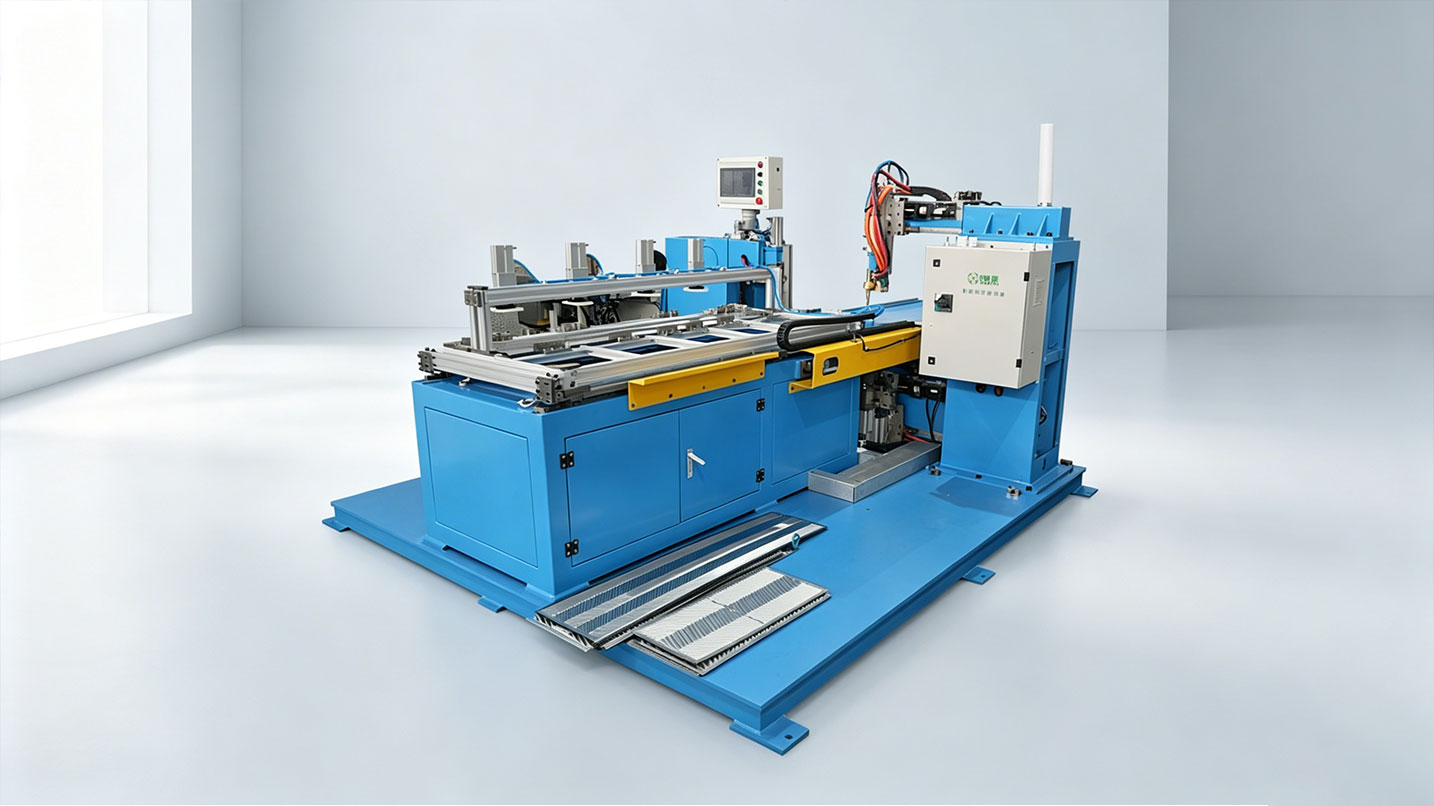
The equipment used in this project is an automatic spot welding machine developed specifically for heat exchanger plates.
It automatically moves to the specified welding positions and completes each weld according to the stored process settings. The dedicated fixture supports the thin stainless steel plate and maintains contact between the overlapping layers during welding.
| Project Item | Details |
| Equipment | Automatic spot welding machine |
| Workpiece | Thin stainless steel heat exchanger plates |
| Typical structure | Flat, formed or corrugated layered plates |
| Welding method | Resistance spot welding |
| Positioning | Numerically controlled automatic positioning |
| Tooling | Custom uniform-pressure support fixture |
| Main objective | Accurate weld distribution with controlled plate deformation |
| Process confirmation | Welding tests using customer components |
The machine's working range, power capacity, electrode arrangement and fixture structure are selected according to the actual heat exchanger plate.
Customer Background
The customer specializes in the development and batch production of plate heat exchangers, condenser components and industrial heat exchanger plates.
Its products use multiple thin stainless steel plates. Some plates have formed or corrugated surfaces that create the required spacing and flow channels after assembly.
The thin material supports effective heat transfer but has low structural rigidity before assembly. Changes in welding heat, electrode force or plate positioning can affect the plate shape, weld distribution and spacing between layers.
The customer therefore needed an automatic welding system that could position multiple weld points consistently while limiting heat-related deformation.
Problems with the Previous Welding Process
Warping and Local Plate Collapse
The thin stainless steel plates were sensitive to welding heat. A large heat-affected area could cause warping, bulging or local collapse.
Inconsistent Weld Positions
Manual positioning produced differences in weld spacing and distribution. Offset or missed welds affected the consistency of the assembled plate structure.
Burn-Through and Small Holes
Excessive heat input could produce burn-through, pinholes or oxidation cracks in thin areas of the plate.
Uneven Weld Formation
Changes in electrode contact, welding current or pressure resulted in differences in weld appearance and joint formation. Some positions could be insufficiently welded, while others received excessive heat.
Surface Damage
Spatter, oxidation and visible burn marks affected the stainless steel surface and increased subsequent inspection or finishing work.
No Practical Parameter Management
The previous process did not provide stable parameter storage and traceability. Welding settings had to be readjusted when production changed to another plate specification.
What Did the Customer Require?
The customer required a welding system that could:
- Automatically locate each specified weld.
- Maintain uniform weld spacing and distribution.
- Reduce positioning differences caused by manual operation.
- Control heat input on thin stainless steel plates.
- Reduce warping, bulging and local collapse.
- Improve weld formation and reduce incomplete welds.
- Limit burn-through, pinholes, cracks and surface damage.
- Support compatible plate specifications.
- Store welding programs and process settings.
- Maintain stable operation during batch production.
The machine, fixture and welding process therefore had to be developed as one complete solution.
HAIFEI's Customized Solution
Welding Trials for Different Plate Structures
HAIFEI first carried out welding trials using representative customer parts.
Different plate thicknesses and corrugated structures were tested because the same current, welding time and electrode pressure cannot be used for every heat exchanger plate.
The testing considered:
- Stainless steel grade
- Individual plate thickness
- Number of overlapping layers
- Corrugation and formed features
- Electrode contact area
- Welding current
- Welding time
- Electrode force
- Weld spacing
- Plate deformation
- Weld appearance and strength
The results were used to determine a suitable process range before the machine and fixture were finalized.
Numerically Controlled Automatic Positioning
The automatic positioning system moves the welding head or workpiece to the weld locations defined by the component drawing.
This replaces repeated manual alignment and helps maintain the required weld pattern across the plate.
Automatic positioning reduces:
- Offset welds
- Irregular weld spacing
- Missed weld locations
- Differences between operators
- Repeated manual measurement
Compatible weld-position programs can be stored in the control system and selected during model changeover.
Controlled Resistance Spot Welding
The machine applies resistance heat only at each specified welding position. Welding current, welding time and electrode force are adjusted together according to the plate structure.
For thin stainless steel, increasing the current alone can cause burn-through, excessive indentation or surface oxidation. HAIFEI therefore confirms the parameters through sample welding instead of selecting them from thickness alone.
The welding sequence can also be arranged to avoid concentrating too much heat or stress in one section of the plate.
Custom Uniform-Pressure Fixture
The fixture is an important part of the heat exchanger plate welding process.
If a thin or corrugated plate is not properly supported, electrode force can cause local collapse. Uneven support can also leave gaps between the plate layers.
HAIFEI developed a custom fixture that applies flexible, uniform pressure and supports the plate over the required area.
The fixture is used to:
- Position the plate from repeatable reference points
- Support thin and formed areas
- Maintain contact between overlapping layers
- Distribute pressure more evenly
- Reduce movement during welding
- Limit local plate collapse
- Disperse welding stress
- Preserve the required plate shape and spacing
The fixture contact surface is developed from the customer's plate profile and corrugation.
Program Storage and Model Changeover
Weld locations and process parameters can be stored for compatible plate specifications.
When changing production, the operator selects the corresponding program and installs the required locating or supporting tooling.
Whether several plate models can use the same fixture depends on their dimensions, corrugation, weld positions and support requirements.
Recommended Quality Checks
A heat exchanger plate should not be accepted based only on weld appearance.
| Inspection Item | Purpose |
| Weld position | Confirm that each weld matches the drawing |
| Weld count | Check whether any weld positions were missed |
| Weld appearance | Identify spatter, cracks, burn marks and excessive indentation |
| Plate flatness | Check warping, bulging and local collapse |
| Layer spacing | Confirm that the specified plate geometry is maintained |
| Destructive sample test | Evaluate weld formation and joint strength |
| Cross-section inspection | Check internal weld quality at selected positions |
| Pressure or leakage test | Verify sealing performance when required by the product design |
| Continuous production trial | Confirm stability over repeated cycles |
Spot welding should not automatically be described as providing complete heat exchanger sealing. Pressure or leakage performance must be verified according to the customer's finished-product standard.
FAQ
Q: What equipment is used in this heat exchanger plate welding solution?
A: The project uses an automatic resistance spot welding machine with a numerically controlled positioning system and a custom uniform-pressure fixture.
Q: Are all plate heat exchangers manufactured by spot welding?
A: No. Different heat exchanger designs may use gaskets, brazing, laser welding or other joining processes. Spot welding is suitable only where localized resistance welds are specified.
Q: Can the machine weld corrugated stainless steel plates?
A: Corrugated plates can be evaluated. The fixture must match the formed profile and support the workpiece without flattening the required channel structure.
Q: How does the system reduce deformation?
A: The system controls welding current, time, electrode force and weld sequence. The custom fixture supports the plate and distributes pressure and welding stress more evenly.
Q: Can spot welding prevent leakage?
A: Correct spot welds can reduce leakage risk where those welds form part of the designed joint. The finished assembly must still pass the customer's specified pressure or leakage test.