

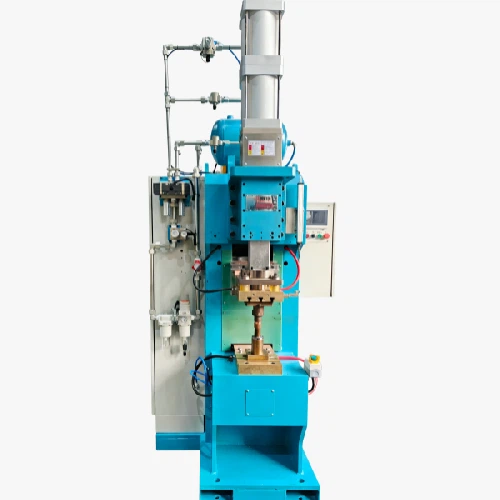
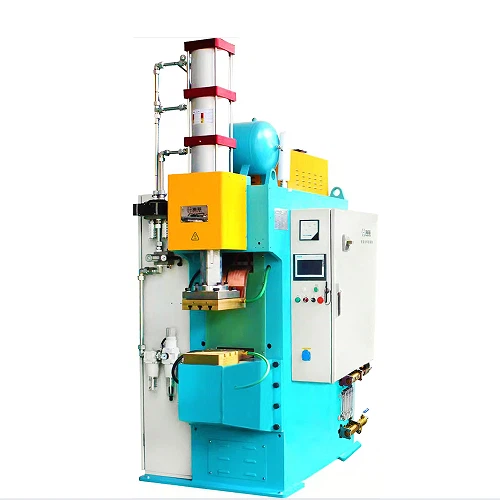
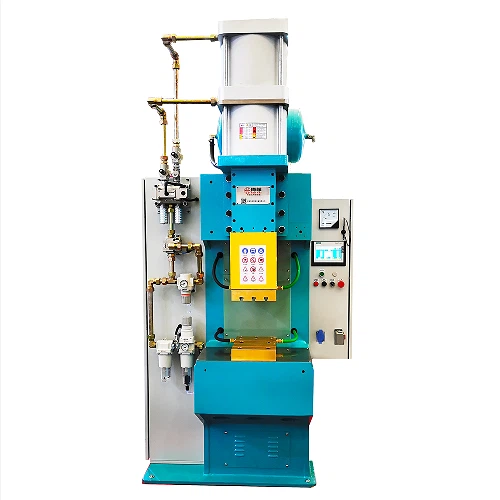
Product Introduction
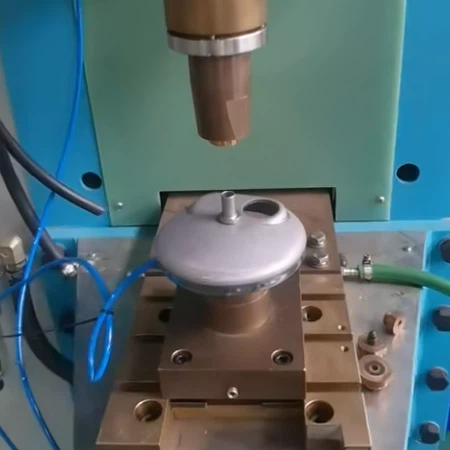
This Capacitor Discharge Spot Welder for Three-Way Catalytic Converters is designed for spot welding and projection welding applications in automotive exhaust system manufacturing. It is especially suitable for welding brackets, hangers, reinforcement plates, mounting seats, nuts, studs, and other small metal parts used around three-way catalytic converters.
During the production of exhaust pipes and catalytic converter assemblies, many welded components must have stable joint strength, low heat distortion, and consistent welding quality in batch production. A capacitor discharge spot welder releases high current within a short time, allowing the weld area to form quickly with concentrated heat input. This makes it suitable for stainless steel sheet parts, projection welding parts, and automotive exhaust components.
The machine can be configured according to the customer's workpiece structure, material thickness, welding position, projection design, and strength requirements. Dedicated electrodes, positioning fixtures, and welding parameters can also be customized to support sample testing and mass production.


Why Use a Capacitor Discharge Spot Welder for Three-Way Catalytic Converters?
Short-Time High-Current Discharge for Fast Automotive Parts Welding
A capacitor discharge spot welder uses stored capacitor energy and releases high current within a short time. This allows the weld nugget to form quickly at the welding area.
For catalytic converter brackets, exhaust pipe hangers, reinforcement plates, nuts, and other small automotive components, this welding method helps improve welding speed and meet the needs of batch production.
Concentrated Heat Input to Reduce Distortion of Thin Stainless Steel Parts
Automotive exhaust pipes and external catalytic converter parts are often made of thin stainless steel sheets. These parts are sensitive to heat and may deform during welding if heat input is not properly controlled.
Capacitor discharge welding has a short discharge time, so the heat is mainly concentrated in the weld area. This helps reduce overall heat input to the workpiece and lowers the risk of distortion, burn-through, and poor surface appearance.
Suitable for Projection Welding Structures
Nuts, studs, bracket projections, and reinforcement plate projections are common in catalytic converter and exhaust system parts.
Capacitor discharge projection welding allows the current to concentrate at the projection points, causing the projections to melt rapidly and form a stable joint. Compared with conventional spot welding, projection welding helps control weld position and weld formation more effectively, which is important for high-volume automotive parts production.
Stable Weld Strength for Vibration Conditions
Exhaust systems operate under high temperature, vibration, and impact. The weld strength of brackets, hangers, and mounting parts directly affects the reliability of the final product.
By adjusting welding energy, electrode pressure, electrode structure, and fixture positioning, the capacitor discharge spot welder can help achieve repeatable weld quality and support customer requirements for tensile tests, torque tests, vibration tests, or fatigue tests.
Suitable Materials and Workpiece Types
This capacitor discharge spot welder can be used for welding a variety of metal parts in automotive exhaust system manufacturing. Common materials include stainless steel, low-carbon steel, coated steel sheets, and selected automotive structural materials.
For three-way catalytic converter and exhaust pipe applications, typical workpieces include:
1
Thin stainless steel sheet parts
2
Exhaust pipe connecting parts
3
External catalytic converter accessories
4
Automotive brackets
5
Hangers and hooks
6
Nut and stud projection welding parts
7
Small reinforcement plates
8
Positioning plates and mounting seats
For each project, the suitability of capacitor discharge spot welding should be confirmed based on material type, material thickness, projection structure, welding area, and required joint strength.
Typical Application Scenarios
Batch Welding of Catalytic Converter Brackets
This application is suitable for automotive parts manufacturers that need to weld catalytic converter brackets and exhaust pipe connecting brackets in volume production. With fixture positioning and stable discharge control, the machine helps improve weld consistency and reduce operator-dependent variation.
Exhaust System Hanger and Hook Welding
The machine can be used for welding exhaust pipe hangers, hooks, lugs, and other suspension components. The welded parts can then be used for exhaust system assembly, providing support and vibration reduction.
Nut and Mounting Seat Projection Welding
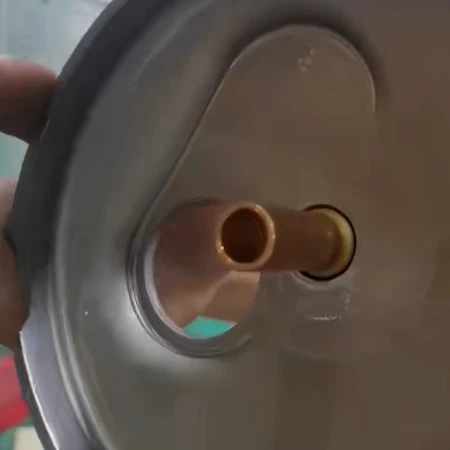
This application is suitable for projection welding of mounting nuts, fixing nuts, studs, and connecting seats used in exhaust systems. With proper positioning, the machine helps keep the nut position accurate and reduces the risk of misalignment or weak welding.
Thin Stainless Steel Reinforcement Plate Welding
The machine is suitable for welding local reinforcement structures on exhaust pipes or catalytic converter housings. With low heat input and short welding time, it is suitable for thin-wall parts where distortion control is important.
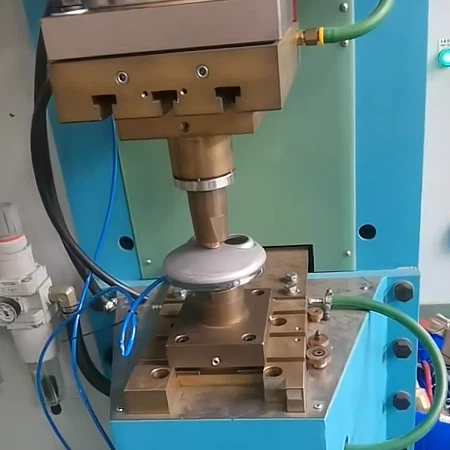
Information Needed for Welding Evaluation
To help evaluate whether the machine is suitable for your specific workpiece and to recommend a proper welding solution, please provide the following information.
Workpiece Material and Thickness
Please provide the material type and thickness of the catalytic converter housing, exhaust pipe, bracket, hanger, reinforcement plate, nut, or stud.
01
Welding Position and Product Drawing
Product drawings, welding position photos, or sample images help us evaluate electrode direction, fixture design, and operation method.
02
Projection Size and
Welding Area
For projection welding applications, please provide the number of projections, projection height, projection diameter, projection position, and welding contact area.
03
Weld Strength
Requirements
Please share the required testing standards, such as tensile test, torque test, peel test, vibration test, fatigue test, or any internal quality requirements.
04
Production Capacity and Automation Requirements
Please confirm whether the project is for sample testing, small-batch production, or automated mass production. This helps us recommend the right machine configuration and fixture solution.
05
Specification and Parameters
| Items \ Model | unit | HFTR-45000 |
| Capacitor volume | uf | 90000 |
| Power supply | KVA/V/Hz | 100/380/50 |
| Rated duty cycle | % | 50% |
| Primary current Max. | A | 120 |
| Primary cable | mm2 | 3*35+2*10 |
| Short-circuit current Max. | KA | 120 |
| Secondary voltage | V | 22-25 |
| Air pressure cylinder | Ø*L | Ø320*150 |
| Working pressure Max. (0.5/10.5MPa) | KN | 40 |
| Working environment | temperature: 1~45℃ humidity: 35~90% |
Products Description
Certifications
40+ Patents and 2 National Software Copyrights, 10,000㎡ Factory with 100+ skilled employees.

Invention Patent Certificate

Design patent certificate

Utility Model Patent Certificate

Utility Model Patent Certificate

CE certificate for polymer diffusion welding machine

CE certificate for diffusion welding machine
Our Partners
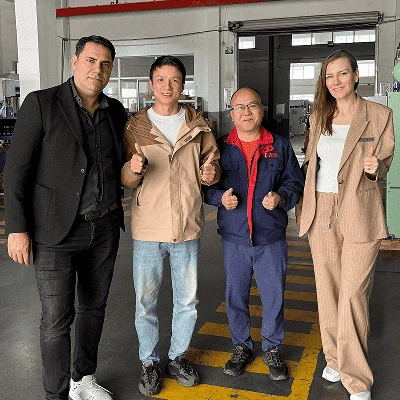
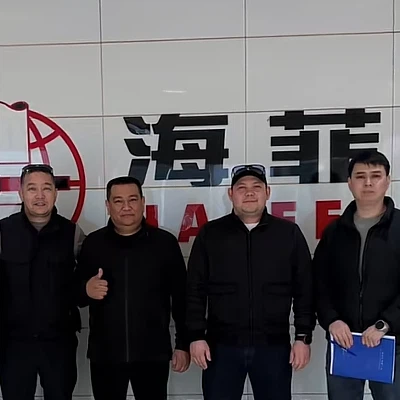
We have served over 3,300 customers worldwide, and our long-term partners include Tesla, BYD, and Siemens.Over 40+ Fortune 500 companies.


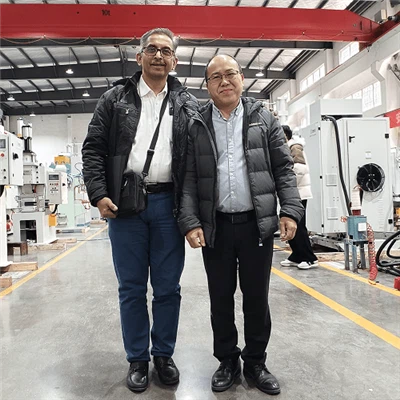
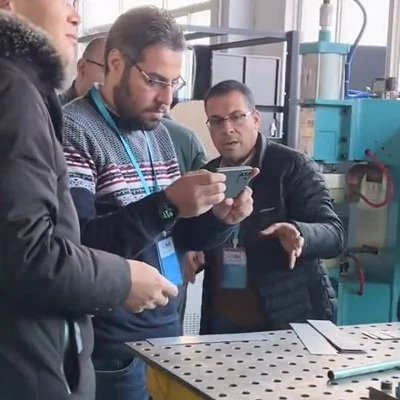
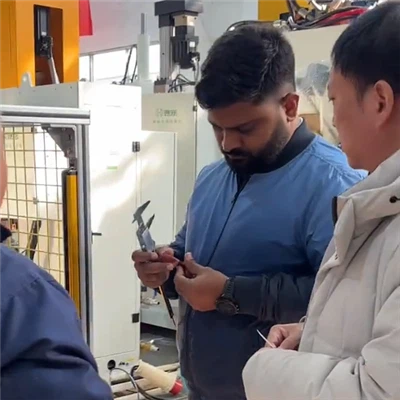
Haifei Customer Site





Advantages of Haifei Capacitor Discharge Spot Welding Solutions
Sample Welding Test Support
Customers can provide catalytic converter brackets, exhaust pipe hangers, nuts, reinforcement plates, or other sample parts. Haifei can assist with welding tests to confirm welding parameters, joint strength, and workpiece deformation.
Fixture Customization Based on Workpieces
Automotive exhaust pipe and catalytic converter parts often have complex shapes and irregular welding angles. Haifei can design dedicated positioning fixtures based on customer samples or drawings to improve welding stability and production efficiency.
Suitable for Automotive Parts Mass Production
The capacitor discharge spot welder offers fast welding speed and stable weld consistency, making it suitable for continuous production of automotive brackets, hangers, nuts, reinforcement parts, and other small exhaust system components.
Expandable Automation Solutions
According to the customer's production cycle time and factory layout, the machine can be combined with automatic feeding, rotary fixtures, robotic handling, and inspection devices to build a customized automotive parts welding solution.
FAQ
Q1: Can this machine weld three-way catalytic converter housings?
A: It can be used for welding brackets, reinforcement plates, hangers, nuts, and small mounting parts around the catalytic converter housing. For full housing seam welding, other welding processes such as seam welding, arc welding, laser welding, or robotic welding may be required depending on the product structure. The final process should be confirmed based on actual samples.
Q2: Is this machine suitable for stainless steel exhaust pipe parts?
A: Yes. It is suitable for selected stainless steel exhaust pipe accessories, such as brackets, hangers, reinforcement plates, mounting seats, and projection welding parts. Since many exhaust components are thin-wall structures, sample welding is recommended to confirm weld strength and distortion control.
Q3: Can it be used for nut projection welding?
A: Yes. The machine is suitable for nut, stud, and projection part welding. With proper electrodes and positioning fixtures, it can help maintain accurate nut position and improve welding consistency.
Q4: Is weld strength testing required after welding?
A: Yes, it is recommended. Automotive exhaust systems are exposed to heat, vibration, and impact during operation. Welded parts are often tested by tensile, torque, peel, vibration, or fatigue testing according to the customer's product standards.
Q5: Can the machine be customized for our workpiece?
A: Yes. Haifei can customize electrodes, fixtures, and automation solutions according to the customer's material, thickness, welding position, projection structure, and production capacity requirements. Sample welding tests can also be arranged before mass production.
Wuxi Haifei Intelligent Equipment Co., Limited is one of the leading manufacturers and suppliers of capacitor discharge spot welder for three-way catalytic converters in China. With abundant experience, we warmly welcome you to buy advanced capacitor discharge spot welder for three-way catalytic converters for sale here from our factory. Quality products and reasonable price are available.
Hot Tags: capacitor discharge spot welder for three-way catalytic converters, China capacitor discharge spot welder for three-way catalytic converters manufacturers, suppliers, factory, Capacitor Discharge Spot Welder For Three Way Catalytic Converters


