


In new energy batteries, photovoltaic energy storage systems, and high-current conductive connectors, multi-layer aluminum foil stacks are commonly used for current transmission, flexible connection, and conductive transition structures. Because aluminum foil is thin, layered, and prone to surface oxidation, poor control of temperature, pressure, holding time, or fixture clamping can easily lead to incomplete bonding, weak joints, or localized bonding defects between layers.
A servo polymer diffusion welding machine uses stable temperature control, servo pressure control, and holding pressure to create strong interlayer bonding without filler metal. For multi-layer aluminum foil stacks, preventing incomplete bonding is not simply a matter of increasing temperature or pressure. It requires control over surface preparation, stacking accuracy, process parameters, fixture design, and post-weld inspection.
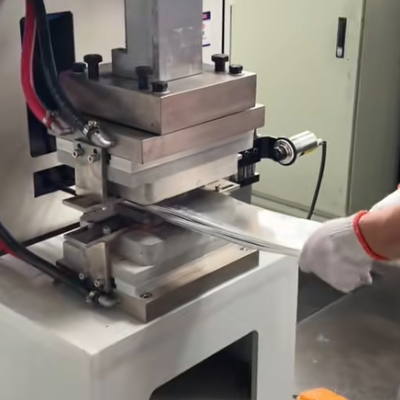
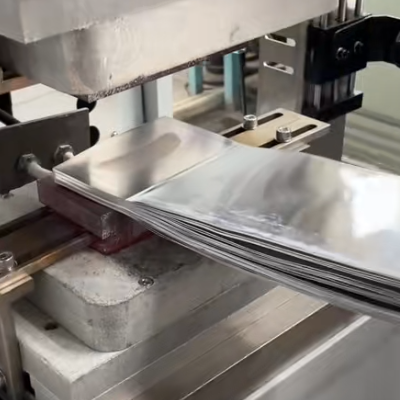
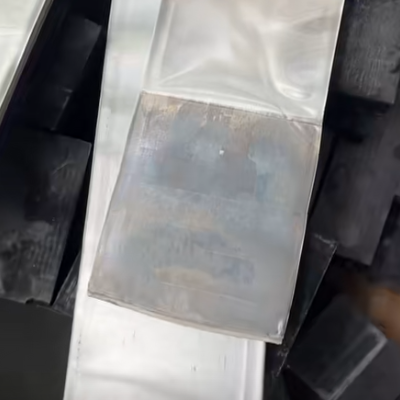
What Are the Signs and Risks of Incomplete Bonding?
Common Signs of Incomplete Bonding
Incomplete bonding in multi-layer aluminum foil stacks is often difficult to identify from the surface. In many cases, the welded area may appear properly pressed and shaped, with no obvious cracks or deformation, while the internal layers are not fully bonded.
Common signs include tiny gaps between layers, areas that are only pressed together but not bonded, good surface bonding with separation in the middle layers, blackened or oxidized spots in the weld area, or delamination during peel, tensile, or bending tests. For foil stacks with many layers, visual inspection alone is usually not enough to confirm whether the internal layers are fully bonded.
Problems Caused by Incomplete Bonding
Incomplete bonding first affects electrical conductivity. Multi-layer aluminum foil relies on sufficient interlayer bonding area to maintain stable current transmission. If unbonded areas remain inside the stack, the effective conductive area is reduced, contact resistance may increase, and localized heating may occur during operation.
Incomplete bonding also weakens the mechanical strength of the part. During assembly, bending, vibration, or long-term operation, poorly bonded layers may delaminate, crack, or break. For batteries, energy storage systems, and high-current connectors, these problems can increase rework and scrap costs, and may also affect product safety and service life.
Why Do Multi-Layer Aluminum Foil Stacks Develop Incomplete Bonding?
The Oxide Film on the Aluminum Foil Was Not Properly Removed
Aluminum naturally forms an oxide film on its surface, and oil, dust, fingerprints, and cutting residue can also reduce interlayer contact. When multiple aluminum foil layers are stacked, the surface condition of each layer affects the final welding result. If the oxide film and contaminants are not properly removed before welding, localized unbonded areas may occur even when the machine parameters appear to be within the set range.
In batch production, surface cleaning should be treated as a standard process rather than a temporary correction after defects appear. After cleaning, aluminum foil should not be exposed for a long time in humid or dusty environments. It should move to the welding process as soon as possible to reduce secondary oxidation.
Poor Cutting Accuracy Creates Gaps After Stacking
Burrs, curled edges, warping, or dimensional variation can create uneven contact after multiple aluminum foil layers are stacked. During welding, pressure is applied first to the higher areas, while lower areas may not be fully compressed, leading to incomplete bonding.
This issue is common during trial welding. The machine parameters may look normal, but unstable cutting and stacking accuracy can cause inconsistent results within the same batch. Some parts may pass inspection, while others show interlayer separation. For this reason, multi-layer aluminum foil welding should not focus only on the machine. Cutting, stacking, and positioning must also be included in the process control plan.
Temperature, Pressure, and Holding Time Are Not Properly Matched
Diffusion welding requires the combined effect of temperature, pressure, and time. If the temperature is too low or the holding time is too short, the middle layers may not receive enough heat or diffusion time, resulting in surface bonding while the inner layers remain unbonded. Insufficient pressure prevents micro-gaps between layers from closing, while excessive pressure may damage the aluminum foil, causing deformation, wrinkling, or edge cracking.
For multi-layer aluminum foil stacks, process parameters should not be copied directly from other materials or from thinner foil stacks with fewer layers. As the number of layers increases, heat transfer and pressure transmission change, so a suitable process window must be confirmed through trial welding.
Fixture Positioning or Machine Condition Is Unstable
Fixture wear, uneven pressing surfaces, poor positioning, or contamination on the equipment surface can affect pressure uniformity. Multi-layer aluminum foil is sensitive to flatness and clamping consistency. If part of the stack does not receive enough pressure, the surface may look properly pressed while the internal layers remain incompletely bonded.
A servo polymer diffusion welding machine must maintain stable temperature and pressure control, while fixtures also need regular inspection and cleaning. In batch production, worn or deformed fixtures can gradually reduce welding consistency and may eventually lead to batch defects.
How to Prevent Incomplete Bonding in Multi-Layer Aluminum Foil Welding?
Clean and Prepare the Foil Surface Before Welding
Before welding, the oxide film, oil, dust, and cutting residue on the aluminum foil surface should be removed. For parts with high conductivity requirements, the cleaning method should be selected according to the material condition, and welding should be performed soon after cleaning.
A pre-weld inspection standard is also recommended. This may include checking for surface discoloration, oil contamination, burrs, stacking direction, and dimensional consistency. The more stable the previous process is, the easier it is to maintain stable welding parameters.
Ensure Accurate Stacking and Pre-Pressing
When stacking multiple aluminum foil layers, each layer should be aligned properly. The welding area should be free from folds, warping, curled edges, or obvious misalignment. For stacks with many layers, pre-pressing can help the foil layers achieve better initial contact before the main welding process.
If too many layers are stacked at once and the middle layers repeatedly fail to bond, staged pressing or multi-step welding may be considered. Although this adds process steps, it can reduce the risk of insufficient internal heating, uneven pressure transmission, and excessive gaps between layers.
Optimize Temperature, Pressure, and Holding Time
Fast heating and fast cooling are generally not recommended for multi-layer aluminum foil welding. Depending on the number of layers, single-layer thickness, total thickness, and bonding area, a stepped heating process, stable holding stage, and controlled cooling process can help heat reach the middle layers more evenly.
Parameter adjustment should not rely only on experience. A better approach is to record temperature, pressure, holding time, displacement change, and inspection results during trial welding, then gradually establish a stable process window. This not only reduces incomplete bonding but also helps prevent foil damage, deformation, and excessive oxidation.
Use Dedicated Fixtures to Improve Clamping Consistency
Fixtures directly affect pressure transmission. Fixtures for multi-layer aluminum foil welding should have good flatness, positioning accuracy, and heat resistance. For large-area or high-layer-count foil stacks, dedicated fixtures should be designed according to the part size, bonding area, and positioning method.
A suitable fixture helps keep the foil layers aligned and reduces edge lifting and localized insufficient pressure. For parts with complex shapes, wide bonding areas, or many layers, fixture design is often more important than simply adjusting machine parameters.
Strengthen Post-Weld Inspection
Multi-layer aluminum foil parts should not be judged only by surface appearance. Peel testing, tensile testing, cross-section inspection, resistance testing, and powered heating tests can be used together to evaluate bonding quality.
Peel testing shows whether the layers are strongly bonded. Cross-section inspection helps identify gaps in the middle layers. Resistance and heating tests are especially useful for batteries, energy storage systems, and high-current connectors because they help evaluate electrical consistency.
What Should You Look for When Choosing a Servo Polymer Diffusion Welding Machine?
When selecting a diffusion welding machine, do not focus only on maximum pressure or maximum temperature. It is more important to check whether the machine can control the entire welding process in a stable and repeatable way. For multi-layer aluminum foil stacks, process stability, repeatability, and application adaptability are often more important than a single specification.
Stable Temperature Control
Multi-layer aluminum foil is sensitive to temperature uniformity. The machine should have a stable heating system and temperature feedback control to avoid overheating the outer layers while leaving the middle layers underheated. For parts with larger bonding areas, temperature uniformity across the heating zone should also be checked.
Precise Servo Pressure Control
The servo pressing system should provide stable pressurization, pressure holding, and pressure feedback. Thin aluminum foil stacks are sensitive to pressure. Too little pressure causes poor interlayer contact, while too much pressure can damage the material. Pressure accuracy and repeatability should therefore be key factors when choosing the machine.
Displacement Monitoring and Process Data Recording
If the machine can record temperature, pressure, time, and displacement curves, welding quality becomes easier to trace. When incomplete bonding occurs, process data can help determine whether the issue is caused by pressure fluctuation, abnormal temperature, or inconsistent displacement, instead of relying only on repeated trial and error.
Fixture Customization and Sample Welding Support
Different aluminum foil stacks vary in layer count, thickness, bonding area, and positioning method. A standard fixture cannot cover every application. Before purchasing equipment, it is important to confirm whether the supplier can provide dedicated fixture design and sample welding support.
Sample welding helps determine whether the material is suitable for diffusion welding and allows the process window, fixture design, and machine configuration to be confirmed in advance. For batch production, thorough trial welding reduces the risk of incomplete bonding and rework later.
What Information Should Be Provided Before Inquiry or Sample Welding?
To help the equipment supplier evaluate the machine configuration and process feasibility more accurately, customers are advised to prepare the following information before discussing a servo polymer diffusion welding machine:
| Information Type | Details to Provide |
|---|---|
| Material information | Aluminum foil grade, single-layer thickness, total number of layers, total thickness |
| Part size | Welding length, width, bonding area, and whether full-surface bonding is required |
| Product structure | Whether it is a pure aluminum foil stack or combined with copper or other materials |
| Quality requirements | Tensile strength, peel strength, resistance, appearance, or heating requirements |
| Production requirements | Cycle time, daily output, and whether automatic loading and unloading is required |
| Existing defects | Photos of incomplete bonding, cross-section images, and trial welding parameter records |
This information helps the equipment manufacturer identify the source of the problem and provide a more accurate machine configuration, fixture design, and process recommendation. If incomplete bonding has already occurred, providing defective samples or inspection results will make it easier to find the root cause.
Summary: Preventing Incomplete Bonding Requires Full Process Control, Not One Single Parameter
When a servo polymer diffusion welding machine is used for multi-layer aluminum foil stacks, incomplete bonding is rarely caused by only one factor. Aluminum oxide film, poor interlayer contact, uneven pressure transmission, insufficient temperature, short holding time, fixture wear, and improper operation can all lead to weak internal bonding.
Therefore, solving incomplete bonding should not depend only on raising the temperature or increasing pressure. Surface cleaning, stacking accuracy, fixture clamping, temperature-pressure curves, holding time, and post-weld inspection all need to be controlled together. For buyers selecting a diffusion welding machine, key points include temperature stability, servo pressure control, displacement monitoring, fixture customization, and sample welding support.
If your multi-layer aluminum foil stacks are experiencing incomplete bonding, weak joints, delamination, conductive heating, or unstable strength, start by preparing the material thickness, number of layers, bonding area, current parameters, and defect photos. A process evaluation and sample welding test can then help determine whether the problem comes from machine configuration, fixture design, material condition, or an unconfirmed process window, and make it easier to develop a welding solution suitable for batch production.
FAQ: Common Questions About Multi-Layer Aluminum Foil Diffusion Welding
Q: Is a servo polymer diffusion welding machine suitable for welding multi-layer aluminum foil?
A: Yes. Multi-layer aluminum foil requires stable temperature, pressure, and interlayer contact. A servo polymer diffusion welding machine can improve bonding consistency through controlled heating, pressure, and holding time. However, the final result should still be confirmed through sample welding based on material thickness, layer count, bonding area, and quality requirements.
Q: Why does the surface look bonded while the middle layers remain unbonded?
A: Common causes include insufficient heat reaching the middle layers, uneven pressure transmission, short holding time, or oxide film and contaminants between layers. Peel testing, cross-section inspection, and resistance testing are recommended to verify internal bonding quality.
Q: Is higher welding pressure always better?
A: No. Insufficient pressure leads to poor interlayer contact, while excessive pressure can damage or deform the aluminum foil. The correct pressure should be determined according to foil thickness, layer count, bonding area, and fixture structure, then verified through trial welding.
Q: How can you tell whether multi-layer aluminum foil is fully bonded?
A: Surface appearance alone is not enough. Peel testing, tensile testing, cross-section inspection, resistance testing, and powered heating tests should be used together. For conductive connectors, resistance stability and localized heating are especially important.
Please contact our engineers if you have any questions.


