

In the world of metal fabrication and automotive component manufacturing, the Energy Storage Welding Machine is renowned for its high power density, minimal heat-affected zone (HAZ), and low demand on the electrical grid. However, when it comes to "thick plate welding," many manufacturers hesitate: Can the energy penetrate deep enough? Will it overload the capacitors?
The reality is that an Energy Storage Welding Machine can excel at heavy-gauge welding, provided there is a perfect synergy between energy discharge density and mechanical rigidity. This guide breaks down the essential technical factors to help you optimize your process and avoid common pitfalls during equipment selection.
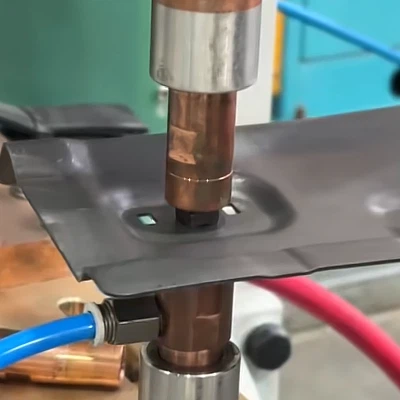


Electrode Selection and Force Regulation: The Foundation of Fusion
When welding thick plates, the stability of physical contact determines the distribution of resistive heat. Improper electrode choice often leads to surface "burn-through" or insufficient internal fusion.
Why Do Thick Plates Require Specialized Electrode Geometry?
Thick plate welding demands intense penetration. We recommend electrodes made of Chromium Zirconium Copper (CuCrZr) for their superior hardness and conductivity. In terms of shape, spherical electrodes or those with a large dome radius are preferred.
- Technical Rationale: A larger diameter increases the effective contact area, which helps disperse high pressure and prevents localized overheating that causes "expulsion" or spatter.
The Golden Ratio of Electrode Force
For thick plates, the electrode force must increase non-linearly with the material thickness.
- Practical Advice: Excessive force causes deep indentations and reduces structural integrity, while insufficient force leads to a spike in contact resistance. The ideal setup ensures the force reaches its peak before discharge and remains constant during the millisecond-long pulse to contain the rapid expansion of molten metal.
Parameter Optimization: The "High-Intensity, Short-Duration" Strategy
The core competitive advantage of an Energy Storage Welding Machine is its millisecond-level discharge speed. When welding steel plates 2mm (approx. 14 gauge) or thicker, the parameters must follow the "High Voltage, Short Time" principle.
The Energy Multiplier Rule
The energy required for thick plates is typically 1.5 to 3 times that of thin sheets.
- Data Reference: Typical discharge times range from 3ms to 10ms. This concentrated energy release ensures the heat stays at the interface rather than dissipating into the surrounding workpiece.
- Key Metric: Ensure the High-Power Energy Storage Welding Machine has a total Joule rating (Capacitance) sufficient for the required nugget diameter. If you encounter a "cold weld," prioritize increasing the charging voltage rather than blindly extending the discharge cycle.
Mitigating the Shunt Effect: A Must for Multi-Point Welding
In heavy-duty structural welding, the interference between adjacent welds-known as the Shunt Effect-is far more pronounced than in thin-gauge applications.
Managing Current Leakage
When two welds are placed too close together, the current "shunts" through the existing weld nugget. This starves the current point of the thermal energy needed for fusion, resulting in a weak joint.
The Solution:
1. Maintain Pitch: Keep the weld spacing at least 3 times the plate thickness.
2. Sequence Optimization: Use a symmetrical welding sequence, moving from the center outward, to minimize the inductive impact on the current flow.
Workpiece Cleaning and Surface Preparation
Thick plates, especially hot-rolled steel or coated materials, often carry heavy mill scale or rust-inhibitive oils that drastically increase contact resistance.
Why Cleanliness Is Non-Negotiable
Since the machine relies on a sudden burst of energy, any surface impurities can cause a violent "arc-over" during discharge. This creates massive spatter, damages electrode tips, and leaves unsightly pits.
- Professional Advice: For automotive-grade or structural components, ensure the metal shows a bright finish via polishing or sandblasting. This can extend electrode life by over 20% and ensure a consistent, high-strength bond.
System Cooling and Maintenance: Ensuring High-Duty Cycle Reliability
Heavy-gauge welding generates significant residual heat, placing extreme stress on the cooling architecture of the Energy Storage Welding Machine.
The Necessity of Closed-Loop Cooling
During thick plate operations, the transformer and electrode shunts heat up rapidly.
- Operational Standard: Cooling water must be maintained strictly between 5–30°C (41–86°F).
- Maintenance Check: If electrode tips begin to discolor (turning purple or black), it indicates a thermal failure. Scale buildup in the water lines must be cleared immediately to prevent the high-capacity capacitors from aging prematurely due to ambient heat soak.
Conclusion
Using an energy storage welding machine for thick plate welding requires technical precision and attention to detail. By selecting appropriate electrodes, optimizing parameters, avoiding shunting, emphasizing cleanliness, and maintaining equipment, welding strength and consistency can be significantly improved, while extending the machine's service life. Mastering these essentials ensures optimal performance of the energy storage welding machine in thick plate applications, supporting reliable industrial production.
The Energy Storage Welding Machine is not only capable of thick plate welding but often superior in terms of controlling distortion and surface aesthetics. Successful execution relies on three pillars: Sufficient Joule Capacity + Precise Pressure Control + Clean Interfacial Surfaces.


