


Thin stainless steel sheets are widely used in energy storage equipment housings, electrical enclosures, precision sheet metal parts, and new energy components. Stainless steel offers good corrosion resistance, strength, and a stable appearance, but it also has a common problem during spot welding: it can distort easily.
Many factories using a capacitor discharge spot welder for thin stainless steel sheets may encounter warping, raised edges, waviness around weld spots, excessive indentation, or assembly hole misalignment. These issues may look minor at first, but they can create serious problems in the next assembly step. For example, covers may not close properly, holes may not align, and flatness may fail inspection.
A capacitor discharge spot welder is suitable for thin sheet welding because it stores energy in capacitors and releases it quickly. The welding time is short, the heat is concentrated, and the overall heat-affected area is relatively small. However, this does not mean distortion can be avoided automatically. The final result still depends on how well the energy, pressure, fixture, electrodes, welding sequence, and cooling are controlled.
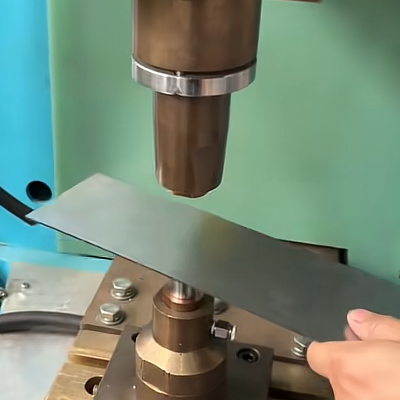
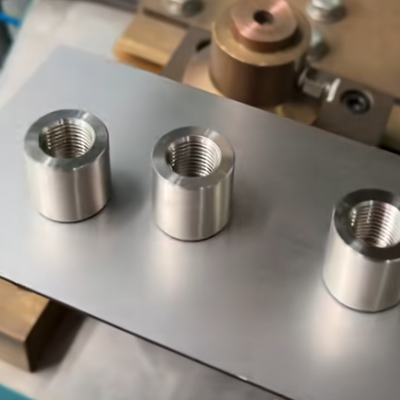
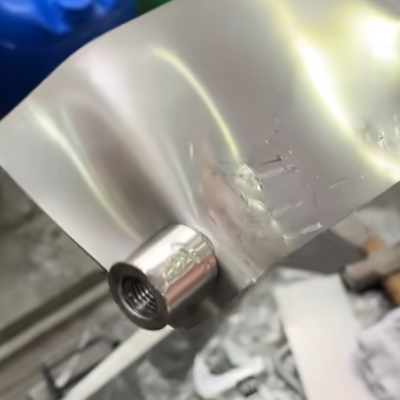
Why Does Thin Stainless Steel Distort After Spot Welding?
Stainless steel dissipates heat slowly, so heat stays near the weld area
Stainless steel has lower thermal conductivity than carbon steel, which means heat does not spread away as quickly during welding. For spot welding, concentrated heat helps form the weld, but if the energy is too high, the area around the weld spot heats up quickly and then shrinks unevenly during cooling.
Because thin sheets have low rigidity, this uneven shrinkage can easily cause warping or waviness.
Stainless steel expands noticeably when heated
Stainless steel expands when heated and contracts as it cools. Thick plates have more rigidity, so minor shrinkage may not be visible. Thin sheets are much easier to pull out of shape, so the thermal expansion and contraction around each weld spot can create visible distortion.
In many cases, distortion is not caused by a poor machine. It is caused by excessive heat input or insufficient restraint during welding.
Thin sheets are sensitive to fixtures, pressure, and electrode condition
When welding thin sheets, even a small gap or unstable clamping can allow the sheet to move during welding. If the electrode is not vertical, the electrode face is worn, or the pressure is uneven, the weld will receive uneven heat and force.
These issues may not be obvious on thicker materials, but they become much more noticeable on thin sheets. The result can be weld offset, uneven indentation, local dents, or overall warping.
Common Distortion Problems When Welding Thin Stainless Steel
Overall sheet warping
This is one of the most common issues. The area around the weld shrinks after heating and pulls the whole sheet out of shape. The larger and thinner the sheet is, and the weaker the fixture support is, the more obvious the warping becomes.
Waviness around the weld spots
If several weld spots are made continuously in the same area, heat can build up locally. After cooling, the sheet may show a wavy surface. This is especially noticeable on housings, panels, and visible sheet metal parts.
Deep indentation or local dents
Excessive electrode pressure, high energy, or a small electrode face can cause deep marks around the weld. For appearance parts, even if the weld strength is acceptable, deep indentation may still fail customer inspection.
Hole or edge misalignment
After thin sheet distortion, the most difficult issue is often assembly. Screw holes may shift, edges may become uneven, covers may not fit, or sealing surfaces may no longer sit flat. This is usually not caused by one weld spot alone, but by the overall heat and shrinkage during the welding process.
Main Causes of Distortion in Thin Stainless Steel Spot Welding
Welding energy is too high
A capacitor discharge spot welder forms the weld by releasing stored energy instantly. If the charging voltage or energy setting is too high, the weld area can overheat quickly. Thin stainless steel may soften, shrink, discolor, or form deep indentation.
Higher energy does not always mean a better weld. For thin sheets, the right parameter is the one that achieves enough weld strength while minimizing unnecessary heat.
Energy is too low, leading to rework welding
Some operators reduce the energy too much in an attempt to prevent distortion. This may reduce visible heat at first, but if the weld strength is not enough, the part may need to be welded again. Rewelding exposes the same area to repeated heat cycles and can cause even more distortion.
The goal is not simply to reduce energy. The goal is to make a qualified weld in one stable operation.
Electrode pressure is not suitable
If the pressure is too low, contact becomes unstable, which can cause spatter and local overheating. If the pressure is too high, the electrode may dent the thin sheet and leave a deep mark. For thin stainless steel, pressure and energy must be adjusted together.
The fixture does not hold the sheet firmly
Thin sheets should not be loose during welding. If there is a gap between the sheets, or if the fixture only holds the edge without supporting the weld area, the material may move during welding. After cooling, distortion becomes harder to control.
In many thin sheet welding projects, the fixture is just as important as the welding parameters.
The welding sequence is too concentrated
If multiple weld spots are made continuously from one side to the other, heat and shrinkage stress build up in one direction. This can pull the sheet out of shape. The problem is especially common with housings, long sheet parts, and large panels.
Electrodes are worn or cooling is insufficient
A worn electrode face creates uneven current and pressure distribution. Poor cooling causes the electrode temperature to rise, making the welding process less stable over time. Many distortion problems that look like parameter issues are actually related to electrode condition or cooling system maintenance.
How to Prepare Before Welding to Reduce Distortion?
Use a dedicated fixture to hold the thin sheet
Thin stainless steel should not be welded by hand holding or simple manual pressing. A dedicated fixture should be designed according to the part shape so the sheet stays flat and stable around the weld area.
A good fixture should position the part accurately, clamp it firmly, and allow easy loading and unloading. If the part has visible surfaces, the fixture should also avoid leaving pressure marks.
Control gaps between the sheets
Before welding, check whether the overlap area fits well. Look for raised edges, burrs, stamping springback, or assembly gaps. The larger the gap, the more likely the sheet will move during welding and distort after cooling.
For batch production, use locating pins, stops, and clamping structures to keep every part in the same position. Do not rely only on operator experience.
Clean the welding area
Oil, dust, oxide film, adhesive residue from protective film, and stamping lubricant can all affect welding contact. The weld area should be cleaned before welding. Light polishing or wiping may be needed in some cases.
If the sheet has coating or protective film, confirm that the weld area has been cleaned properly. Coating inside the weld area can lead to weak welds, spatter, and surface contamination.
Check the machine, electrodes, and water cooling system
Before production, confirm that the charging voltage is stable, the electrode faces are flat, the upper and lower electrodes are aligned, and the water cooling system is working properly. Thin sheet welding is very sensitive to electrode condition. A worn or uneven electrode can directly affect weld appearance and flatness.
How to Control Distortion During Welding?
Use short discharge time and stable energy
The reason a capacitor discharge spot welder works well for thin sheets is its short discharge time and concentrated heat. When parameters are set properly, the weld can be formed quickly while limiting overall heat input.
During setup, start with a lower energy level and increase gradually. Use pull testing, peel testing, or destructive testing to confirm weld strength. Do not judge the setting only by weld color or how visible the weld mark looks.
Set proper pressure, squeeze time, and hold time
Squeeze time allows the electrode and sheets to make stable contact before current flows. If squeeze time is too short, the instant discharge may cause spatter and local overheating. Hold time keeps the weld stable during the early cooling stage and helps reduce rapid stress release.
For thin stainless steel, record weld strength, indentation depth, and distortion under different pressure settings during sample testing. This helps identify a stable process window.
Use multi-pulse or staged discharge when needed
If a single discharge causes spatter or surface burn marks, multi-pulse or staged discharge can be evaluated. A smaller preheat pulse can improve contact, while the main pulse forms the weld.
However, more pulses do not always mean better results. If the total heat input becomes too high, distortion can still increase. The setup must be verified through sample welding.
Avoid welding too many spots continuously in one area
If the part has multiple weld spots, do not weld one local area continuously. Use symmetrical welding, segmented welding, or skip welding to distribute heat more evenly.
For housing parts, one practical method is to weld the center first and then weld both sides. Another method is to alternate left and right positions to avoid pulling the sheet in one direction.
Control welding rhythm to prevent heat buildup
A capacitor discharge spot welder can work quickly, but faster is not always better for thin sheets. If welding continues too quickly, the workpiece temperature rises gradually. Even if each individual weld setting is correct, overall distortion may increase.
For parts that distort easily, add short intervals between welds or use auxiliary heat-dissipation fixtures.
What to Do After Welding to Avoid Secondary Distortion
Do not release the fixture immediately
After welding, the weld spots and surrounding sheet are still warm. If the fixture is released immediately, residual stress may relax and cause new distortion.
For parts that require good flatness, keep the workpiece in the fixture for a short cooling period before removing it.
Avoid sudden forced cooling
Very thin stainless steel sheets should not be cooled suddenly with water or strong cold air. A large temperature difference may create new stress. In most cases, natural cooling or gentle assisted cooling is safer.
The best cooling method should depend on sheet thickness, surface requirements, and production cycle.
Minor distortion can be corrected with proper tools
If the part has only slight warping, it can be corrected with a dedicated flattening fixture or cold correction tool. Avoid hammering, twisting, or forcing the sheet by hand, as this can create new dents, scratches, or cracks.
If distortion is severe, the root cause is usually in the welding parameters, fixture, or welding sequence. The process should be adjusted instead of relying only on correction after welding.
Inspect flatness and weld quality
After welding, check flatness, weld position, indentation depth, spatter, discoloration, and weld strength. For energy storage housings, precision components, and appearance parts, first-piece inspection and routine sampling should be used.
Equipment Maintenance Also Helps Prevent Distortion
Check capacitor condition regularly
The energy stability of a capacitor discharge spot welder depends heavily on capacitor condition. If the capacitors are aging, the actual discharge energy may fluctuate. Thin sheet welding may then switch between weak welds and overheating.
Capacitor capacity, charging voltage stability, and discharge consistency should be checked regularly.
Maintain electrodes and the conductive circuit
Electrode faces should stay flat, clean, and aligned. If conductive busbars, cables, electrode holders, or output terminals become loose or oxidized, circuit resistance can increase and energy output may fluctuate.
These issues directly affect weld quality and can increase the risk of thin sheet distortion.
Keep the cooling system working properly
Water cooling lines should remain clear, and coolant should be replaced according to equipment requirements. Once electrode temperature rises, weld appearance and heat input become less stable.
A common production problem is that welding looks good at the beginning but distortion appears after the machine runs for a while. This is often related to electrode heating or insufficient cooling.
What to Check When Choosing a Capacitor Discharge Spot Welder for Thin Stainless Steel
Energy control must be stable
For thin stainless steel, maximum power is not the main point. The machine must allow stable and fine energy adjustment. It should support adjustment of charging voltage, discharge energy, pulse mode, and welding time based on sheet thickness and weld requirements.
If energy control is too rough, thin sheet welding may swing between weak welds and overheating.
Pressure control must be reliable
Thin sheets are sensitive to pressure. The machine should provide stable and adjustable pressure, and the electrodes should contact the workpiece vertically during welding. If pressure is unstable, even good energy settings will not deliver consistent results.
Electrodes and fixtures should be optimized for the actual part
Thin stainless steel parts vary in shape, weld position, and surface requirements. Proper electrode face design, locating fixtures, and clamping methods can significantly reduce distortion and indentation.
If a supplier only provides a standard machine without helping optimize electrodes and fixtures, flatness may be difficult to control during production.
The cooling system should support continuous production
During continuous production, electrodes and conductive parts keep heating up. The machine should have reliable electrode cooling, power component heat dissipation, and temperature protection to prevent weld quality drift over time.
Sample welding should be done before purchase
Different stainless steel thicknesses, surface conditions, and appearance requirements can produce very different welding results. Before buying a capacitor discharge spot welder, it is best to send real samples, drawings, and acceptance standards for testing. Sample welding helps confirm weld strength, indentation, spatter, flatness, and cycle time.
FAQ
Q: Is a capacitor discharge spot welder suitable for thin stainless steel?
A: Yes. A capacitor discharge spot welder has a short discharge time and relatively small heat-affected area, making it suitable for many thin stainless steel sheets and precision metal parts. The parameters, pressure, electrodes, and fixture must match the actual workpiece.
Q: Why does thin stainless steel warp after spot welding?
A: Thin stainless steel dissipates heat slowly and expands noticeably when heated. After local heating at the weld spot, uneven shrinkage occurs during cooling. If the fixture is weak or the energy is too high, warping is more likely.
Q: Can lowering welding energy prevent distortion?
A: Not always. If the energy is too low, the weld may be weak and require rework, which adds more heat and may increase distortion. The goal is to find the right energy and pressure so the weld is completed correctly the first time.
Q: Does welding sequence affect thin sheet distortion?
A: Yes. Welding many spots continuously in one area can create heat buildup. Symmetrical welding, segmented skip welding, and proper cooling intervals help distribute heat more evenly.
Conclusion
When welding thin stainless steel with a capacitor discharge spot welder, distortion cannot be solved simply by lowering energy. The real goal is to keep heat input, welding pressure, fixture restraint, electrode condition, welding sequence, and cooling stable.
When choosing a capacitor discharge spot welder or energy storage spot welding machine, do not focus only on maximum power or price. For thin sheet welding, pay closer attention to energy control precision, pressure stability, electrode and fixture customization, cooling system, protection functions, and sample welding results.
If you are dealing with thin stainless steel welding distortion, you can send Haifei your stainless steel grade, thickness, drawings, weld positions, appearance requirements, flatness standards, and production target. We can help evaluate a suitable capacitor discharge spot welder, fixture design, and automated spot welding solution for your application.


