

In modern industrial production, capacitor welding machine, with their unique characteristic of instantaneous high-current discharge, demonstrate exceptional welding efficiency and energy-saving advantages across various sectors, including electronics, automotive manufacturing, and hardware processing. These machines store electrical energy in capacitors and then release it rapidly to achieve quick heating and fusion of workpieces.
However, many operators often overlook the critical role of electrode pressure in the welding process. Improper electrode pressure settings, particularly excessive pressure, can directly impact weld nugget formation and strength, and may lead to a series of complex weld quality issues, thereby affecting the overall performance and reliability of the product.


This article will delve into the specific mechanisms by which high pressure influences the welding performance of CD welders and propose a systematic optimization strategy based on industry practices and scientific data. The aim is to help businesses enhance weld quality and maximize production efficiency.
Core Principle: How Does Pressure Affect Weld Quality?
During capacitor welding machine, electrode pressure is a crucial physical parameter connecting the workpiece to the electrode. It directly determines the contact resistance in the welding zone and the efficiency of heat transfer. Welding fundamentally relies on Joule heating (Q = I²Rt) to locally melt the workpiece and form a weld nugget.
In this process, current (I), resistance (R), and time (t) are the three core elements. Electrode pressure indirectly regulates heat generation and distribution by influencing contact resistance (R).
When the electrode applies appropriate pressure to the workpiece, it ensures good electrical contact between the workpieces and between the workpieces and the electrodes. This generates suitable contact resistance, allowing heat to accumulate rapidly upon current discharge to form a stable weld nugget. However, once the pressure deviates from the optimal range, this delicate balance is disrupted, leading to a decline in weld quality.
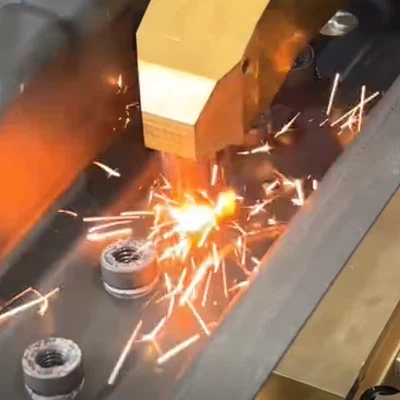
Four Major Negative Impacts of High Pressure on Weld Quality
Excessive electrode pressure does not always lead to better welding results. On the contrary, it can become a hidden killer of CD weld quality, leading to the following four typical categories of defects:
1. Reduced Weld Nugget Size and Decreased Strength
- Technical Mechanism: Excessive electrode pressure significantly increases the contact area between the electrode and the workpiece. According to Ohm's Law and Joule's Law, an increase in contact area leads to a reduction in current density (J) per unit area, while the total contact resistance (R) also decreases. Since welding heat is proportional to the square of the current and resistance (Q=I²R), the reduction in resistance directly diminishes heat generation in the welding zone. Insufficient heat prevents the workpiece from fully melting, resulting in a weld nugget size significantly smaller than expected. Research indicates that when electrode pressure exceeds the optimal range by 20%, the weld nugget diameter can shrink by 10% to 15%.
- Visible Symptoms: Welds appearas "undersized" or "under-penetrated." During tensile or shear tests, the joint strength may fail to meet design requirements, or even experience premature fracture, severely compromising the structural integrity and load-bearing capacity of the product.
2. "Cold Weld" Phenomenon and Joint Embrittlement
- Thermodynamic Principle: Under high-pressure conditions, the rate of heat transfer from the workpiece to the electrode accelerates. This effectively provides a more efficient heat dissipation path for the welding zone. Rapid heat dissipation prevents the core welding area from accumulating sufficient temperature for melting, causing the workpiece to cool and solidify before complete fusion. This phenomenon is known as "cold welding."
- Quality Indicators: Cold welds typically exhibit a rough, porous, "slag-like" appearance, with a non-dense internal microstructure and coarse grains. This leads to poor joint toughness and significantly reduced strength. In some applications, the shear strength can be reduced by 15% to 20% compared to normal welds.
3. Surface Defects and Expulsion
- Physical Causes: Excessive electrode pressure creates localized stress concentrations on the workpiece surface. When welding current passes through, the locally overheated metal, under immense pressure, is prone to plastic deformation and expulsion outwards, forming metal spatter (expulsion). Simultaneously, excessive pressure can leave noticeable indentations around the weld spot, affecting the product's aesthetic appeal.
- Surface Quality: Expulsion not only contaminates equipment and the working environment but can also form sharp burrs around the weld spot, impacting subsequent assembly and use. Deep indentations, on the other hand, weaken the effective thickness of the workpiece, creating stress concentration points and reducing fatigue strength. Industry standards generally consider an indentation depth exceeding 15% to 20% of the sheet thickness as a severe defect.
4. Reduced Equipment Lifespan and Increased Maintenance Costs
High pressure not only compromises weld quality but also accelerates the wear and tear of welding equipment. Electrodes subjected to excessive pressure experience greater mechanical stress, leading to faster deformation and wear of the electrode tips, requiring more frequent dressing or replacement. Furthermore, hydraulic or pneumatic pressure systems operating under prolonged heavy loads will experience accelerated wear of critical components such as seals and valves, increasing equipment failure rates and maintenance costs, thereby shortening the equipment's service life.
Systematic Optimization Strategies: Achieving the "Golden Ratio" of Pressure and Current
To overcome the negative impacts of high pressure and achieve optimal performance in CD welding, a scientific and systematic parameter management and optimization strategy is required.
1. Scientific Pressure Setting: Tailoring Pressure to Materials
Electrode pressure settings are not static; they should be finely adjusted based on the material type, thickness, and electrical conductivity of the workpiece. Below are some reference ranges based on practical experience:
| Material Type | Thickness Range (mm) | Recommended Pressure Range (N) | Typical Application Areas |
Remarks |
| Thin Materials (Low Carbon Steel) | < 0.5 | 500 - 1000 | Electronic Components, Precision Instruments | Prevents excessive compression and overly small weld nuggets |
| Medium-Thick Materials (Low Carbon Steel) | 0.5 - 1.5 | 1000 - 2000 | Automotive Parts, Hardware Components | Ensures good contact and prevents expulsion |
| Highly Conductive Materials (Copper, Aluminum) | 0.1-1.0 | 1500-2500 | Battery Connections, Conductive Parts | Requires simultaneous current increase to compensate for heat dissipation |
For highly conductive materials, due to their rapid heat dissipation, it is often necessary to apply higher electrode pressure than for less conductive materials of the same thickness to reduce contact resistance. Simultaneously, the welding current must be increased to ensure sufficient heat input. For instance, when welding copper, pressure may need to be increased by 20% to 30%, with a corresponding increase in welding current of 15% to 25%.
2. Dynamic Parameter Synchronization: The Art of Current and Time Compensation
Electrode pressure, welding current, and welding time are interrelated. When pressure is adjusted, other parameters should be dynamically compensated to maintain thermal balance in the welding zone.
- Current Adjustment: When electrode pressure increases due to material characteristics or process requirements, the welding current should be increased proportionally by 10% to 20%. This compensates for the reduced heat generation caused by lower contact resistance, ensuring weld nugget size and strength. For example, if pressure increases by 10%, a preliminary current increase of 5% to 8% can be considered.
- Time Compensation: Appropriately extending the discharge time (typically by 5 to 10 milliseconds) allows more time for heat accumulation. This is particularly helpful in situations where high pressure accelerates heat dissipation, contributing to the formation of a more robust weld nugget.
- Process Optimization: Employing a "soft schedule" (i.e., relatively lower current and longer discharge time) combined with appropriate pressure can reduce expulsion and improve weld spot stability. Conversely, a "hard schedule" (high current, short time) demands greater precision in pressure matching.
3. Preventive Maintenance and Quality Verification Procedures
Continuous equipment maintenance and stringent quality verification are crucial for ensuring the quality of CD welding.
- Electrode Management: Regularly inspect electrodes for wear and perform polishing or dressing to maintain the optimal shape and contact area of the electrode tip. Worn electrodes lead to unstable contact resistance, affecting weld quality.
- System Calibration: Periodically calibrate the pressure system of the CD welder to ensure the stability and accuracy of its pressure output, typically requiring a tolerance range within ±5%.
- Component Monitoring: Closely monitor wear patterns in hydraulic or pneumatic pressure systems, such as cylinders, valves, and pipelines. Promptly replace aging components to prevent pressure fluctuations caused by system performance degradation.
- Visual Inspection: After each weld, operators should visually inspect the weld spot for indentation depth, presence of expulsion, and uniformity of the weld appearance. Excessive indentation or expulsion are direct indicators of overly high pressure.
- Mechanical Testing: Conduct regular shear tests, tensile tests, and other mechanical performance tests to quantitatively verify the joint strength and integrity of the weld spots. For cases of insufficient nugget formation or substandard strength, try reducing pressure by 5% to 10% while increasing current by 10% to 15% for optimization.
Implementation Framework
Successful management of CD welder pressure parameters requires a structured implementation framework to ensure process stability and consistent product quality:
- Establish a Baseline Parameter Database: Develop a detailed database of welding parameters for different material combinations, thicknesses, and welding requirements. This should include recommended electrode pressure, welding current, and time. This data should be derived from experimental validation and production practice.
- Incremental Adjustment Method: When optimizing parameters, adopt a "small steps, fast iteration" strategy. Each adjustment should be limited to within 5%, and its impact on weld quality should be observed. Avoid large, blind adjustments.
- Detailed Process Records: Maintain detailed welding process records for each batch or product model, including parameters used, quality inspection results, and encountered problems with their solutions. This aids in traceability and continuous improvement.
- Regular Equipment Performance Verification: In addition to daily maintenance, conduct comprehensive performance verification of the CD welder periodically, including the accuracy of pressure sensors, current output, and time control.
- Operator Training: Provide professional training to operators, ensuring they fully understand the impact of electrode pressure on weld quality, master correct parameter setting methods, troubleshooting techniques, and quality inspection standards.
Conclusion
Electrode pressure, as one of the core parameters in CD welding processes, directly determines the quality of the weld. Excessive pressure not only leads to reduced weld nugget size and decreased joint strength but also triggers a series of quality issues such as "cold welds," metal expulsion, and excessive indentation, potentially accelerating equipment wear. By scientifically setting electrode pressure, dynamically adjusting welding current and time, and implementing rigorous preventive maintenance and quality verification procedures, manufacturers can effectively mitigate these risks, significantly enhancing the process stability and product quality of CD welding.
To fully unleash the performance potential of CD welders in various complex industrial applications, it is recommended to integrate these technical optimization measures with professional equipment calibration and continuous operator training programs. Only through such a comprehensive approach can every weld achieve optimal strength and reliability, providing a sustained competitive advantage for businesses.


