


In industries such as new energy vehicles, home appliances, and metal component manufacturing, production is increasingly shifting toward high-mix, low-volume models. Traditional rigid production systems, designed for a single product type, struggle to keep up with frequent product changes. Lengthy changeover times, unstable yield rates, and unplanned downtime often lead to higher operational costs and reduced productivity.
Flexible manufacturing has therefore become a critical requirement for modern automated production lines. Among the core technologies enabling this transition, the Medium Frequency Direct Current (MFDC) spot welding machine plays a key role. Compared with conventional AC spot welding equipment, MFDC systems provide more stable output, faster response times, and superior compatibility with automation systems. When properly implemented, MFDC spot welding technology allows manufacturers to maintain consistent weld quality while significantly improving production flexibility.
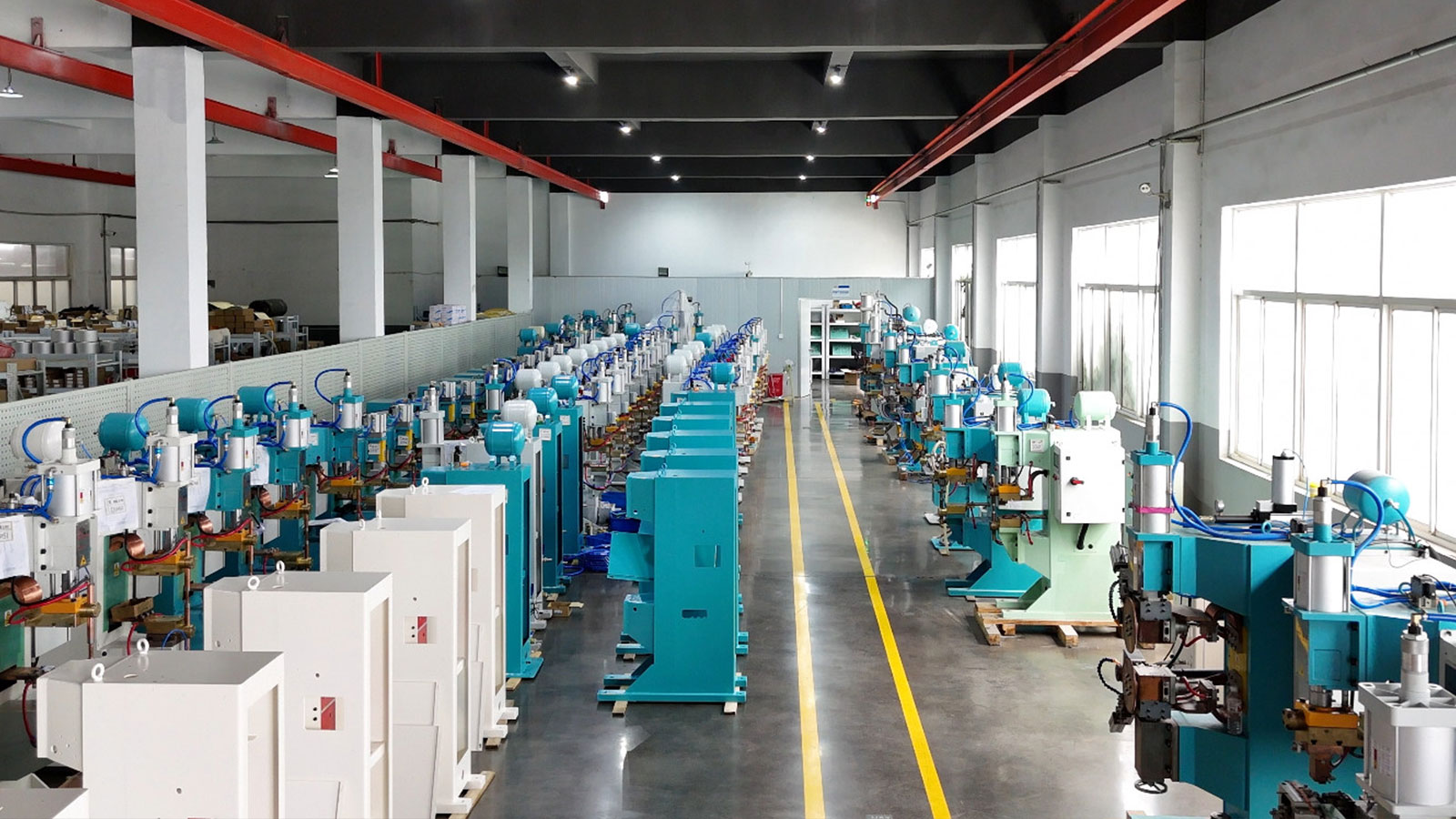
The Core Role of MFDC Spot Welding Machines in Flexible Manufacturing
Recipe Management Enables Rapid Changeover
In multi-product production environments, frequent product changes usually require repeated adjustment of welding parameters such as current, weld time, and electrode force. Manual parameter tuning not only consumes valuable time but also introduces variability that can negatively affect weld quality.
Modern MFDC spot welding machines typically include advanced welding recipe management systems that allow storage of multiple parameter sets for different product models. Each recipe contains optimized welding parameters that can be recalled instantly through the Human-Machine Interface (HMI).
During production, operators simply select the required product number, and the system automatically loads the corresponding welding parameters. This eliminates time-consuming manual adjustments and ensures repeatable welding performance.
In many real-world applications, recipe management reduces changeover time from 20–30 minutes to less than 5 minutes, significantly improving equipment utilization in high-mix production environments.
Open Communication Interfaces Support Automation Integration
In automated manufacturing environments, a spot welding machine is no longer a standalone unit but an integral component of the overall production system. To support flexible manufacturing, the welding system must communicate seamlessly with robots, conveyors, and supervisory control systems.
Most modern MFDC spot welding machines support widely used industrial communication protocols such as Profinet, EtherNet/IP, and Modbus TCP. These protocols allow synchronized operation between welding equipment and industrial robots, ensuring accurate timing and motion coordination.
In addition, integration with Manufacturing Execution Systems (MES) enables real-time data transfer, including welding current, weld time, and pass/fail status. This data traceability supports quality assurance programs and helps manufacturers meet industry standards such as IATF 16949, which is commonly required in automotive manufacturing.
Adaptive Control Improves Welding Stability
Material variations are unavoidable in real production environments. Differences in sheet thickness, surface coatings, or electrical conductivity between batches can cause weld inconsistency if parameters remain fixed.
To address this challenge, many MFDC spot welding machines incorporate adaptive control technology. By continuously monitoring dynamic resistance during the welding process, the system can automatically adjust welding energy in real time.
This capability helps maintain consistent weld quality even when material properties vary slightly. In well-optimized production environments, adaptive control systems can maintain first-pass yield rates above 99%, significantly reducing rework and material waste.
Modular Design Enables Future Production Expansion
Flexible manufacturing systems must not only meet current production requirements but also support future growth. When production volume increases or new product models are introduced, rigid systems often require complete replacement, leading to significant investment costs.
MFDC spot welding systems designed with modular architecture allow individual components such as power supplies, controllers, and welding units to be added or upgraded as needed.
When production capacity needs to increase, manufacturers can expand the system by adding additional welding modules rather than replacing the entire line. This approach reduces capital investment and minimizes production downtime during upgrades.
How MFDC Spot Welding Improves Overall Production Efficiency
Reduced Downtime and Improved Equipment Utilization
Frequent product changeovers are one of the primary causes of low equipment utilization in conventional production systems. Each adjustment cycle interrupts production flow and reduces overall efficiency.
By combining automation control with stored parameter recipes, MFDC spot welding machines enable rapid switching between product models. This significantly reduces downtime associated with setup adjustments.
In high-mix production environments, flexible MFDC welding systems typically increase equipment utilization rates by 15% to 30%, resulting in measurable productivity gains over time.
Lower Labor Dependence and Improved Process Consistency
Traditional welding operations often depend heavily on skilled operators to adjust parameters and monitor weld quality. Human involvement introduces variability due to differences in skill levels and fatigue.
Automated MFDC spot welding systems rely on programmed welding parameters and integrated quality monitoring functions, ensuring consistent welding results across production cycles.
In many automated facilities, the adoption of MFDC-based welding systems reduces manual labor requirements by approximately 30% to 50%, while simultaneously improving overall process reliability.
Improved Product Consistency and Reduced Quality Risk
Product consistency is a critical performance indicator in modern manufacturing. Variations in weld quality can compromise product reliability and increase warranty risks.
MFDC spot welding systems continuously monitor welding current, voltage, and time during each welding cycle. This real-time monitoring ensures stable weld formation and consistent weld nugget quality.
In demanding applications such as structural component welding, improved process control significantly reduces defect rates and minimizes the need for rework or scrap.
Flexible Welding Systems vs. Traditional Rigid Production Lines
Understanding the advantages of flexible manufacturing becomes easier when comparing it directly with traditional rigid production systems.
| Comparison Item | Traditional Rigid Welding Line | Flexible MFDC Welding Line |
|---|---|---|
| Changeover Time | Typically 20–30 minutes | Typically less than 5 minutes |
| Parameter Adjustment | Manual tuning required | Automatic recipe loading |
| Automation Compatibility | Limited | High compatibility |
| System Expansion | Difficult | Modular expansion supported |
| Product Adaptability | Single product type | Multi-model production |
| Production Stability | Operator-dependent | Highly consistent |
This comparison clearly demonstrates the operational advantages of flexible MFDC welding systems, particularly in environments where frequent product changes are required.
Key Technical Factors to Consider When Selecting an MFDC Spot Welding Machine
Selecting the right equipment is a critical step in building a reliable flexible manufacturing system. The following technical factors should be carefully evaluated during the selection process.
Parameter Storage Capacity and Management
The system should provide sufficient storage capacity to support multiple product models. In most applications, equipment capable of storing more than 100 welding recipes is recommended to accommodate future production expansion.
User-friendly recipe selection is equally important, as it simplifies operation and reduces training requirements.
Communication Protocol Compatibility
Reliable communication capability is essential for seamless integration with robots and automation systems.
Equipment supporting widely used industrial communication standards ensures smoother system integration and reduces compatibility risks during installation or upgrades.
Control System Stability
The control system is one of the most critical components of an MFDC spot welding machine. Stable control performance directly affects weld consistency and production reliability.
Systems designed with mature control algorithms and robust hardware architecture are better suited for high-load industrial environments.
Technical Support and After-Sales Service
Reliable technical support plays an essential role in maintaining production continuity. Selecting equipment from manufacturers with strong service networks ensures timely troubleshooting and reduces downtime risks.
For long-term production systems, dependable support infrastructure is just as important as equipment performance.
FAQ
Q: Which industries benefit most from flexible MFDC spot welding systems?
A: Flexible MFDC welding systems are particularly suitable for industries with frequent product changes, such as electric vehicle manufacturing, home appliance production, and metal component fabrication. These industries often require multi-model production capability while maintaining consistent welding quality.
Q: How many MFDC spot welding machines are typically required for a flexible production line?
A: The required number depends on weld quantity and cycle time requirements. For moderately complex products, 2 to 4 MFDC welding machines are commonly used. For high-density welding applications, such as structural assemblies, 4 to 6 machines may be necessary to maintain production efficiency.
Q: How much can changeover time be reduced in flexible welding systems?
A: In traditional production systems, changeover typically takes 20 to 30 minutes. With recipe-based MFDC systems, this time can often be reduced to less than 5 minutes, resulting in significantly improved productivity in multi-model environments.
Q: What is the typical return on investment (ROI) for flexible welding systems?
A: In most industrial applications, the ROI period for flexible welding systems ranges from 1 to 3 years. Savings typically come from reduced downtime, lower labor costs, and improved weld quality that minimizes rework and scrap.
Q: What key features should be prioritized when selecting an MFDC spot welding machine?
A: Important features include welding recipe management capability, industrial communication compatibility, adaptive control functions, and modular expansion capability. These factors directly affect system flexibility and long-term operational reliability.
Conclusion
As manufacturing continues to evolve toward high-mix, low-volume production, flexible manufacturing systems are becoming increasingly essential. MFDC spot welding machines provide the stability, responsiveness, and integration capability required to support this transition.
By leveraging advanced features such as recipe management, open communication interfaces, adaptive control, and modular architecture, manufacturers can significantly enhance production flexibility while maintaining consistent weld quality.
In the long term, welding systems designed for flexibility will provide manufacturers with a strong competitive advantage, enabling faster response to market changes and improved production efficiency.


