


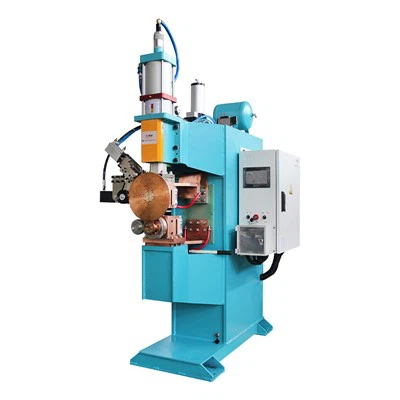
Metal tanks, containers, drums, and thin-sheet housings usually require continuous and stable weld seams. Unlike ordinary spot welding, resistance seam welding uses rotating electrode wheels to move along the weld path and form a series of overlapping weld nuggets. This creates a continuous seam and is commonly used for sheet metal structures that require air-tight or liquid-tight performance.
When choosing a resistance seam welding machine, it is not enough to compare machine power, price, or general supplier claims. A more reliable approach is to start with the workpiece requirements, then evaluate whether the machine structure, power supply type, electrode wheels, fixtures, cooling system, and automation level match the actual production needs. This article explains how to choose a suitable resistance seam welding machine for metal tanks and containers.
Why Metal Tanks and Containers Need Seam Welding?
Continuous Weld Seams for Better Sealing
Metal tanks, drums, food containers, fuel tanks, liquid storage shells, and some appliance tanks usually need more than a few weld spots. They require a continuous weld seam. A resistance seam welding machine uses rotating electrode wheels to apply pressure and welding current along the joint, creating a continuous seam or a seam made of highly overlapping weld nuggets.
For products that need to prevent air leakage, liquid leakage, or withstand a certain level of pressure, this process is more suitable than standard spot welding.
If there are unfused areas along the seam, the final product may have leakage, weak strength, or rework issues. For metal tanks and containers, the key points to check are seam continuity, weld overlap, and welding stability.
Repeatable Welding Quality for Batch Production
In batch production, weld quality should not rely only on operator experience. Tank diameter, sheet thickness, welding speed, electrode wheel pressure, and cooling conditions can all affect seam appearance and sealing performance.
The value of a resistance seam welding machine is that it allows welding current, pressure, speed, and time to be controlled and repeated. This makes the welding process more stable from part to part.
For manufacturers producing metal containers in large quantities, long-term stability is more important than a single successful weld. When buying a machine, you should check whether it can support continuous operation, whether the parameters are easy to adjust, whether the electrode wheels are easy to maintain, and whether different welding programs can be stored for different products.
Key Workpiece Information to Confirm First
Material Type
Different materials require different welding currents, pressures, and electrode designs. Carbon steel, stainless steel, galvanized steel, and some coated steels are commonly used in seam welding. For copper, aluminum, brass, nickel alloys, or other materials with high electrical or thermal conductivity, standard steel welding parameters cannot be applied directly. Sample welding should be carried out based on the material grade, thickness, and surface condition.
If the product surface has coating, oil, oxide layers, or plating, heat generation during welding may be affected. Before purchasing the machine, it is better to send real production materials for welding tests instead of only providing the material name.
Material Thickness
Sheet thickness directly affects welding current, electrode pressure, welding speed, and machine capacity. For thin sheets, excessive current may cause burn-through, deep indentation, or deformation. For thicker sheets, the machine must provide enough heat and pressure to form a strong seam.
Many buyers only say they need to weld "metal tanks," but do not provide the material thickness. This is not enough for proper machine selection. The machine supplier needs to know the single-layer thickness, joint design, seam length, and sealing requirement before recommending AC, DC, or MFDC seam welding equipment.
Tank or Container Size
Tank diameter, length, height, seam position, and loading direction all affect machine design. Longitudinal seam welding, circular seam welding, and edge seam welding require different electrode wheel arrangements and fixture structures.
For larger tanks or containers, throat depth, working space, workpiece support, and loading convenience must also be considered. Before requesting a quotation, provide the product drawing, or at least the overall size, seam location, and production method. This helps avoid problems such as a machine that can weld the part but is difficult to load, position, or operate efficiently.
Continuous Seam Welding or Intermittent Seam Welding?
When to Choose Continuous Seam Welding
If the product requires air-tight, water-tight, oil-tight, or high-continuity weld strength, continuous seam welding is usually preferred. Common examples include metal fuel tanks, low-pressure liquid containers, food cans, drums, metal water tanks, and sealed housings.
Continuous seam welding does not always mean that the current stays on without interruption. In many production processes, pulse current is used while the electrode wheels move continuously. The overlapping weld nuggets then form a sealed seam.
When to Choose Intermittent Seam Welding
If the product does not require full sealing and only needs segmented joining, or if the material is thin and easy to deform, intermittent seam welding may be more suitable. It can reduce heat input, lower the risk of deformation, and work well for some housings and structural parts that do not require a fully sealed seam.
The choice between continuous and intermittent seam welding should be based on the final quality requirement, not only on the product name. If the part must pass air leakage, water leakage, or pressure tests, continuous seam welding is usually the safer option. If the part only needs structural connection, intermittent seam welding may be more economical.
AC, DC, or MFDC Seam Welding Machine: Which Is Better?
AC Seam Welding Machine
An AC seam welding machine is suitable for many standard sheet metal and container welding applications. It is often a cost-effective choice for production environments where the welding requirement is not highly complex.
If the material is stable, the thickness is moderate, and the output requirement is not very high, an AC seam welder can be considered as a basic option. However, compared with DC or MFDC systems, AC machines usually have limitations in current stability, energy control, and automation compatibility. For projects with higher sealing or process stability requirements, the selection should be evaluated carefully.
DC Seam Welding Machine
A DC seam welding machine usually provides more stable current output. It is suitable for products that require better seam consistency. For metal tanks, containers, and shell parts, if the customer cares about seam appearance, weld overlap, and sealing performance, a DC configuration often provides better process control than a conventional AC machine.
MFDC Seam Welding Machine
An MFDC seam welding machine is more suitable for high-output production, automated welding lines, and projects with stricter quality requirements. It usually offers better current control and is often selected when stable heat input, energy management, automation integration, and process monitoring are required.
In simple terms, AC can be considered for standard container production. DC is more suitable when better weld consistency and sealing quality are required. MFDC is a better choice for high-volume automated lines, strict sealing requirements, or projects that need process traceability.
Key Machine Parameters to Check
Rated Capacity
Rated capacity affects whether the machine can handle the material thickness, seam length, and continuous production load. If the capacity is too low, the machine may not provide stable welding performance under high-load production. If the capacity is much higher than needed, the purchase cost may increase unnecessarily.
The machine capacity should be selected based on material thickness, production cycle, seam length, and welding requirement.
Welding Current Range
Insufficient welding current may cause weak fusion, poor seam strength, or sealing failure. Excessive current may cause burn-through, spatter, deep indentation, or sheet deformation.
When comparing machines, do not only look at the maximum current. You also need to confirm whether the machine can provide stable and suitable current for the actual material thickness and joint design.
Electrode Wheel Pressure
Electrode wheel pressure affects contact resistance, seam width, indentation depth, and welding stability. If the pressure is too low, the contact between sheets may be unstable. If the pressure is too high, thin sheets may deform and surface marks may become more visible.
For containers and housings with appearance requirements, electrode pressure and wheel profile should be confirmed in advance.
Welding Speed
Welding speed must match the welding current and electrode pressure. If the speed is too fast, weld overlap may be insufficient, causing missed welds or leakage. If the speed is too slow, heat input may be too high, causing burn-through or deformation.
For metal tanks and containers, faster speed is not always better. The correct speed should balance production output and seam quality.
Cooling Water Requirement
The electrode wheels of a seam welding machine heat up continuously during operation. If the cooling water flow is insufficient, electrode wear will increase and seam stability may decline.
For long-term batch production, cooling water should be treated as a key machine requirement. Buyers should confirm water flow, inlet and outlet design, cooling capacity, and site water conditions before finalizing the machine.
Electrode Wheel Design Matters
Electrode Wheel Material and Profile
The electrode wheel is not just a standard spare part. It directly affects seam shape, contact area, heat distribution, and surface indentation. Different materials, thicknesses, and seam positions may require different electrode wheel materials and profiles.
For example, thin-sheet containers may require better indentation control, while thicker workpieces may need more attention to heat input and weld strength.
Electrode Wheel Maintenance
During production, the electrode wheel surface should be checked regularly for wear, adhesion, deformation, or contamination. If the wheel surface is in poor condition, weld quality may become unstable even when the welding parameters remain the same.
For continuous production, buyers should also understand electrode wheel replacement, dressing, cooling, and maintenance requirements.
Fixture and Workpiece Positioning
Why Fixture Design Affects Weld Consistency
If a tank or container is not positioned properly during welding, the seam may shift, bend, lose overlap, or have poor local contact. This is especially important for cylindrical products because the welding process often involves rotation, support, and guiding.
A suitable seam welding machine should not only have the correct welding power source and electrode wheels. It also needs a workholding method that matches the product structure. For non-standard tanks, special openings, irregular housings, or multi-size production, custom fixtures or adjustable structures should be considered.
Manual, Semi-Automatic, or Automatic Loading
For small-batch production, manual loading with automatic welding may be enough and can keep the investment lower. For medium-volume production, semi-automatic designs such as automatic clamping, automatic rotation, or assisted positioning can improve efficiency.
For high-output production, a fully automatic solution with automatic feeding, welding, inspection, and unloading may be more suitable.
Sealing Requirement and Leakage Test
Why Sealing Standards Should Be Confirmed Early
If the product must pass air-tightness, water-tightness, or pressure testing, the testing standard should be confirmed before machine selection. Different sealing requirements affect weld overlap, welding speed, current control, fixture stability, and sample testing.
Many seam welding problems should not be left until after the machine is delivered. They should be reviewed during the process evaluation stage.
Common Causes of Leakage After Seam Welding
Leakage after seam welding is often caused by insufficient weld overlap, unstable current, unsuitable electrode pressure, excessive welding speed, oil or coating on the workpiece surface, or unstable fixture positioning.
For products with sealing requirements, sample welding and leakage testing are recommended before placing the final machine order.
Common Mistakes When Choosing a Seam Welding Machine
Only Comparing Machine Price
Choosing a machine only by price may lead to higher costs later, such as rework, rejects, electrode consumption, and output loss. For metal tanks and containers, the ability to pass sealing tests consistently is often more important than the initial purchase price.
Ignoring Cooling Capacity
Continuous seam welding has higher cooling requirements than many other welding processes. Poor cooling can cause electrode overheating, faster wear, unstable weld seams, and production interruptions. Cooling capacity should be treated as a core configuration, not an optional detail.
Not Testing Real Samples
Even when two products are both described as "stainless steel" or "galvanized sheet," differences in grade, thickness, surface condition, and joint design can lead to different welding results. For new products, special materials, or sealed containers, real sample testing is strongly recommended.
Choosing a Standard Machine for a Non-Standard Container
If the workpiece size, seam position, or loading method is special, a standard seam welder may not meet the expected production efficiency or stability. In these cases, custom fixtures, dedicated electrode wheels, adjusted electrode positions, or automation options should be evaluated first.
Information Needed Before Getting a Quotation
| Information | Why It Matters |
|---|---|
| Tank or container drawing | Confirms size, structure, and seam position |
| Material type | Helps determine welding current, pressure, and electrode selection |
| Material thickness | Affects machine capacity and heat input |
| Seam length | Affects welding speed and production cycle |
| Seam type | Helps determine longitudinal, circular, or custom seam welding structure |
| Sealing requirement | Defines weld overlap and testing method |
| Production capacity | Helps decide manual, semi-automatic, or fully automatic configuration |
| Current production process | Helps identify what needs to be improved |
| Factory layout | Helps plan machine size and loading method |
How HAIFEI Supports Seam Welding Machine Selection
HAIFEI can evaluate material, thickness, seam position, sealing requirement, and production target based on customer drawings and samples, then recommend a suitable AC, DC, or MFDC seam welding machine configuration.
For metal tanks, containers, drums, and sealed housings, Haifei can support fixture design, electrode wheel selection, welding parameter setup, sample welding, and automation planning.
If the product requires air-tightness, water-tightness, or pressure testing, the customer should provide the testing standard in advance. Haifei can carry out sample welding based on the actual workpiece to check seam appearance, weld strength, sealing performance, and process stability before confirming the final machine solution.
FAQ
Q: Can one seam welding machine weld different tank sizes?
A: Yes, but it depends on the size difference, fixture design, electrode wheel position, and machine throat depth. For multi-size production, replaceable fixtures or adjustable structures are recommended.
Q: Is sample welding necessary for sealed containers?
A: Yes, it is recommended. For products that require air-tightness, water-tightness, or pressure testing, sample welding helps confirm the parameters and sealing performance before production.
Q: What causes burn-through during seam welding?
A: Common causes include excessive welding current, slow welding speed, unsuitable electrode pressure, thin material, or insufficient cooling.
Q: How do I choose between AC and MFDC seam welding?
A: AC can be considered for standard thin-sheet container welding. MFDC is more suitable when stable current, higher output, automation integration, or stricter sealing requirements are needed.
Q: What should I send to Haifei for machine selection?
A: Please provide the drawing, material, thickness, seam length, seam position, sealing standard, production capacity, and automation requirements.
Conclusion
Choosing a resistance seam welding machine for metal tanks and containers should not be based only on machine model or price. The real welding result depends on material, thickness, seam design, sealing requirement, electrode wheel design, cooling system, fixture accuracy, and automation level.
If your product requires a continuous seam, stable appearance, or reliable sealing performance, it is better to provide workpiece drawings and sample information before purchasing the machine. Sample welding can help confirm the right machine configuration and reduce later production risks.
Send your tank or container drawing to Haifei. Our team will help evaluate the seam welding process and recommend a suitable resistance seam welding machine configuration.


