

In the rapidly expanding sectors of New Energy, Electric Power, and Photovoltaic Energy Storage, the polymer diffusion welding machine has become a critical piece of equipment for connecting flexible links, power busbars, and other essential components. This technology offers significant advantages in efficiency and environmental friendliness by precisely controlling temperature and pressure to achieve a molecular-level diffusion bond in an air environment.
However, the localized appearance of micro-voids on the weld surface is a common and persistent challenge for many manufacturers. These micro-voids not only compromise the product's appearance but, more critically, they significantly reduce the stability and safety of power transmission, directly impacting the long-term reliability of the product.


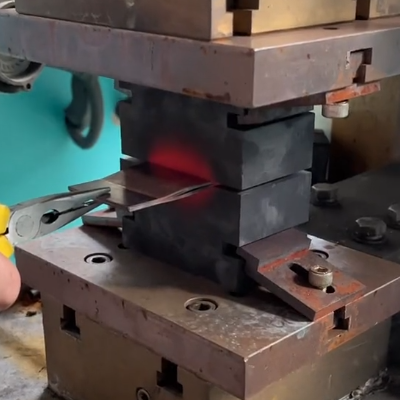

To address this challenge, companies require a systematic solution. This article will delve into the root causes of micro-void formation, detail a "Five-Step" process optimization strategy, provide essential industry parameter benchmarks, and ultimately guide users on how to select a high-quality diffusion welding machine capable of fundamentally preventing micro-voids, thereby securing a competitive edge in the high-quality development of the new energy industry.
Why Do Localized Micro-Voids Occur in Diffusion Welds?
The essence of polymer diffusion welding is the use of thermal energy and pressure to promote the mutual diffusion of atoms or molecules across the joint interface, resulting in a metallurgical bond. The presence of micro-voids indicates that this bonding process was either obstructed or incomplete in localized areas. Micro-void issues are typically caused by four core factors:
Surface Cleanliness – The Overlooked "First Line of Defense"
Oil stains, oxide layers, dust, or other contaminants present on the surface of the workpieces are the primary cause of micro-void formation. These impurities cannot fully volatilize or be expelled during the welding process. They act as a barrier, preventing the intimate contact and mutual diffusion between the molecules of the workpieces. This is particularly true for materials like copper and aluminum, commonly used in the new energy sector, where highly reactive surface oxides, if not thoroughly removed, will directly lead to localized incomplete fusion and micro-voids.
Temperature Field Uniformity – The Trade-Off Between Overheating and Under-Cooling
Precise temperature control in the polymer diffusion welding machine is crucial for molecular diffusion. If the equipment's temperature control system lacks sufficient accuracy, leading to uneven temperature distribution across the weld surface, two types of micro-voids can arise:
- Localized Overheating: Excessively high temperatures can cause the workpiece material or trace organic substances adsorbed on its surface to volatilize, forming gases. If these gases are not expelled under pressure, they create small gas pores within the bond interface.
- Localized Under-Cooling: In areas where the temperature is insufficient, molecular activity is low, and the diffusion rate is slow. The joint fails to achieve sufficient bond strength by the end of the welding cycle, leaving behind un-fused micro-gaps, which manifest as micro-voids.
Pressure System Precision – The Terminator of Micro-Gaps
Welding pressure is essential for eliminating microscopic surface irregularities and promoting intimate molecular contact. If the welding pressure is insufficient, or if the pressure is unevenly distributed across the weld surface, the micro-gaps between the workpieces cannot be fully consolidated. These uneliminated gaps appear as micro-voids at the microscopic level. Furthermore, excessive pressure in certain composite materials can lead to excessive material deformation and extrusion, which may negatively affect the bond quality.
Equipment Stability and Time Parameters – The Catalysts for Molecular Diffusion
If the polymer diffusion welding machine suffers from issues such as equipment aging, or degraded performance of critical components like the induction coil or pressure system, it will result in unstable energy and pressure output, directly compromising weld quality. Concurrently, if the welding time is set too short, molecules will not have enough time to complete sufficient diffusion and grain growth, leading to an incomplete bond layer and the hidden risk of micro-voids.
The Five-Step Method to Completely Eliminate Weld Micro-Voids
Solving the micro-void problem requires a systematic, comprehensive adjustment strategy that addresses the process from its source to its completion. We recommend following this "Five-Step Method" for process optimization:
Step One: Intensify Surface Pre-Treatment
This is the foundation for preventing micro-voids. Before welding, a specialized cleaning agent must be used to thoroughly remove oil, mold release agents, and other organic impurities from the workpiece surface. For easily oxidized materials like copper and aluminum, methods such as physical abrasion or chemical pickling are necessary to completely remove the oxide layer. Ensuring the workpiece surface achieves a mirror-grade cleanliness is a prerequisite for achieving intimate molecular contact.
Step Two: Optimize the Temperature Curve Based on Material Properties
Temperature is the most sensitive parameter in diffusion welding. The welding temperature should be precisely controlled within the range of 0.5 $T_m$ to 0.7 $T_m$ (where $T_m$ is the melting point) based on the workpiece material's melting point and thermal sensitivity. Crucially, the temperature across the entire weld surface must be uniformly consistent. It is recommended to use a heating system with PID algorithms and zone temperature control, maintaining a temperature control accuracy of ±10°C or better (e.g., ±1°C) to prevent localized overheating or under-cooling.
Step Three: Precisely Set the Pressure Gradient
Pressure must be not only sufficient but also uniformly stable. Based on the workpiece's yield strength and thickness, an optimal pressure range must be set (industry references typically fall between 20-50 kg/cm², or 2-5 MPa). This pressure must be high enough to cause plastic deformation of microscopic surface irregularities without causing excessive macroscopic extrusion. The use of a servo-electric pressure system is highly recommended. Compared to traditional pneumatic or hydraulic systems, servo systems provide smoother, more precise pressure loading and holding, ensuring that micro-gaps are completely eliminated.
Step Four: Establish a Regular Equipment Inspection Mechanism
The equipment is the vehicle for the process. A strict periodic maintenance and inspection regime must be established, focusing on the induction coil, pressure sensors, heating elements, and temperature control modules. Ensure the equipment operates stably, paying particular attention to the pressure system's pressure compensation function. This is vital for maintaining tight contact despite minor deformation and creep of the material at high temperatures.
Step Five: Reasonably Extend the Diffusion Holding Time
The welding time should be appropriately extended based on the material properties and thickness to ensure molecules have sufficient time to complete full diffusion and grain growth. While extending the welding time slightly increases the production cycle, it is a critical step for eliminating micro-voids and enhancing bond strength and conductivity. The shortest effective time that guarantees quality should be determined through small-batch testing.
Typical Process Parameters for Copper and Aluminum Diffusion Welding
In the new energy and power industries, copper and aluminum foils are the primary materials for welding. Their significant differences in thermophysical properties necessitate distinct process parameters. The following table provides typical reference data for practical applications:
| Workpiece Material | Typical Application Scenario | Recommended Temperature Range | Recommended Pressure Range | Typical Holding Time | Key Differentiating Factor |
| Copper Foil | High-power transmission, large current busbars | 480°C ~ 580°C (750K ~ 850K) | 30 ~ 50 kg/cm² | 10 ~ 30 minutes | Higher melting point requires higher temperatures and longer diffusion time. |
| Aluminum Foil |
Photovoltaic energy storage systems, battery flexible links |
350°C ~ 440°C | 20 ~ 40 kg/cm² | 5 ~ 15 minutes | Lower melting point requires finer temperature control to prevent excessive oxidation and deformation. |
The data above represents industry reference ranges. Specific parameters must be determined through process trials based on the workpiece thickness, number of layers, and equipment performance.
How to Select a Diffusion Welding Machine Based on Quality Requirements
For companies aiming to fundamentally resolve micro-void issues, selecting a high-quality, high-precision diffusion welding machine is paramount. When purchasing, focus on these three core technical indicators:
Focus on Temperature Control Accuracy: PID Zone Control and the ±10°C Industry Baseline
A superior diffusion welding machine must have a temperature control system capable of precise, uniform, and controllable heating.
- Temperature Control Accuracy: Always select equipment with a temperature control accuracy of within ±10°C; high-end applications may require ±1°C. This is the key to ensuring uniform weld surface temperature and preventing localized micro-void formation.
- Heating Method: Evaluate whether the equipment utilizes zone temperature control technology, which uses multiple independent heating units and sensors to control different areas of the welding platen independently, thereby eliminating temperature gradients.
- Algorithm Support: Verify if the equipment uses advanced PID algorithms to achieve adjustable heating rates (e.g., 1-20°C/min), ensuring the material is heated uniformly during the ramp-up phase and reducing thermal stress.
Stability of the Pressure System: Servo-Electric vs. Pneumatic
The choice of pressure system directly determines the thoroughness of micro-void elimination.
- Servo-Electric System: The use of a servo-electric pressure system is highly recommended. It achieves closed-loop pressure control through high-precision motors and sensors, offering fast response, stable pressure holding, high accuracy, and strong programmability. It can implement pressure gradient loading, making it the optimal choice for eliminating micro-gaps and preventing excessive deformation.
- Traditional Pneumatic/Hydraulic: Traditional systems often exhibit fluctuations in pressure holding and uniformity, making it difficult to meet the high-precision, zero-micro-void welding requirements.
Brand Strength and Authoritative Certification
When selecting equipment, the supplier's expertise and reliability must be considered:
- Authoritative Certification: Confirm whether the equipment manufacturer has obtained ISO9001 Quality Management System Certification, National 3C Certification, and CE Certification. These are fundamental guarantees of product quality and safety.
- Market Share and Industry Experience: Investigate the brand's market share and successful case studies within the industry. For instance, a brand with a market presence of over 5,000 units undoubtedly possesses greater maturity in equipment and process technology, offering more reliable process guidance and after-sales service.
- Professional Endorsement: Prioritize manufacturers recognized as National High-Tech Enterprises or "Specialized, Refined, Differential, and Innovative" (SRDI) Enterprises, as this signifies their professional authority in technological research and innovation.
Conclusion
Eliminating localized micro-voids in polymer diffusion welds is not a matter of a single adjustment but a systematic engineering effort involving surface preparation, temperature control, pressure adjustment, equipment maintenance, and welding time. By mastering these core process parameters and making a judicious selection of high-precision diffusion welding machines, companies can not only completely eliminate the risk of micro-voids, ensuring the high conductivity and long-term reliability of power transmission but also significantly enhance production efficiency and product competitiveness.
Choosing the right polymer diffusion welding machine means choosing a more reliable, safer, and more efficient product future. Mastering the correct process methods and selection criteria is key for enterprises to maintain a leading position in the fierce competition of the new energy industry.


