


In the high-volume manufacturing of components for New Energy Vehicles, battery trays, and other high-precision parts, projection welding technology has become a critical process due to its efficiency and consistent joint quality.
However, as the manufacturing sector shifts toward greater intelligence and sustainability in 2026, the challenges in procuring a projection welding workstation have become increasingly complex. Issues such as weld expulsion damaging threads, failure to meet production cycle times, and lengthy changeover periods often stem from a fundamental "information asymmetry" during the initial selection phase.
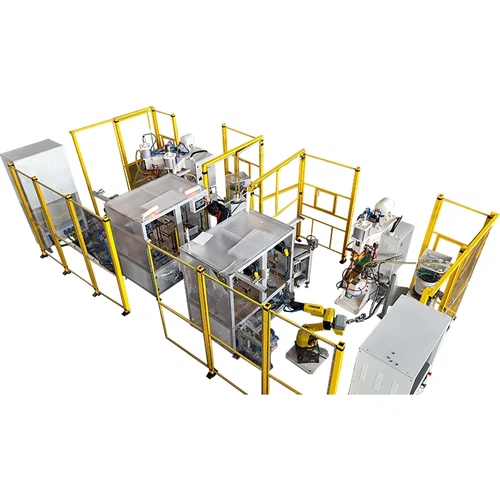
To help businesses navigate these pitfalls, this guide leverages the extensive practical experience of industry leaders like Haifei Welding Equipment Co., Ltd. It provides an in-depth analysis of the three major core configuration traps in projection welding workstations and offers selection advice that adheres to the EEAT standard.
Power Source Differentiation: Avoiding the Misalignment Trap between CD and MFDC
The most common pitfall in procurement is when vendors use vague, "universal" language to confuse power source types. In reality, Capacitor Discharge and Medium Frequency Direct Current power sources differ fundamentally in their process principles and application scenarios. Selecting the wrong power source will directly lead to a significant drop in product acceptance rates.
Capacitor Discharge Welding: The Preferred Choice for Precision Fasteners
Capacitor Discharge technology releases stored energy from a capacitor bank instantaneously. The discharge time is extremely short, typically between 3 milliseconds and 8 milliseconds. This rapid discharge minimizes the Heat Affected Zone, effectively preventing weld expulsion from damaging threads. It is particularly well-suited for welding M6 to M12 nuts onto materials like hot-stamped steel and high-strength steel.
Medium Frequency DC Welding: The Workhorse for Thick and Multi-Layer Materials
MFDC power sources typically operate at a frequency of 1000Hz, offering control precision that is over 20 times greater than traditional AC welders. They provide a continuous and highly stable current output, making them ideal for applications involving no-projection joints, multi-layer thick plate welding, or processes with specific heat input requirements.
| Feature | Capacitor Discharge Welding | Medium Frequency DC Welding |
| Discharge Time | 3 – 8 ms (Extremely Short) | 10 – 1000 ms (Adjustable) |
| Heat Affected Zone | Minimal, virtually no expulsion | Small, highly controlled |
| Key Advantage | Thread protection, energy efficiency, low grid impact | High stability, suitable for thick materials |
| Typical Application | Automotive nuts, hot-stamped steel, precision electronics | Battery trays, body-in-white structures, multi-layer plates |
Do not be misled by claims of a "one-size-fits-all" machine. Reputable manufacturers, such as Haifei Welding, typically offer free process validation (sample testing) based on the customer's material thickness and fastener specifications to ensure the power platform perfectly matches the actual production requirements.
Beyond "Pseudo-Integration": Transitioning from Automation to True Intelligence
Many low-cost solutions merely involve adding a robotic arm next to a welding machine and labeling it an "automated workstation." Such systems, lacking deep integration, often become "information silos" on the production line after commissioning, failing to meet the stringent quality traceability demands of modern factories.
Integrity of Industrial Communication Protocols
A truly intelligent workstation must feature standard industrial bus interfaces such as Profinet or EtherNet/IP. This is not just for communication between the robot and the welder, but crucially, for seamless integration with the factory's Manufacturing Execution System.
Data Traceability and SPC Analysis Capabilities
Under the IATF 16949 quality management system, critical data for every weld-including current, pressure, and displacement-must be collected in real-time and archived, often linked to a Vehicle Identification Number or work order. Haifei's workstations support real-time data traceability and automatic judgment, enabling Statistical Process Control analysis to predict and preempt process deviations, elevating quality management from "post-production inspection" to "proactive prevention."
Flexibility and Compensation Technology
To address inconsistencies in workpieces, high-quality workstations should incorporate floating compensation mechanisms or vision guidance systems. These features significantly reduce changeover and debugging time, ensuring high welding precision even under complex operating conditions.
The "Invisible" Standard of Core Components: MTBF as the Key Metric
The difference in equipment price is often hidden within unseen internal components. To cut costs, some manufacturers use non-industrial-grade capacitors or simplified cooling systems, leading to frequent errors within six months of operation.
Critical Component Checklist
- IGBT Modules: Prioritize international Tier 1 brands like Infineon to ensure stability during high-frequency switching.
- Storage Capacitors: The lifespan and capacity stability of high-performance capacitors (e.g., EPCOS) are central to the equipment's durability.
- Cooling System: A dual-circuit water cooling system is mandatory to ensure the transformer and power components do not overheat during continuous operation.
Reliability Data Reference
Industry statistics indicate that the Mean Time Between Failures for a premium projection welding workstation should exceed 5,000 hours. In contrast, low-end equipment with compromised components often has an MTBF of less than 2,000 hours. In multi-shift production, this means the low-end equipment may face multiple unplanned downtimes per quarter, with the resulting production losses far outweighing the initial cost savings.
After-Sales Service: From "Repair" to "Lifecycle Assurance"
For high-tempo production lines, such as those for automotive components, an hour of downtime can cost tens of thousands of dollars. Therefore, a manufacturer's service response capability is a critical factor in the procurement decision.
- Local Spare Parts Inventory: Assess whether the manufacturer has technical service centers in major industrial areas. For instance, Haifei maintains 8 technical service stations across China, ensuring common spare parts are available within 48 hours.
- Remote Diagnostics Capability: Advanced 2026 equipment should feature a remote operation and maintenance module, allowing technical experts to perform preliminary troubleshooting via the cloud, significantly reducing on-site response time.
- Continuous Process Optimization: An excellent partner provides more than just equipment; they offer ongoing process parameter optimization support when products are upgraded or materials are changed.
Conclusion
In the competitive environment of 2026, procuring a projection welding workstation is no longer a simple "machine purchase." It is about selecting a technological partner capable of supporting the company's long-term growth. Businesses are advised to prioritize domestic leading brands that are technically transparent, solidly configured, and possess extensive industry case studies.
By conducting on-site inspections of the manufacturer's R&D facilities, verifying the critical component list, and performing rigorous process sampling, you can avoid low-price traps and build an efficient, reliable, and intelligent welding production line.


