


In industries such as new energy, power equipment, photovoltaic storage, and advanced manufacturing, diffusion welding equipment has become a core technology for producing high-reliability electrical connections and structural joints. Unlike conventional fusion welding or brazing, diffusion welding forms joints through controlled temperature, pressure, and time, allowing atoms at the material interface to diffuse and bond at a metallurgical level.
Because the process does not rely on material melting, the joint structure is more uniform, defect rates are lower, and long-term reliability is significantly improved. This makes diffusion welding especially valuable in applications where electrical conductivity, mechanical strength, and long-term stability are critical performance requirements.

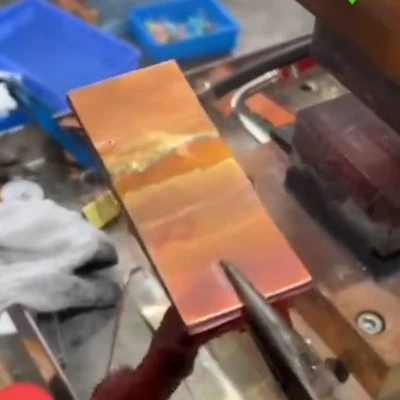

For manufacturers and buyers, understanding what materials diffusion welding can join is not just a technical question-it is a foundation for equipment selection and investment decisions. Different material systems require different temperature ranges, pressure levels, and interface control strategies, and the true capability of a diffusion welding system is defined by how well it handles these variations.
This article provides a clear, practical overview of the main material categories diffusion welding equipment can handle, while offering useful guidance for learning, selection, and procurement.
High-Quality Joining of Metal Materials
Typical weldable metals
Diffusion welding systems are highly effective for joining common industrial metals, including:
- Copper (Cu)
- Aluminum (Al)
- Stainless steel (e.g., 304 / 316)
- Nickel (Ni)
- Silver (Ag)
- Titanium (Ti)
- Iron-based alloys
In the new energy and power industries, one of the most representative applications is the welding of copper foil flexible connectors and power busbars. These structures are widely used in battery packs, energy storage systems, and power distribution units. Traditional welding methods often suffer from interface oxidation, unstable contact resistance, and localized stress concentration.
Diffusion welding forms a continuous metallurgical bond instead of a mechanical or partial fusion joint. This significantly improves interface quality and reduces electrical resistance. In practical applications, diffusion-welded joints typically show 20–40% lower interface resistance compared to conventional mechanical or localized fusion joining methods, making them especially suitable for high-current and high-reliability electrical systems.
Stable Bonding of Composite and Laminated Structures
Typical composite structures
Diffusion welding equipment is also well suited for multi-layer and composite material structures, such as:
- Copper–aluminum composite plates
- Laminated copper foil stacks
- Multi-layer metal laminations
- Composite conductive busbars
These structures are widely used in energy storage systems, photovoltaic inverters, and high-current power distribution modules, where the design requirements include high conductivity, structural stability, and long-term reliability.
By precisely controlling temperature distribution and pressure uniformity, diffusion welding enables all interface layers to undergo atomic diffusion simultaneously. The result is a dense, integrated structure rather than a stack of mechanically bonded layers. This eliminates micro-gaps between layers and significantly reduces the risk of contact degradation caused by thermal cycling, vibration, or long-term mechanical stress.
For high-power and high-load operating environments, this structural integrity is a major reliability advantage.
Reliable Joining of Dissimilar Metals
Typical dissimilar metal combinations
Diffusion welding excels in joining dissimilar metals, including combinations such as:
- Copper – Aluminum
- Copper – Stainless steel
- Aluminum – Nickel alloy
- Copper – Nickel alloy
- Titanium – Stainless steel
The main challenges in dissimilar metal welding include thermal expansion mismatch, different diffusion behaviors, and the formation of brittle intermetallic compounds. Traditional fusion welding often exacerbates these problems.
Diffusion welding avoids full melting and instead promotes controlled atomic diffusion at the interface. With optimized temperature gradients and pressure parameters, a stable transition zone is formed, reducing the risk of brittle phase formation and improving joint toughness and corrosion resistance.
In the new energy sector, this capability is widely applied in:
- Battery connectors
- High-current terminals
- Cable lugs and power connectors
- Conductive heat dissipation modules in inverters
These joints show improved fatigue resistance and long-term stability, making them suitable for environments with frequent thermal cycling and high electrical loads.
Special Bonding Between Metals and Non-Metal Materials
Typical non-metal combinations
Certain high-end power and electronic systems require bonding between metals and non-metal materials, such as:
- Metal – Ceramic
- Metal – Graphite
- Metal – Insulating composites
Diffusion welding systems typically use interlayer-assisted bonding techniques for these applications. A transition layer is introduced between the metal and non-metal material to stabilize interface reactions and enable controlled diffusion bonding.
Typical applications include:
- Energy storage capacitor terminals
- High-voltage insulation components
- Power electronics packaging structures
When operated in controlled or protected atmospheres, diffusion welding systems prevent oxidation while preserving the thermal stability of non-metal materials and the electrical conductivity of metal components. This allows the joint to meet simultaneous requirements for sealing, electrical performance, and mechanical strength.
Material-Driven Equipment Selection Logic
When selecting diffusion welding equipment, buyers should not focus only on the list of compatible materials. A rational decision should be based on the combination of material systems, product structure, and operating environment.
Practical selection guidelines
- For copper and aluminum conductive components → prioritize pressure control accuracy and temperature uniformity
- For multi-layer composite structures → focus on pressure distribution systems and tooling design capability
- For dissimilar metal applications → emphasize temperature gradient control and process stability
- For metal–non-metal bonding → ensure interlayer process support and atmosphere control capability
A high-quality diffusion welding system is defined not by its specification sheet, but by its process adaptability, consistency, and long-term operational stability.
Conclusion
From a material compatibility perspective, diffusion welding equipment is not simply a welding tool-it is a system-level joining solution. It supports a wide range of material systems, from pure metals to composites, from similar metals to dissimilar metals, and from metals to non-metal materials.
In industries such as new energy, power equipment, photovoltaic storage, and advanced manufacturing, diffusion welding is becoming a foundational process technology rather than an optional manufacturing method.
The real value of diffusion welding equipment is not just in what materials it can join, but in what it delivers over long-term operation:
structural reliability, electrical stability, process consistency, and manufacturing controllability.


