


Uneven, wrinkled or lifted edges on a welded copper foil connector usually mean that the foil stack was not compressed or heated uniformly. If the problem appears at only one corner, check foil alignment, tooling flatness, workpiece position and local pressure before increasing the welding current or temperature.
The visible shape cannot confirm the condition inside the joint. Isolate and inspect the part before rework or release.
What Does an Uneven or Lifted Edge Indicate?
| Defect appearance | First area to check |
|---|---|
| Only one corner or one side lifts | Tooling parallelism, workpiece position and local pressure |
| Several foil layers protrude or fold | Cutting tolerance, stacking and side location |
| The entire terminal is wavy | Heat input, compression and pressure-release timing |
| The surface is flat but layers peel apart | Cleanliness, interface contact, heat and holding time |
| Copper is pushed sideways | Foil movement or excessive hot deformation |
| The defect repeatedly occurs on the same machine side | Tooling wear, press alignment or uneven pressure |
Appearance and joint integrity should be evaluated separately because weak bonding can remain hidden inside a flat terminal.
For the full manufacturing sequence, see our guide to the copper foil flexible busbar diffusion welding process.
View the diffusion welding machine
Common Causes of Copper Foil Edge Lifting
1. Misaligned or Unevenly Stacked Copper Foils
Thin copper foils can move during handling and loading. A longer layer, burr or existing fold may wrinkle under pressure.
Align the foil ends against a fixed reference. End stops control the bonding length, while side guides limit sideways movement. The complete terminal area must remain inside the effective tooling contact zone.
Also check for particles, oil, oxidation and damaged edges that can interrupt local contact.
2. Worn or Non-Parallel Graphite Tooling
Worn graphite, copper residue, a chipped corner or incorrect installation can leave a gap at one edge while the centre bonds.
Inspect the upper and lower graphite blocks for flatness, cracks and uneven wear. If the defect always appears on the same side of the machine, check the tooling, press head and guides before changing the welding schedule.
3. Uneven Pressure Distribution
The displayed pressure does not prove that every part of the stack receives equal pressure. Distribution also depends on bonded area, tooling alignment and workpiece position.
An off-centre stack or tilted tool can leave one edge open. Establish stable pressure before heating so the foils do not slide as the copper softens.
4. Excessive or Uneven Heat Input
A curled edge does not automatically mean excessive temperature. Too much heat can soften the copper and increase sideways movement; insufficient or uneven heat can leave an edge unbonded.
Compare current, heating time and temperature with an accepted schedule for the same copper grade, foil thickness, layer count and terminal area.
5. Pressure Released Before the Terminal Stabilizes
If the tooling opens while the terminal remains hot and soft, the foil edge may spring back or separate.
Maintain pressure for the validated hold period. If later parts become uneven, check tool temperature, cooling and production interval.
How to Find the Cause Before Changing Parameters?
1. Perform a Cold-Press Test
Press a representative stack without heat. Wrinkling or shifting points to cutting, stacking, location or pressure. If cold pressing is stable, check heat distribution and the hot hold sequence.
2. Rotate the Workpiece 180 Degrees
Repeat the trial after rotating the workpiece while keeping the machine setup unchanged.
If the defect remains on the same machine side, inspect the graphite blocks, press head and local pressure.
If the defect follows the same workpiece corner, inspect foil cutting, stacking and loading.
3. Check the Pressure Contact Pattern
Check pressure contact across the complete terminal. A light or missing mark near the lifted edge points to uneven compression.
Check the graphite blocks in their installed position. A block may appear flat after removal but sit at an angle because of residue, an incorrect support or installation error.
4. Change One Parameter at a Time
Correct location, tooling and pressure first. Then adjust current, heating time or hold time in controlled steps so the effective change can be identified.
Corrective Actions for Uneven Copper Foil Welding Ends
| Inspection result | Corrective action |
|---|---|
| Foils extend outside the effective contact area | Reposition the stack or use tooling that covers the full bonded zone |
| Individual layers are offset | Add end stops and side guides; improve cutting control |
| Foils move during compression | Improve location support and establish full pressure before heating |
| Graphite surface is worn or contaminated | Clean, reface or replace the graphite block as appropriate |
| Upper and lower tooling are not parallel | Correct the tooling installation, press head or guide alignment |
| One edge has weak contact | Centre the workpiece and verify the contact pattern |
| Copper is excessively softened or pushed sideways | Reduce heat input in controlled steps after correcting pressure and location |
| Edge remains unbonded without excessive deformation | Confirm cleanliness and pressure, then evaluate heating and hold time |
| Terminal opens after pressure release | Extend the validated post-heating hold period |
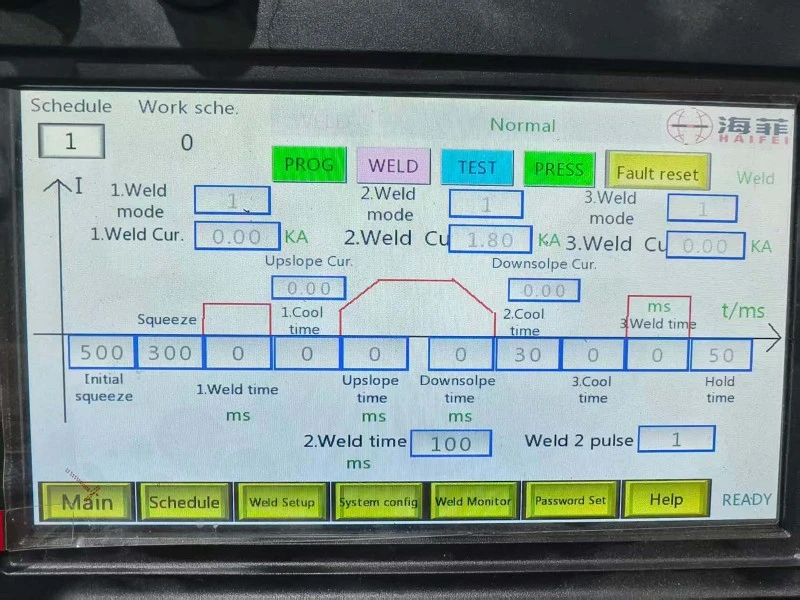
Example: Edge Lifting at One Corner of a Copper Foil Connector
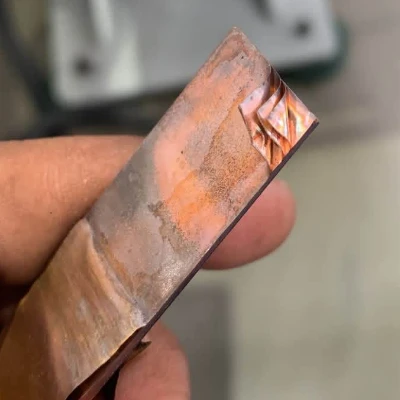
In the sample shown in this article, several copper foil layers lifted and wrinkled at one corner while most of the welded terminal remained relatively flat.
Because the defect is concentrated on one side, first check tooling parallelism, workpiece position, foil alignment and local pressure. More current may add heat without closing the local gap.
The recommended sequence is:
- Inspect and clean the upper and lower graphite blocks.
- Confirm that the complete terminal area is supported.
- Run a cold-press test and watch for foil movement.
- Rotate the workpiece and repeat the trial.
- Check the pressure-contact pattern.
- Correct the mechanical condition before adjusting heat.
- Verify the final joint using the required dimensional, electrical or mechanical test.
The photograph suggests this sequence; the cause must be confirmed on the sample, tooling and machine.
Can an Uneven Copper Foil Connector Be Reworked?
Material within a planned trimming allowance may be trimmed after the remaining bond is verified. If the defect enters the finished terminal, exposes layers or reduces contact area, pressing it flat does not repair the joint.
Do not hammer the foil flat or reheat it without an approved procedure. Decide rework or rejection against the drawing and required resistance, strength, peel, dimensional or cross-section checks.
For hidden layer separation rather than visible edge deformation, read our guide to copper foil delamination and weak bonding.
FAQ
Q: Why does only one side of a copper foil connector lift?
A: A one-sided defect commonly points to workpiece misalignment, non-parallel tooling, local pressure loss or foil extending outside the effective bonding area.
Q: Should the welding current be reduced when the edge curls?
A: Not automatically. Excessive heat can contribute, but uneven pressure, foil movement and tooling contact can create a similar appearance. Check the mechanical setup first.
Q: Can a lifted copper foil edge be pressed flat again?
A: Pressing it flat may improve its appearance, but it does not repair an unbonded interface. The terminal must be inspected before rework is accepted.
Q: How can edge lifting be prevented in continuous production?
A: Use repeatable foil cutting and stacking, fixed location stops, flat graphite tooling, stable pressure and sufficient hold time before release. Cooling conditions and production intervals should also remain consistent.


