

In resistance spot welding, weld nugget quality directly determines joint strength, electrical conductivity, and long-term structural reliability. In industries such as automotive manufacturing, electrical power connections, and precision metal fabrication, inconsistent weld nuggets can lead to premature product failure, increased rework rates, and higher production costs.
For this reason, achieving consistent weld nugget formation has become a primary objective in modern manufacturing. Compared with conventional AC spot welding systems, Medium Frequency Direct Current (MFDC) inverter spot welding machines provide superior control over current output and heat input, enabling more predictable and repeatable welding results.
Understanding how MFDC technology improves weld nugget formation is essential not only for process optimization but also for selecting the right spot welding equipment for specific production needs.

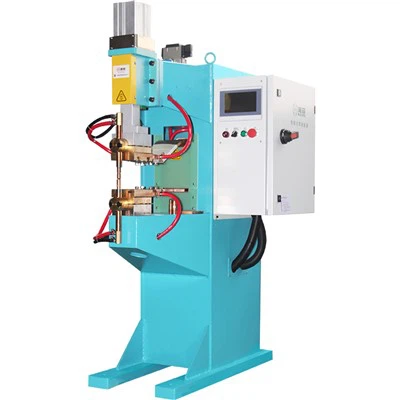
How MFDC Spot Welding Machines Achieve More Stable Weld Nugget Formation
High-Frequency DC Output Enables More Stable Welding Current
Traditional AC spot welding machines typically operate at 50 Hz or 60 Hz, where the current waveform repeatedly passes through zero during each cycle. This periodic fluctuation results in discontinuous heat generation, which can cause uneven nugget formation and variability in weld strength.
MFDC spot welding machines utilize rectification and inverter technology to convert incoming power into medium-frequency current, typically in the range of 1,000 Hz to 4,000 Hz, before delivering a stable direct current output. This higher operating frequency significantly reduces current fluctuation and allows heat to be delivered in a more continuous and controlled manner.
Industry experience has shown that MFDC systems can reduce current fluctuation by approximately 70% to 90%, resulting in denser weld nuggets, fewer spatter events, and improved weld consistency. This stable energy delivery plays a critical role in achieving uniform weld nugget formation across high-volume production runs.
Concentrated Heat Input Helps Reduce the Heat-Affected Zone (HAZ)
Weld nugget formation relies on resistance heating, where electrical energy is converted into heat at the contact interface between materials. The distribution of this heat directly affects weld quality, part distortion, and surface integrity.
In conventional AC welding systems, slower current rise times often require longer weld durations to generate sufficient heat. This extended heating period allows heat to spread into surrounding material, enlarging the heat-affected zone (HAZ) and increasing the likelihood of distortion.
MFDC spot welding machines feature rapid current rise times-often reaching target current levels in less than 5 milliseconds. This rapid energy delivery allows heat to be concentrated precisely at the weld interface, reducing unnecessary thermal spread.
Field data indicates that MFDC welding technology can reduce the HAZ by approximately 20% to 40%, resulting in improved dimensional stability, reduced distortion, and better surface appearance. This capability is especially important when welding thin sheet materials, coated metals, and highly conductive materials such as copper or aluminum.
Precision Control Systems Improve Weld Nugget Consistency
In addition to stable current output, modern MFDC spot welding machines rely on advanced control systems to ensure consistent weld performance. These systems, typically based on microprocessor or PLC control, allow precise adjustment of welding current, weld time, and electrode force.
High-quality MFDC systems commonly provide time control accuracy within ±1 millisecond and current control accuracy within ±1%, enabling highly repeatable welding cycles. This level of precision ensures that each weld nugget forms under nearly identical conditions, significantly reducing variability in weld quality.
For manufacturers operating high-volume production lines, consistent weld nugget size translates directly into fewer defective parts, reduced inspection requirements, and improved overall production efficiency.
Three Critical Parameters That Directly Affect Weld Nugget Quality
Even with advanced MFDC equipment, improper parameter settings can still result in poor weld quality. Understanding how to properly control key welding parameters is essential for achieving reliable weld nugget formation.
Welding Current: The Primary Factor Determining Nugget Size
Welding current is the most influential parameter in weld nugget formation because heat generation is proportional to the square of the current (Q = I²Rt). Insufficient welding current will not generate enough heat to fully melt the interface, leading to undersized nuggets or weak welds. Excessive current, on the other hand, may cause severe spatter, electrode wear, or even burn-through.
Typical current ranges vary depending on material type:
- Low-carbon steel: approximately 8 kA to 12 kA
- Stainless steel: approximately 10 kA to 14 kA
- Copper and copper alloys: typically 15 kA or higher due to high conductivity
Selecting the appropriate welding current range is fundamental to achieving consistent weld strength.
Weld Time: Controls the Nugget Formation Process
Weld time works in conjunction with welding current to determine total heat input. If weld time is too short, the material may not reach melting temperature, resulting in incomplete nugget formation. If weld time is too long, heat may spread beyond the intended area, increasing the size of the heat-affected zone and causing material distortion.
MFDC spot welding machines allow shorter weld cycles due to their efficient energy delivery. In many applications, weld times typically range from 5 milliseconds to 20 milliseconds, representing a 30% to 50% reduction compared with conventional AC welding systems.
Shorter weld cycles not only improve productivity but also reduce thermal damage to surrounding materials.
Electrode Force: Ensures Stable Electrical Contact
Electrode force directly influences electrical contact resistance and heat generation at the weld interface. Insufficient force can lead to unstable contact, inconsistent resistance, and increased spatter. Excessive force may reduce resistance too much, limiting heat generation and preventing proper nugget formation.
For this reason, electrode force should be carefully matched to material thickness and mechanical properties. Maintaining consistent electrode force throughout production is essential for ensuring repeatable weld quality.
Practical Methods to Further Improve Weld Nugget Quality
Beyond parameter selection, several practical process improvements can significantly enhance weld nugget performance. These methods are widely used in industrial production environments and can be implemented without major equipment changes.
Use Constant Current Control to Maintain Stable Output
Voltage fluctuations in industrial power systems can affect welding current output, resulting in inconsistent weld quality. MFDC spot welding machines equipped with constant current control can automatically adjust output to maintain stable current levels despite input voltage variation.
In many production environments, implementing constant current control has been shown to increase weld consistency and improve overall weld acceptance rates by approximately 20% or more.
Maintain Electrodes Regularly to Preserve Welding Performance
Electrodes are critical components that directly affect current flow and pressure distribution. Over time, electrode tips gradually wear or deform, changing the contact area and altering current density distribution.
Chromium-zirconium copper (CuCrZr) is commonly used as an electrode material due to its strength and conductivity. In continuous production environments, electrodes are typically dressed or reshaped after 500 to 1,000 welds, depending on application requirements.
Routine electrode maintenance is one of the simplest yet most effective methods for maintaining consistent weld nugget quality.
Optimize Squeeze and Hold Time to Prevent Internal Defects
A complete spot welding cycle generally includes squeeze time, weld time, and hold time. After current flow stops, the weld nugget must cool under pressure to prevent shrinkage cracks and internal defects.
Extending hold time appropriately allows the molten nugget to solidify under compression, improving mechanical strength and reducing the likelihood of internal cracking. This step is particularly important for thicker materials and high-strength alloys.
Key Factors to Consider When Selecting an MFDC Spot Welding Machine
When selecting an MFDC spot welding system, understanding technical specifications alone is not enough. Equipment performance must be evaluated in relation to real production requirements.
Transformer Performance Determines Output Stability
The MFDC transformer is one of the core components of the system. Its design directly affects output efficiency, thermal performance, and energy stability. High-quality transformers typically feature low energy loss and efficient cooling systems, ensuring reliable operation during continuous production.
When evaluating equipment, it is important to review transformer capacity, duty cycle rating, and cooling performance.
Control System Capability Determines Flexibility
Modern MFDC spot welding machines often support multi-stage welding programs and adjustable parameter profiles. Systems with flexible control capabilities can accommodate different material types and thickness combinations, making them suitable for diverse production requirements.
For manufacturers handling multiple product types, programmable control systems offer significant advantages.
Machine Structure Affects Mechanical Stability
Machine frame rigidity plays a crucial role in maintaining consistent electrode force. Insufficient structural strength may lead to slight deflection during high-force welding operations, resulting in unstable contact pressure.
For this reason, selecting equipment with a rigid frame and precise mechanical alignment is essential for long-term welding stability.
Conclusion
MFDC inverter spot welding machines provide clear advantages in weld nugget formation due to their stable current output, concentrated heat delivery, and precise process control capabilities. However, achieving consistently high-quality weld nuggets requires more than advanced equipment alone.
Reliable welding results are achieved through a combination of proper parameter selection, routine maintenance, and well-managed welding procedures. For manufacturers seeking consistent weld quality in applications such as automotive components, electrical connections, or precision metal assemblies, selecting the right MFDC spot welding system and optimizing process parameters can significantly improve production efficiency and reduce defect rates.


