


Why Diffusion Welding Is the Preferred Choice for High-Reliability Applications
In industries such as new energy, power equipment, and energy storage systems, copper flexible connectors are widely used in critical current-carrying circuits. Their primary function is to maintain low electrical resistance while accommodating thermal expansion, vibration, and mechanical tolerance during operation. As system power density continues to increase, welding quality has become one of the key factors determining the safety, stability, and service life of copper flexible connectors.
Different welding methods show fundamental differences in electrical consistency, structural integrity, and long-term reliability. This article provides a structured overview of the welding processes commonly used for copper flexible connectors and explains, from an engineering perspective, why diffusion welding is better suited for applications with high reliability requirements. It also offers practical guidance to help users evaluate and select an appropriate diffusion welding machine.

Structural Characteristics of Copper Flexible Connectors and Welding Requirements
Basic Structure of Copper Flexible Connectors
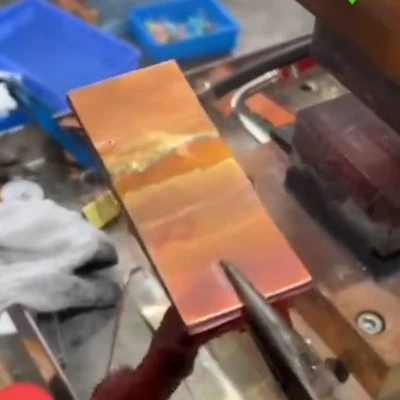
Copper flexible connectors are typically manufactured from stacked layers of pure copper foils or braided copper conductors. This structure is not designed to increase mechanical strength but rather to enable stable high-current transmission within a limited space while relieving stress caused by thermal expansion and vibration.
Because of this structural design, the welding process must not only ensure mechanical bonding but also allow all copper layers to participate evenly in current conduction, instead of forming localized current paths.
Typical Application Scenarios
In real-world applications, copper flexible connectors are often installed at the most critical points of the electrical circuit, including:
- Main current paths in energy storage systems and battery modules, where low resistance and thermal stability are essential
- Transformers, switchgear, and busbar systems, where flexible connections help compensate for assembly tolerances and thermal stress
- Electric vehicles and high-power drive systems, which operate under frequent start-stop cycles and current surges
A common characteristic of these applications is that welding-related issues may not appear immediately but tend to develop gradually under long-term operation.
Welding Challenges Associated with Copper Materials
From an engineering standpoint, welding copper flexible connectors presents several inherent challenges:
- Copper's high thermal conductivity makes it difficult to concentrate heat during welding
- Copper surfaces oxidize easily, which can significantly increase contact resistance if not properly controlled
- Multi-layer structures require a welding method capable of achieving integral bonding rather than point connections
- Under long-term thermal cycling and vibration, even minor welding defects can evolve into serious reliability risks
For these reasons, selecting a welding method for copper flexible connectors is fundamentally a system-level reliability decision.
Common Welding Methods for Copper Flexible Connectors and Their Limitations
Resistance Welding (Spot Welding / Projection Welding)
Resistance welding generates heat at the contact interface through high current and forms a weld under applied pressure. This process is well known for its high productivity and compatibility with automated manufacturing lines, making it attractive for certain volume production scenarios.
However, when applied to copper flexible connectors, resistance welding typically results in localized weld nuggets rather than uniform bonding across the entire interface. In multi-layer copper structures, this can lead to uneven current distribution, and under high-current, long-term operating conditions, welded areas may become localized heat concentration points. These limitations restrict the suitability of resistance welding for high-reliability applications.
Brazing and Other Welding Methods
Brazing relies on filler material to join copper components and is relatively simple to implement. It may be acceptable for applications with low performance requirements. However, because the electrical conductivity and long-term stability of filler materials are inferior to pure copper, the brazed joint often becomes a weak point in high-current systems.
Laser welding and ultrasonic welding can be effective for thin copper components or specialized precision applications. That said, limitations in weld area, material thickness, and process stability generally prevent these methods from meeting the comprehensive performance requirements of copper flexible connectors used in high-current environments.
Diffusion Welding: Principles and Advantages for Copper Flexible Connectors
Basic Principle of Diffusion Welding
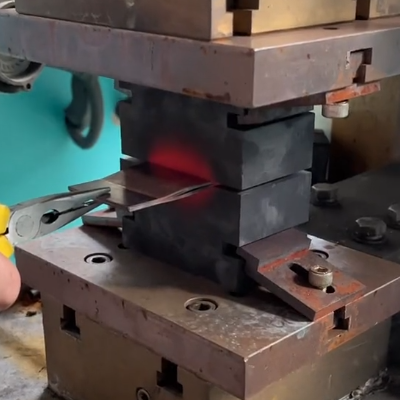
Diffusion welding is a solid-state joining process performed in a vacuum or controlled atmosphere. By applying carefully controlled temperature and pressure, atomic diffusion occurs across the interface without melting the base material.
Because no filler material is introduced and the copper's crystal structure remains largely intact, the welded interface closely resembles the parent material in both microstructure and electrical performance.
Key Advantages of Diffusion Welding for Copper Flexible Connectors
From practical engineering experience, diffusion welding offers several significant advantages when used for copper flexible connectors:
- Extremely low and stable contact resistance, as the joint becomes a continuous copper structure rather than a discrete weld point
- Integral bonding of multiple copper layers, allowing all layers to conduct current uniformly and reducing the risk of localized overheating
- Superior long-term reliability under thermal cycling and vibration, with minimal risk of fatigue-related degradation
- High process repeatability and consistency, making it well suited for applications with strict quality and lifespan requirements
Applications Where Diffusion-Welded Copper Flexible Connectors Are Most Suitable
Based on field experience, diffusion welding is particularly well suited for the following applications:
- Main circuit copper flexible connectors in energy storage systems and battery assemblies
- High-power converters and power electronics operating under continuous load
- Electric vehicles and rail transportation systems with defined reliability and service life standards
- Power equipment where electrical resistance consistency is critical
In these scenarios, the long-term performance benefits of diffusion welding often outweigh the differences in initial process cost.
Key Considerations When Selecting a Diffusion Welding Machine
-
Temperature and Pressure Control Capability
A diffusion welding machine intended for copper flexible connectors should provide precise, stable, and repeatable control of both temperature and pressure. Proper control ensures sufficient atomic diffusion while maintaining a consistent process window.
-
Tooling and Fixture Compatibility
Because copper flexible connectors often consist of stacked thin foils, the machine must support suitable tooling and fixtures that ensure uniform pressure distribution and accurate positioning throughout the welding cycle.
-
Process Stability and Long-Term Reliability
When evaluating equipment, users should focus not only on single-weld results but also on long-term operational stability, component durability, and maintenance requirements under continuous production conditions.
-
Supplier Experience and Technical Support
Diffusion welding is a process where equipment and application expertise are closely linked. Suppliers with proven experience in copper flexible connector applications are better positioned to provide meaningful process validation, parameter guidance, and ongoing technical support.
Conclusion: Choosing a Welding Method Is Ultimately a Reliability Decision
For copper flexible connectors, the welding method is not merely a manufacturing choice but a decision that directly impacts system safety, stability, and lifecycle cost. As power and reliability demands continue to rise in modern energy and electrical systems, the limitations of conventional welding methods have become increasingly apparent.
By delivering a joint that closely matches the parent copper material in structure and performance, diffusion welding has emerged as a forward-looking solution for high-reliability copper flexible connectors. Selecting the right diffusion welding machine is therefore a critical step in transforming this technical advantage into long-term product value.


