


Aluminium alloys can be joined by resistance spot welding, but the welding schedule and equipment cannot be selected in the same way as for mild steel. Aluminium conducts electricity and heat efficiently, while its surface oxide affects contact resistance and weld consistency.
Reliable aluminium spot welding requires sufficient current delivered over a controlled weld time, stable electrode force, consistent surface condition, effective electrode cooling and a validated inspection method. The correct machine depends on the alloy, thickness of each sheet, joint design, production rate and required weld quality.
This guide explains the main welding challenges, compares MFDC and capacitor-discharge equipment, and shows what manufacturers should confirm before selecting an aluminium spot welding machine.
Aluminum plate welding demonstration

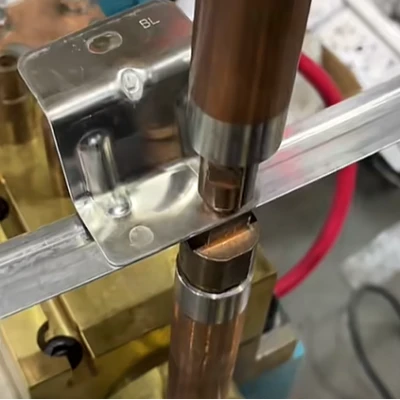


This guide leverages authoritative industry data and advanced technology to provide an in-depth analysis of the spot welding machine types suitable for aluminum sheets, along with practical selection recommendations.
Why Aluminium Spot Welding Is More Difficult Than Steel?
Before discussing welder types, we must understand the unique requirements of aluminum spot welding. Compared to common steel, aluminum has three distinct characteristics that demand more advanced equipment:
- Extremely High Thermal Conductivity: Aluminum's thermal conductivity is approximately three times that of steel. This means heat generated during welding dissipates rapidly, making it difficult to form a stable weld nugget in a short time. Consequently, aluminum welding requires extremely high current density and an ultra-fast energy release rate.
- Low Electrical Resistivity: Aluminum has low electrical resistivity. According to Joule's law ($Q=I^2Rt$), less heat is generated at the same current. To reach the melting temperature, the current required for aluminum welding is typically two to three times that needed for steel sheets of the same thickness.
- Stubborn Oxide Layer: A dense, passive layer of aluminum oxide ($\text{Al}_2\text{O}_3$) rapidly forms on the surface. This oxide film has a melting point of up to 2050°C, while aluminum itself melts at only 660°C. The oxide layer not only impedes stable current flow but also easily leads to false welds and electrode sticking.
Due to these challenges, traditional Alternating Current (AC) spot welders, with their current fluctuations and uneven heat input, have been largely superseded by more advanced Direct Current (DC) welding technologies.
Which Machine Is Suitable for Aluminium Spot Welding??
The industry generally recognizes three primary equipment types best suited for aluminum welding: Medium Frequency Direct Current (MFDC) spot welders, Capacitor Discharge (CD) spot welders, and robotic systems integrating these technologies.
1. MFDC Spot Welding for Aluminium
Technical Core: The MFDC welder converts the utility frequency AC power (50/60Hz) into medium frequency AC (typically 1-4 kHz), which is then stepped down by a transformer and rectified to produce a stable DC output.
Key Advantages and Data:
- Eliminates "Skin Effect": The DC output completely eliminates the "skin effect" that occurs with AC, allowing the current to penetrate the material uniformly. This effectively overcomes the challenge of aluminum's high electrical conductivity, achieving current densities up to 150A/mm².
- Ultra-Fast Response and High Precision: Operating at a high frequency, the MFDC system boasts an ultra-fast response time (typically ≤0.5ms). This allows for millisecond-level precise control over the welding current, which is vital for controlling the aluminum weld nugget size.
- Significant Energy Savings: Compared to traditional AC welders, MFDC machines can save 30% to 50% of energy per weld, substantially reducing production costs.
- Stable Weld Quality: Due to stable current and precise control, the weld qualification rate for MFDC welders in aluminum applications can exceed 99.5%.
Best Application: MFDC spot welders are the most widely used and efficient solution for industrial aluminum welding, particularly for sheet thicknesses ranging from 0.5 mm to 3 mm, such as EV battery trays, structural body components, and aerospace parts.
2. Capacitor-Discharge Welding for Thin Aluminium Parts
Technical Core: The CD welder stores a large amount of electrical energy in capacitors and releases it as a high-intensity current pulse over an extremely short duration (typically 5-10 milliseconds).
Key Advantages and Data:
- Minimal Heat Input: The ultra-short discharge time minimizes heat transfer to the surrounding material, resulting in a very narrow Heat-Affected Zone (HAZ), typically ≤0.15 mm. This effectively prevents thermal distortion and discoloration caused by aluminum's high thermal expansion coefficient.
- Ultra-High Peak Current: Peak currents can easily exceed 80 kiloamperes (kA), sufficient to instantaneously break through the aluminum's oxide layer and form a strong weld.
- Low Grid Power Demand: Since energy is pre-stored, the system's instantaneous power demand from the utility grid is low, making it suitable for locations with limited power capacity.
Best Application: CD welders are the ideal choice for ultra-thin materials and precision electronics, such as mobile phone frames, flexible circuit boards, and battery tabs, suitable for aluminum sheets less than 0.5 mm thick.
3. When Does Aluminium Spot Welding Need Automation?
Technical Core: This system integrates a high-performance spot welder (typically an MFDC DC welder) with a 6-axis industrial robot, 3D vision systems, and force sensors to create a fully automated welding workstation.
Key Advantages and Data:
- Extreme Precision and Consistency: The robotic system can execute complex welding paths with a repeatability of up to ±0.05 mm, ensuring high consistency in the position and quality of every weld.
- Real-Time Quality Monitoring: Integrated force sensors and current monitoring systems provide real-time feedback, keeping the defect rate below 0.03%.
- High Efficiency and Mass Production: Suitable for 24/7, high-volume production lines.
Best Application: Automotive Body-in-White (BiW) assembly lines and large-scale battery module production, where there are stringent requirements for speed, consistency, and complex geometries.
Aluminium Spot Welding Machine Selection Checklist
Selecting the most appropriate spot welder requires a comprehensive consideration of material characteristics, production needs, and quality standards. The table below compares the key performance indicators of the three main spot welder types for aluminum:
| Configuration | Consider it when | Confirm before selection |
|---|---|---|
| MFDC spot welder | Programmable current control, repeated production or automation is required | Required current, electrode force, duty cycle and cooling |
| Capacitor-discharge welder | Short energy delivery or limited surrounding heat is important | Actual discharge waveform, joint design and nugget quality |
| Manual or semi-automatic system | Production volume is moderate and loading is straightforward | Operator access, fixture repeatability and cycle time |
| Robotic welding workstation | Multiple weld locations or automated handling is required | Robot reach, gun accessibility, fixture accuracy and monitoring |
| Custom welding machine | Part geometry or loading prevents the use of a standard machine | Drawing, samples, production target and acceptance criteria |
1. Selection Based on Material Thickness
- Ultra-Thin Aluminum Sheets (<0.5 mm): The Capacitor Discharge (CD) Spot Welder is the preferred choice. Its instantaneous high-energy release minimizes heat input, preventing material burn-through and distortion.
- Medium Thickness Aluminum Sheets (0.5 mm - 3.0 mm): The Medium Frequency Direct Current (MFDC) Spot Welder is the industry standard. It provides stable energy input and precise control, ensuring consistent nugget size and strength.
- Thick Sheets (>3.0 mm): This typically requires larger MFDC equipment or consideration of other welding processes like MIG/TIG.
2. How Surface Condition Affects Aluminium Spot Welding
Regardless of the spot welder you choose, pre-weld surface preparation is a non-negotiable condition for ensuring the quality of aluminum welding. Due to the presence of the aluminum oxide layer ($\text{Al}_2\text{O}_3$), it must be removed using one of the following methods:
- Mechanical Cleaning: Using a stainless steel brush or abrasive paper to lightly clean the welding area. Care must be taken to avoid embedding contaminants into the aluminum surface.
- Chemical Cleaning: Using specialized acidic or alkaline solutions for immersion to dissolve the oxide layer.
- Crucial Tip: Cleaned aluminum sheets should be welded within 4 hours to prevent the rapid formation of a new oxide layer.
3. Current, Weld Time, Electrode Force and Cooling
To fully leverage the performance of MFDC or CD welders, key parameters must be optimized:
- Electrode Force: The electrode force for aluminum welding typically needs to be 20% to 50% higher than for steel. The purpose is to thoroughly crush the oxide layer before current application, ensuring stable contact resistance.
- Electrode Material: Since aluminum is highly prone to sticking to the electrodes, leading to rapid wear, it is recommended to use Chromium Zirconium Copper (CuCrZr) or Dispersion-Strengthened Copper ($\text{Al}_2\text{O}_3$ Dispersion-Strengthened Copper) as the electrode material to enhance electrode life and conductivity.
How to Check Aluminium Spot Weld Quality?
Surface appearance alone cannot confirm weld strength or nugget size. During process development, aluminium spot welds should be evaluated using the inspection method required by the product or customer.
Depending on the application, evaluation may include visual inspection, peel or chisel testing, tensile-shear testing, cross-section examination or production-process monitoring. Acceptance criteria should be based on the product drawing, customer specification or applicable welding standard.
FAQ
Q: Can aluminium be spot welded?
A: Yes. Many aluminium alloys can be resistance spot welded, but the current, weld time, electrode force, surface condition and cooling must be developed for the actual sheet combination.
Q: What type of spot welder is best for aluminium?
A: There is no universal best machine. MFDC and capacitor-discharge systems can both be evaluated depending on the alloy, thickness, joint design, production output and required weld quality.
Q: Why does aluminium spot welding require high current?
A: Aluminium has high electrical and thermal conductivity, so heat is generated less readily and moves away from the joint quickly. The required current must still be confirmed through representative welding trials.
Q: Does the oxide layer need to be removed before spot welding aluminium?
A: Not always. The important requirement is a controlled and consistent surface condition. Any cleaning or oxide-removal process changes contact resistance and may require a different welding schedule.
Q: How should aluminium spot weld quality be tested?
A: Use the inspection method defined by the product requirement. Visual inspection may be combined with peel, tensile-shear, cross-section or other applicable tests.
Selecting Equipment for Your Aluminium Workpiece
For the vast majority of industrial aluminum sheet welding applications, the Medium Frequency Direct Current (MFDC) Spot Welder is the most effective, economical, and reliable solution. Its stable DC output and high-frequency control perfectly address the challenges posed by aluminum's high electrical and thermal conductivity.
However, the final choice should always be based on your specific requirements:
- For extreme precision and ultra-thin parts: Choose a CD welder.
- For high-efficiency, high-consistency mass production: Choose a Robotic Integrated MFDC system.
By thoroughly understanding the technical principles and performance data of different spot welders and strictly adhering to pre-weld surface preparation, you can ensure strong, reliable aluminum welds and maximize your manufacturing Return on Investment (ROI).


