


In high-performance industries where maximum conductivity and high-strength connections are non-negotiable, diffusion welding has become the gold standard for joining copper and its alloys. This solid-state process achieves an atomic-level metallurgical bond without melting the base metals. However, many manufacturers encounter a common frustration: joint performance that fails to meet specifications. More often than not, the issue isn't the machine itself, but a lack of control over the copper's "pre-conditions"-specifically its purity and surface state.
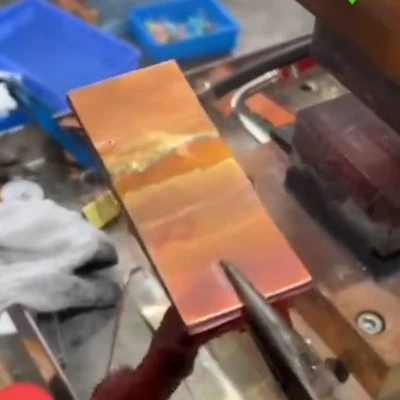


In this guide, we will take a deep dive from the perspective of a senior process engineer to analyze the rigorous requirements for copper materials and provide a practical framework for selecting a diffusion welding machine. Our goal is to help you ensure quality from the source and maximize the value of your investment.
Copper Purity: The Foundation of Weld Integrity
The success of diffusion welding relies on the seamless interdiffusion of atoms under high temperature and pressure. Any impurities that obstruct this atomic migration will inevitably lead to latent defects in the joint.
Oxygen Content: The "Public Enemy Number One"
When selecting copper, we strongly recommend Oxygen-Free Copper (OFC, such as C10100 or C10200). Standard electrolytic tough pitch copper contains trace amounts of oxygen that can trigger catastrophic failures during the high-temperature diffusion process:
- The Risk of "Hydrogen Embrittlement": If trace amounts of hydrogen are present in the welding environment or the material itself, high temperatures cause the hydrogen to react with cuprous oxide (Cu₂O) inside the copper. This reaction generates high-pressure water vapor (H₂O). Since the vapor cannot escape the dense copper matrix, it forms microscopic voids at the grain boundaries, leading to severe embrittlement and a sharp drop in structural strength-a phenomenon known in the industry as "hydrogen disease."
- Oxide Film Barriers: Even without hydrogen embrittlement, high oxygen content makes the copper surface prone to forming a thick, stable oxide film. This film acts as a physical barrier to atomic diffusion, preventing direct contact and mutual solubility between the mating surfaces. The result is a low bonding rate and poor electrical conductivity.
For applications requiring high conductivity and hermetic sealing, oxygen content should be kept below 0.001%, with a copper purity of at least 99.95%.
Strict Limits on Impurity Elements
Beyond oxygen, other low-melting-point impurities such as Bismuth (Bi) and Lead (Pb) must be strictly controlled. At typical diffusion welding temperatures (usually 0.6 to 0.8 times the melting point of copper), these elements tend to segregate at the grain boundaries, forming liquid or low-melting-point phases. This segregation significantly weakens the grain boundary strength, causing hot shortness (brittleness) during cooling or while in service. Choosing high-purity copper is the only way to eliminate these harmful impurities at the source.
Surface Treatment: Ensuring "Zero-Distance" Atomic Contact
If material purity is the "internal health" of the weld, surface treatment is the "external discipline." Diffusion welding requires mating surfaces to be absolutely flat and pristine at the microscopic level.
Quantifying Surface Roughness
Surface roughness is the primary metric for flatness. In diffusion welding, it directly determines the initial contact area and the difficulty of closing microscopic interface voids.
| Application Scenario | Recommended Roughness Average | Key Impact |
| Industrial Grade (e.g., standard busbars) | Ra < 0.8 μm | Ensures a basic bonding rate and reduces required pressure. |
| High-Precision (e.g., vacuum seals, heat sinks) | Ra 0.1 μm - 0.2 μm | Achieves maximum hermeticity and conductivity by minimizing interface gaps. |
The lower the roughness, the more easily the surfaces undergo plastic deformation when pressure is applied. This quickly closes microscopic irregularities, shortening the distance and time required for atoms to diffuse across the interface.
The Rigorous "Three-Step" Cleaning Protocol
Any residual organic matter or oxide layers will act as a physical roadblock to atomic diffusion. A strict cleaning protocol is mandatory:
- High-Efficiency Degreasing: Use acetone or industrial alcohol combined with ultrasonic cleaning to thoroughly remove residual cutting fluids, lubricants, and fingerprints.
- Chemical Activation (Acid Pickling): Use a dilute nitric or sulfuric acid solution to pickle the copper. This removes the naturally occurring oxide film, exposing a fresh, high-activity metallic substrate.
- Rapid Drying and Protection: After pickling, parts must be rinsed with deionized water and dried immediately using high-purity nitrogen or hot air. Crucially, treated copper should be loaded and welded within 4 hours to prevent re-oxidation.
Selecting a Diffusion Welding Machine: Matching Material Needs to Equipment Performance
Once you understand the rigorous material requirements, you can accurately select a machine capable of meeting them. Buying a diffusion welding machine is essentially an investment in the ultimate control of temperature, pressure, and environment.
Pressure Control: Consistency and Precision
Because copper has low yield strength at high temperatures, it is extremely sensitive to pressure.
- Selection Key: A superior machine must provide high-precision, high-uniformity pressure application. Look for equipment driven by servo-hydraulics or servo-electrics, which allow for real-time closed-loop control. This ensures that pressure fluctuations remain within ±1% or less. For large-area welding, the machine must guarantee uniform pressure distribution across the entire surface to prevent localized crushing or unbonded areas.
Temperature Control: Stability and Uniformity
The temperature window for diffusion welding is narrow. Too low, and diffusion won't occur; too high, and you risk grain growth or excessive material softening.
Selection Key:
- Control Accuracy: Core temperature sensors (like thermocouples) should be positioned as close to the workpiece as possible, ensuring control accuracy within ±5°C.
- Heating Uniformity: For large workpieces, evaluate whether the machine uses multi-zone independent temperature control or induction heating to ensure a uniform thermal profile across the entire welding zone.
Welding Environment: Vacuum vs. Atmospheric Protection
The choice of environment is critical for protecting the purity of your materials.
- Vacuum Diffusion Welding Machine: Ideal for applications requiring extreme hermeticity or when welding reactive metals. A vacuum level of $10^{-3}$ Pa to $10^{-5}$ Pa is typically required to completely isolate oxygen. This is the gold standard for the highest quality copper connections.
- Atmospheric Protection (Polymer/Flexible Connection): Often used for high-volume production of EV busbars and flexible connectors. These machines use high-purity shielding gases (like Argon or Nitrogen) to displace air. While more cost-effective and efficient for mass production, they demand even higher surface cleanliness to compensate for the lack of a vacuum.
Conclusion and Practical Buyer's Checklist
Successful copper diffusion welding is the perfect synergy of high-purity materials, meticulous surface treatment, and precision equipment control.
Practical Buyer's Checklist
| Selection Criteria | Key Technical Metric | Why It Matters to You |
| Material Purity | Oxygen ≤ 0.001%, Purity ≥ 99.95% | Prevents hydrogen embrittlement; ensures maximum conductivity. |
| Surface Roughness | Ra ≤ 0.2 μm (Precision), Ra ≤ 0.8 μm (Industrial) | Reduces pressure requirements; increases atomic contact area. |
| Pressure System | Servo-driven, ±1% precision | Ensures uniform bonding; prevents deformation or unbonded spots. |
| Temperature System | ±5°C accuracy, multi-zone control | Guarantees uniform diffusion across the entire interface. |
| Welding Environment | $10^{-3}$ Pa Vacuum or High-Purity Argon | Prevents re-oxidation of the fresh metallic surface. |
Before committing to a purchase, always insist that the supplier perform full-scale sample testing using your actual copper materials and treatment process. Verify the machine's performance through metallographic analysis (to observe the bonding rate and void count) and conductivity testing. This is the only reliable way to validate that the equipment meets your specific needs.


