


Flexible copper connectors, as critical flexible conductive components in high-current applications like new energy vehicles, energy storage systems, and high-voltage switchgear, have a welding quality that directly impacts the safety and performance of the entire system. A high-quality welded joint not only ensures extremely low contact resistance, reducing heat loss, but also forms the foundation for long-term stable equipment operation.
However, with a wide array of welding technologies available, determining the most suitable welding process based on the connector's thickness and layer count has become a primary challenge for many engineers and procurement personnel.


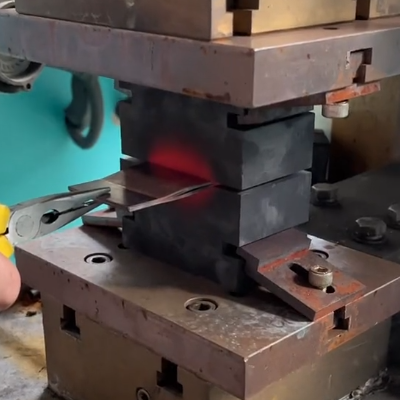
This guide breaks down how to select the right welding process for flexible copper connectors. We'll dive into the technical logic behind the three industry-standard methods and provide actionable advice for sourcing high-performance Diffusion Welding Machines to help you make an informed, professional choice.
Understanding the Core Parameters of Flexible Copper Connectors: Thickness and Layer Count
Before discussing welding processes, we must first clarify the two core structural parameters of flexible copper connectors, as they are key determinants of the welding method:
Single Foil Thickness vs. Overall Thickness
Flexible copper connectors are typically composed of multiple layers of thin copper foil. The thickness of a single copper foil (common specifications include 0.05mm, 0.1mm, 0.2mm) determines the material's flexibility and the required heat input during welding. Thinner foil demands tighter control over welding energy.
The overall thickness is the combined thickness of all stacked copper foils, directly determining the connector's current-carrying capacity and mechanical strength. Overall thickness ranges from a few millimeters to tens of millimeters. Greater thickness requires higher welding penetration capability.
The Impact of Layer Count on Welding Penetration
The layer count (ranging from a few layers to over a hundred) is another important characteristic of flexible copper connectors. The more layers there are, the more complex the transfer of heat and pressure becomes during welding. For example, when welding the ends of multi-layer copper foils, insufficient welding energy or uneven pressure can easily lead to incomplete bonding between internal layers, resulting in cold welds or high-resistance areas, severely compromising conductivity.
In-Depth Analysis of the Three Mainstream Welding Processes
Currently, there are three main welding processes applied to the ends of flexible copper connectors: Diffusion Welding, Ultrasonic Welding, and Laser Welding. Each has its advantages and is suitable for different ranges of thickness and layer counts.
Diffusion Welding: The Ultimate Solution for High Current and Multi-Layer Stacks
Diffusion Welding is a specialized solid-state joining technology. It achieves a metallurgical bond between copper layers by subjecting the copper foils to high temperature (usually above the recrystallization temperature of copper) and high pressure, causing molecular diffusion and plastic deformation at the contact surfaces.
- Matching Advantage: Diffusion welding is the preferred method for handling ultra-thick (e.g., 5mm to over 20mm) and multi-layer stacks (20 layers or more) of flexible copper connectors. Because it is a solid-state process without melting, the internal structure of the joint is uniform, offering excellent conductivity, nearly matching the base material. It is the ideal choice for applications demanding ultimate conductivity and high reliability (such as large energy storage busbars and high-voltage switchgear).
- Limitation: High equipment cost and a relatively long welding cycle.
Ultrasonic Welding: Ideal for Thin Foil and Fast Production
Ultrasonic Welding uses the frictional heat and pressure generated by high-frequency mechanical vibration to achieve a solid-state bond without melting the base material.
- Matching Advantage: Ultrasonic welding is suitable for thin foils (single layer thickness down to 0.006mm) and low-to-medium layer counts (typically within 80 layers, with an overall thickness under 4mm). Its main advantages are fast welding speed, low energy consumption, and minimal damage to the copper foil's flexibility, making it highly suitable for rapid, automated connection of battery tabs to busbars.
- Limitation: Welding thickness is limited by equipment power, making it unsuitable for ultra-thick connectors.
Laser Welding: Precision and Automation for Modern Manufacturing
Laser Welding utilizes a high-energy laser beam to melt the material, achieving a fusion weld. Recent advancements, particularly with blue and green light lasers, have effectively mitigated the challenge of copper's high reflectivity.
- Matching Advantage: Laser welding offers extremely high precision and automation, with a small heat-affected zone. It is suitable for medium thicknesses (0.1mm to 3mm) and products requiring high aesthetic standards. It excels in automated production lines, especially for precision components with strict requirements for weld location and depth.
- Limitation: High equipment cost. For high layer counts, precise control of laser power and focus is necessary to ensure adequate penetration and inter-layer bonding.
The Matching Matrix: Thickness, Layer Count, and Process Selection
To facilitate quick decision-making, we have compiled a matching matrix for flexible copper connector thickness, layer count, and mainstream welding processes:
| Structural Parameter | Typical Application Scenario | Recommended Welding Process | Key Advantage |
| Thin Foil / Low-to-Medium Layers (Overall Thickness < 4mm) | Battery Tabs, Small Appliance Connections | Ultrasonic Welding | Fast speed, low cost, good flexibility retention |
| Medium Thickness / High Precision (Overall Thickness 0.1mm - 3mm) | Automated Precision Components, Edge Sealing | Laser Welding | High precision, small HAZ, high automation |
| High Thickness / Multi-Layer Stacks (Overall Thickness > 5mm) |
Large Energy Storage Busbars, High-Voltage Switchgear |
Diffusion Welding | Best conductivity, high reliability, high current capacity |
| Ultra-High Thickness / Dissimilar Joining | Specialized Industrial Busbars | Brazing | Mature process, high strength |
When selecting a welding process, follow the rule: Choose Diffusion Welding for ultimate performance, Ultrasonic Welding for efficiency, and Laser Welding for precision.
Buyer's Guide: How to Select a High-Performance Diffusion Welding Machine
The Diffusion Welding Machine is the cornerstone for achieving high-performance flexible copper connections. If you are seeking the lowest resistance and highest reliability, investing in a quality diffusion welder is crucial. Here are three core indicators you must consider during the purchasing process:
Temperature Accuracy and Pressure Stability
Achieving a high-quality diffusion weld comes down to the precision of your temperature and pressure controls.
- Temperature Control: An ideal diffusion welder should have a temperature control accuracy of within ±1°C. Excessive temperature fluctuation can lead to incomplete copper foil recrystallization or excessive oxidation, compromising bond quality.
- Pressure System: The equipment must provide uniform and stable pressure. Pressure is the key driving force for molecular diffusion; uneven pressure can result in inconsistent bonding at the connector ends, creating localized high-resistance points. When purchasing, be sure to inquire whether the equipment uses a high-precision hydraulic or servo pressure system and request to review pressure distribution test reports.
Level of Automation and Production Efficiency
When you're running high-volume production, automation isn't just a luxury-it's the primary driver of your throughput and labor overhead.
- Automated Fixturing: Evaluate whether the equipment can quickly and accurately clamp flexible copper connectors of different specifications. An efficient automated fixturing design can significantly reduce setup time.
- Programmable Control: A superior diffusion welder should feature programmable control capabilities, allowing it to store and quickly recall welding parameters (temperature, pressure, holding time) corresponding to different thicknesses and layer counts. This minimizes manual setup errors and ensures consistent product quality.
After-Sales Service and Manufacturer Expertise
Diffusion Welding Machines are precision, heavy-duty equipment, demanding high levels of technical support and after-sales service.
- Technical Support: Choose a manufacturer with extensive welding experience and continuous R&D capabilities. They should not only supply the equipment but also offer customized process parameter recommendations and optimization services based on your specific flexible copper connector specifications (e.g., copper foil grade, layer count, overall thickness).
- Equipment Maintenance: Understand the replacement cycle for wear parts and the response time for after-sales support. The stable operation of the equipment is fundamental to ensuring production continuity.
Conclusion
Choosing the right welding process for flexible copper connectors isn't a one-size-fits-all scenario. It requires a strategic match based on the specific thickness and layer count of your components. For applications demanding ultimate performance and high current capacity, Diffusion Welding is undoubtedly the best choice. When purchasing a diffusion welder, you must prioritize temperature accuracy, pressure stability, and the level of automation, as these are the critical factors for ensuring product quality and boosting production efficiency.
Through this guide, we hope you gain a clear understanding of the applicable boundaries for different processes and find practical, valuable references for your procurement and technical decisions.


